Help Centre



For drivers under the age of 25, additional fees and/or restrictions may apply.
For information and assistance in completing your reservation, please call:
1-855-863-0357We're unable to find your location.


Executive Members receive an annual 2% Reward, up to $1,250, on qualified Costco Travel purchases

Member Exclusive: Digital Costco Shop Card with every Holland America Line sailing†

Note: Cruise itineraries are subject to change. Please verify ports and times directly with the cruise line.

Lisbon is Portugal’s hilly, coastal capital city. From the imposing São Jorge Castle, the view encompasses the old city’s pastel-colored buildings, Tagus Estuary, and Ponte 25 de Abril suspension bridge. Nearby, the National Azulejo Museum displays 5 centuries of decorative ceramic tiles. Just outside Lisbon is a string of Atlantic beaches, from Cascais to Estoril.
The city of Cadiz, which practically accounts for the whole of the municipal area, lies to the east of the bay of the same name, in an area that could be described as a half island, half peninsula, connected to the mainland by a slender, sandy strip. Its situation is responsible for its obvious maritime tendencies, and it has been dedicated to seafaring pursuits since its foundation. The Phoenicians, Greeks, Romans, and Arabs all passed through what is believed to be the world’s oldest city, and it was here that Spain’s first democratic Constitution was drawn up. Despite its essentially urban nature, it also boasts areas of natural interest, such as the beaches of La Cortadura and El Chato, as well as Santibanez Mud Flats, which are part of Cadiz Bay Natural Park. The city, popularly known as “La Tacita de Plata” (The Silver Cup), has an unmistakable marine flavor, and its people are famous for their good humor and hospitality, as witnessed by the famous carnival; it boasts monuments of great interest, such as the Cathedral, the city walls, Holy Cross Parish Church, the Genoese Park, Puerta de la Caleta, etc. All places of indubitable charm, to which we must add the city’s cuisine and beaches, famous for their beauty, such as La Caleta, Santa Maria del Mar, and La Victoria. History This legendary city was founded by the Phoenicians in 1100, although the oldest archaeological remains date back to around 800 B.C. Mythology links its foundation with Hercules and the legendary Tartessia. The Phoenicians called the city Gadir, meaning “closed area”. They built a commercial factory and a temple in honor of the god Melkart. In 206 B.C. it was joined with Rome as an allied city under the name Gades. This was the start of one of the most prosperous periods in Cadiz’s history, and it became one of the most important cities in the Roman Empire. In the Imperial age, it was known as “Augusta Urbs Julia Gaditana”. Its inhabitants were soon granted Roman citizenship. When the Moslem invasions began in the 8th century, it provided the armies with significant support by facilitating their passage, though it soon suffered a decline in importance which would prevail until the Christian conquest and re-settlement at the hands of Alfonso X, known as The Wise, between 1260 and 1262. During the 15th century, the city’s economic activity was based essentially on sea commerce, particularly in North Africa. In 1493, the Catholic Monarchs made Cadiz Crown property; it had belonged to the Ponce de Leon estate since 1470. With the discovery of America, Cadiz’s rise to greatness began, culminating in the 18th century. Its natural conditions meant that whenever ships couldn't berth in Seville, they could do so in Cadiz. In 1717, Seville’s Contracting House was moved to Cadiz, the monopoly of American trade traveling with it; however, this situation was short-lived, as the concession to trade with the New World was extended to twelve ports in 1778. The town center was consolidated in the 18th and 19th centuries when urban renovation was carried out and most of the monuments and buildings that we know today were built. La Isla del Leon, now San Fernando, was the setting for the earliest meetings of the famous Cadiz Cortes, general constituent assemblies set up to provide Spain with a Constitution during the War of Independence. Fleeing from the French, the Government took refuge near Cadiz, the only stronghold that the French were unable to capture during the whole of the war. Between 1810 and 1811, Government assemblies took place in La Isla de Leon Theatre; in February 1811, the proximity of Napoleon’s troops forced them to move to San Felipe de Neri Church in Cadiz, returning once more to La Isla de Leon before finally making their definitive journey back to Madrid in 1813. After the war, the city continued at the vanguard of liberalism, with its support for Riego in 1820 and its leading role in the face of the French invasion in 1823. In a similar vein, Cadiz was at the forefront of the 1868 uprising. At the end of the 19th century, the city’s economic decline began. A series of events including the loss of the colonial market, culminating in the 1898 Disaster, and the African War, among others, ushered in a crisis that was to have grave consequences.
At the crossroads of Africa and Europe, the Mediterranean Sea, and the Atlantic Ocean, Tangier has an individual character. It is one of the oldest cities in Morocco. The Phoenicians and Carthaginians established trading posts here. The Romans made it a capital city. It was occupied by the Arabs and invaded by Vandals and Visigoths. Before the Spanish, the Portuguese controlled the town. In the early part of the 20th century, Tangier was an international city whose tax-free status and cosmopolitan image attracted European and American artists and writers. Although it has lost a little of its glamorous image, it is still a bustling city with an air of mystery surrounding it. For most visitors that arrive in Morocco by sea, it is their first point of contact with the country. The town beach has a great setting: it makes up a several-kilometer-long curve with the white houses of Tangier as a frame before it ends in the barren mountains of which there is nothing further north than sea and the European continent. One of the main centers of afternoon and early evening activities in Tangier is along the beach walk. Activities here are rather common, people walk up and down this avenue-sized street, looking at people and allowing others to look at them. There are several Atlantic beaches west of Tangier, which all offer a good alternative to the town beach. The setting of these beaches can be most attractive, with mountains on all sides, yet with a wide and clean beach with all necessary amenities. The medina of Tangier is a real one: Streets are narrow, houses in many different styles, and most of this medina is in good condition. That is proof that even people with some money both live and work here. The medina is quite big, and there are many commercial areas. Most of these serve the tourist traffic, and it is more difficult to find any areas where real handcraft is performed.
Valencia is a vibrant, cosmopolitan city on the Mediterranean coast. Once the capital of its kingdom, it is now a regional capital and Spain’s third-largest city. Surrounded by orange orchards and sandy beaches, the city enjoys year-round sunshine and has become a popular conference center. The city was founded by the Romans, taken by the Visigoths, and prospered under the Moors. Each civilization has left its mark and the historic center includes a 13th-century cathedral (La Seo) with paintings by Goya, and a splendid Gothic 15th-century silk exchange (La Lonja). However, the city is looking to the future and is now home to one of Europe’s most exciting urban development projects. Some $200m has been invested in building an immense and futuristic Arts and Science Centre ( Ciutat de les Arts I les Ciencies ) near the port area. Valencia’s mild climate is another reason to come for a stay. Its warm atmosphere is always inviting and hospitable. Ready to be enjoyed. Valencia means commerce and culture, cinema, theatre, museums, music, and business. It is acentere for industrial design and avant-garde movements. During your stay in Valencia, you will also be able to enjoy the peace of several exceptional natural sites. Between the sea and the rice paddies, closed in by two river mouths, the Albufera Natural Park is a paradise for migratory birds and a recreation area for the city. Along the coast next to the Albufera are broad sandy beaches. There are pleasant recreation areas where people come to enjoy the sun and the sea. No visit to Valencia would be complete without a taste of its ample Mediterranean cuisine based on a fertile ‘Huerta’ or market garden, and fresh fish and shellfish. The queen of local products is rice, served in an infinity of manners as the internationally acclaimed Valencian paella.
If you've ever wondered what sort of prize you'd get for saving Europe, look no further than Valletta. Named after La Valette, the Grandmaster who masterminded Malta's successful stand against the Turkish siege of 1565, Valletta became the city of the Knights of the Order of St John and the seat of Malta's government. While traveling through the Mediterranean, Sir Walter Scott described Valletta as 'the city built by gentlemen for gentlemen'. Today it's a beautifully preserved 16th-century walled city, small enough to cover in a few hours without sweating too much in the Mediterranean sun. The streets were carefully laid out to channel cool breezes in from the harbour. Situated on the northeast coast of Malta, Valletta is the capital and is built on the promontory of Mount Sciberras which juts out into the middle of a bay. This dissects the bay into two deep harbors: the Grand Harbour to the east and the Marsamxett to the west. Valletta is a rough rectangle at the tip of a peninsula on the coast, just a few hundred meters across in either direction, and thus surrounded by water on its northern, eastern, and southern sides. The city was named after Jean Parisot de la Valette who was the Grand Master of the Order of the Knight Hospitallers (Knights of Saint John of Jerusalem). This famed religious order of hospitallers was founded in Jerusalem in the 11th century and made their base in Malta after they were expelled from Rhodes by the Ottoman Turks. During the time of Grand Master La Valette, in 1565, the Knights and the Maltese managed to suppress a siege on the island by the forces of Süleyman the Magnificent, Sultan of the Ottoman Empire in what was to become known as one of history's greatest sieges. Following the siege, the building of the city began in the same year 1565 to create a base for the defense of the island. Although Grand Master La Valette managed to lay the first stone, he died before its completion. Most of the embellishments of Valletta were done during the time of Grand Master La Cassiere, especially the magnificent St John's Co-Cathedral. The reign of the Knights of St John eventually came to an end with the successful invasion by Napoleon who occupied Malta on his way to Egypt. A Maltese revolt against the French garrison was the catalyst for the occupation of Valletta by the British in 1800. Valetta is also the spot where the Italian fleet surrendered to the Allies in 1943. Valletta's network of streets is laid out in an orthogonal grid dominated by a main artery that crosses the length of the entire city and opens up into a series of squares at its geometric center, around the Palace of the Grand Masters. The city architecture is inspired by Italian Renaissance planning principles and served as an early model of urban design. Valletta is one of the most important planned towns of the Renaissance. It equals in its noble architecture, any capital in Europe, while its timeless beauty and artistic treasures make it a well-deserved World Heritage site. There are several superb museums here as well as historical sites that are worth visiting. The main thoroughfare in the city is Republic Street. You'll find all the main shops and character-filled side streets leading off from here. For those interested in shopping, Merchant's Street and Lucia Street are the places to go for the most interesting merchandise. Lucia Street is famous for the exquisite silver and gold filigree jewelry sold there. Merchant Street specializes in souvenirs and is also home to a large open market.
If you've ever wondered what sort of prize you'd get for saving Europe, look no further than Valletta. Named after La Valette, the Grandmaster who masterminded Malta's successful stand against the Turkish siege of 1565, Valletta became the city of the Knights of the Order of St John and the seat of Malta's government. While traveling through the Mediterranean, Sir Walter Scott described Valletta as 'the city built by gentlemen for gentlemen'. Today it's a beautifully preserved 16th-century walled city, small enough to cover in a few hours without sweating too much in the Mediterranean sun. The streets were carefully laid out to channel cool breezes in from the harbour. Situated on the northeast coast of Malta, Valletta is the capital and is built on the promontory of Mount Sciberras which juts out into the middle of a bay. This dissects the bay into two deep harbors: the Grand Harbour to the east and the Marsamxett to the west. Valletta is a rough rectangle at the tip of a peninsula on the coast, just a few hundred meters across in either direction, and thus surrounded by water on its northern, eastern, and southern sides. The city was named after Jean Parisot de la Valette who was the Grand Master of the Order of the Knight Hospitallers (Knights of Saint John of Jerusalem). This famed religious order of hospitallers was founded in Jerusalem in the 11th century and made their base in Malta after they were expelled from Rhodes by the Ottoman Turks. During the time of Grand Master La Valette, in 1565, the Knights and the Maltese managed to suppress a siege on the island by the forces of Süleyman the Magnificent, Sultan of the Ottoman Empire in what was to become known as one of history's greatest sieges. Following the siege, the building of the city began in the same year 1565 to create a base for the defense of the island. Although Grand Master La Valette managed to lay the first stone, he died before its completion. Most of the embellishments of Valletta were done during the time of Grand Master La Cassiere, especially the magnificent St John's Co-Cathedral. The reign of the Knights of St John eventually came to an end with the successful invasion by Napoleon who occupied Malta on his way to Egypt. A Maltese revolt against the French garrison was the catalyst for the occupation of Valletta by the British in 1800. Valetta is also the spot where the Italian fleet surrendered to the Allies in 1943. Valletta's network of streets is laid out in an orthogonal grid dominated by a main artery that crosses the length of the entire city and opens up into a series of squares at its geometric center, around the Palace of the Grand Masters. The city architecture is inspired by Italian Renaissance planning principles and served as an early model of urban design. Valletta is one of the most important planned towns of the Renaissance. It equals in its noble architecture, any capital in Europe, while its timeless beauty and artistic treasures make it a well-deserved World Heritage site. There are several superb museums here as well as historical sites that are worth visiting. The main thoroughfare in the city is Republic Street. You'll find all the main shops and character-filled side streets leading off from here. For those interested in shopping, Merchant's Street and Lucia Street are the places to go for the most interesting merchandise. Lucia Street is famous for the exquisite silver and gold filigree jewelry sold there. Merchant Street specializes in souvenirs and is also home to a large open market.
The Strait of Messina divides the island of Sicily from Calabria in southern Italy and is 3km wide.
Inhabited since antiquity, Salerno found its place as a Roman colony in 197 B.C. After the fall of Rome, a who's who of European kingdoms conquered the city including the Goths, the Byzantines, and the Lombards. It's easy to see why. The warm Mediterranean sun and rolling hillsides beckon with new adventures and pinch-me-I must-be-dreaming experiences.Hike the jaw-dropping Mount Vesuvius, feel the centuries unfold on a guided walk through the amazing cities of Pompeii and Herculaneum, or soak up the scenery with a cruise along the dazzling Amalfi Coast. Whatever you choose, Salerno offers precious memories that will last a lifetime.
Located about 80 kilometers northwest of Rome, the Port of Civitavecchia is the port of Rome and a busy ferry and cargo port serving Italy and southern Europe. Lying on Italy’s eastern shores on the Tyrrhenian Sea, the Port of Civitavecchia has excellent direct connections to Rome. It is an important cruise and ferry port with regular passage to Sardinia, Malta, Sicily, Tunis, and Barcelona. Fishing is of secondary importance to the Port of Civitavecchia. In addition to ocean-going traffic, the Port of Civitavecchia also contains a thermoelectric center and metallurgical works. In 2006, over 51 thousand people called the Port of Civitavecchia home. The Port of Civitavecchia was built on an earlier Etruscan settlement. Emperor Trajan founded the Port of Civitavecchia in the early 2nd Century, calling it Centumcellae. Today, Trajan’s Port is preserved within today’s Port of Civitavecchia. A busy growing town during the late Roman era, the Port of Civitavecchia was attacked by Vandals and then destroyed by the Saracens in 828 AD. Residents escaped to the nearby Allumiere Mountains where Pope Leo IV built a walled town in 854. Eventually, the people returned to Civitavecchia (the name means “old city”). At the end of the 15th Century, the Port of Civitavecchia was under frequent attack by pirates. The naval arsenal was constructed in 1508. Pope Paul III commissioned the building of the keep, which was designed by Donato Bramante and then finished by Michelangelo in 1537, to protect the Port of Civitavecchia from pirate attacks. In 1696, Civitavecchia became a free port under Pope Innocent XII. Because it was Rome’s main port, the French occupied the Port of Civitavecchia in 1849. The Port of Civitavecchia was linked to Rome by the Rome and Civitavecchia Rail Road in 1859. When the Port of Civitavecchia became part of the Kingdom of Italy in 1870, it was one of the Papal State’s most strongly fortified towns when Papal troops welcomed General Nino Bixio on behalf of the Italian unification forces into the Port of Civitavecchia fortress. World War II brought destruction to as much as three-quarters of the Port of Civitavecchia. Reconstruction enlarged the Port of Civitavecchia beyond its pre-war area. The Authority Portuale Civitavecchia (Port of Rome) is responsible for managing and operating the Port of Civitavecchia as well as the ports of Fiumicino and Gaeta. The modern Port of Civitavecchia is at the center of rail, road, and air networks that link it with central Italy and the world. The Port of Civitavecchia can handle about 11 million tons of cargo per year and over 1.5 million passengers. Cargoes include forest products, cereals, iron and steel, chemicals, automobiles, containers, and liquid bulk. In 2007, the Port of Civitavecchia welcomed 856 cruise vessels carrying 1.6 million passengers, and the total number of passengers using ferries and cruise vessels was 3.8 million. In 2007, the Port of Civitavecchia handled a total of 7.7 million tons of cargo. This total included 1.5 million tons of liquid bulk, 1.7 million tons of solid bulk, 4.6 million tons of packages, and 31.1 thousand TEUs of containerized cargo. The Port of Civitavecchia contains 28 berths of a total of 5.6 thousand meters in length alongside depths from 6 to 18 meters. Port properties include five warehouses containing 36 thousand square meters for handling and storing cargo. The intermodal terminal includes seven thousand square meters of storage space and 12.5 thousand square meters for loading/unloading rail cars and parking. The Port of Civitavecchia is one of the busiest ferry ports in the world. Just 80 kilometers northwest of Rome, it is the main tourist destination for people traveling to the Eternal City. It is also a central port for ferries carrying passengers to more local destinations. The ferry terminal offers a complete line of amenities. Different ferry companies offer services to various destinations. Moby Lines handles crossings to Olbia, Sardinia. Corsica Sardinia Ferries runs services to Golfo Aranci. Grimaldi Ferries carries passengers to Barcelona and Tunis, and Grand Navi Veloci operates a route to Tunis. Ferrovie dello Stato operates a combined rail-ferry service to Golfo Aranci.
Located about 80 kilometers northwest of Rome, the Port of Civitavecchia is the port of Rome and a busy ferry and cargo port serving Italy and southern Europe. Lying on Italy’s eastern shores on the Tyrrhenian Sea, the Port of Civitavecchia has excellent direct connections to Rome. It is an important cruise and ferry port with regular passage to Sardinia, Malta, Sicily, Tunis, and Barcelona. Fishing is of secondary importance to the Port of Civitavecchia. In addition to ocean-going traffic, the Port of Civitavecchia also contains a thermoelectric center and metallurgical works. In 2006, over 51 thousand people called the Port of Civitavecchia home. The Port of Civitavecchia was built on an earlier Etruscan settlement. Emperor Trajan founded the Port of Civitavecchia in the early 2nd Century, calling it Centumcellae. Today, Trajan’s Port is preserved within today’s Port of Civitavecchia. A busy growing town during the late Roman era, the Port of Civitavecchia was attacked by Vandals and then destroyed by the Saracens in 828 AD. Residents escaped to the nearby Allumiere Mountains where Pope Leo IV built a walled town in 854. Eventually, the people returned to Civitavecchia (the name means “old city”). At the end of the 15th Century, the Port of Civitavecchia was under frequent attack by pirates. The naval arsenal was constructed in 1508. Pope Paul III commissioned the building of the keep, which was designed by Donato Bramante and then finished by Michelangelo in 1537, to protect the Port of Civitavecchia from pirate attacks. In 1696, Civitavecchia became a free port under Pope Innocent XII. Because it was Rome’s main port, the French occupied the Port of Civitavecchia in 1849. The Port of Civitavecchia was linked to Rome by the Rome and Civitavecchia Rail Road in 1859. When the Port of Civitavecchia became part of the Kingdom of Italy in 1870, it was one of the Papal State’s most strongly fortified towns when Papal troops welcomed General Nino Bixio on behalf of the Italian unification forces into the Port of Civitavecchia fortress. World War II brought destruction to as much as three-quarters of the Port of Civitavecchia. Reconstruction enlarged the Port of Civitavecchia beyond its pre-war area. The Authority Portuale Civitavecchia (Port of Rome) is responsible for managing and operating the Port of Civitavecchia as well as the ports of Fiumicino and Gaeta. The modern Port of Civitavecchia is at the center of rail, road, and air networks that link it with central Italy and the world. The Port of Civitavecchia can handle about 11 million tons of cargo per year and over 1.5 million passengers. Cargoes include forest products, cereals, iron and steel, chemicals, automobiles, containers, and liquid bulk. In 2007, the Port of Civitavecchia welcomed 856 cruise vessels carrying 1.6 million passengers, and the total number of passengers using ferries and cruise vessels was 3.8 million. In 2007, the Port of Civitavecchia handled a total of 7.7 million tons of cargo. This total included 1.5 million tons of liquid bulk, 1.7 million tons of solid bulk, 4.6 million tons of packages, and 31.1 thousand TEUs of containerized cargo. The Port of Civitavecchia contains 28 berths of a total of 5.6 thousand meters in length alongside depths from 6 to 18 meters. Port properties include five warehouses containing 36 thousand square meters for handling and storing cargo. The intermodal terminal includes seven thousand square meters of storage space and 12.5 thousand square meters for loading/unloading rail cars and parking. The Port of Civitavecchia is one of the busiest ferry ports in the world. Just 80 kilometers northwest of Rome, it is the main tourist destination for people traveling to the Eternal City. It is also a central port for ferries carrying passengers to more local destinations. The ferry terminal offers a complete line of amenities. Different ferry companies offer services to various destinations. Moby Lines handles crossings to Olbia, Sardinia. Corsica Sardinia Ferries runs services to Golfo Aranci. Grimaldi Ferries carries passengers to Barcelona and Tunis, and Grand Navi Veloci operates a route to Tunis. Ferrovie dello Stato operates a combined rail-ferry service to Golfo Aranci.
Costco Member Reviews
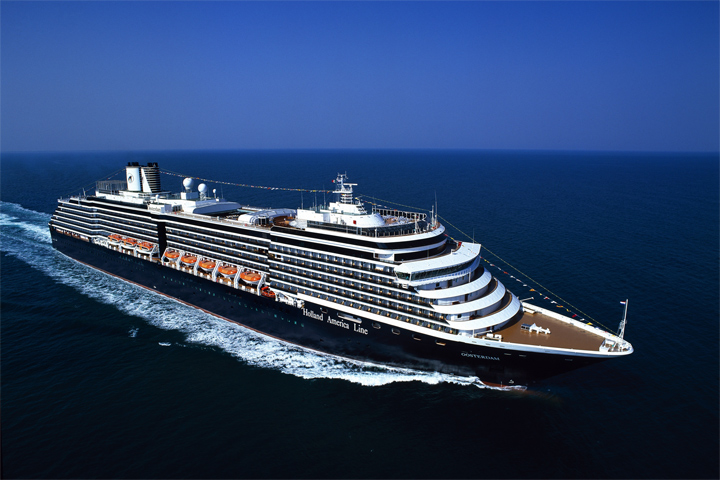
Holland America Line’s first Vista-class cruise ship, Oosterdam has delighted guests since her maiden voyage. Guests now have more world-class entertainment options than ever before. Live music has always been the heart and soul of evenings aboard Holland America Line, and now Oosterdam features the full Music Walk experience with three exciting venues. Lincoln Center Stage features world-class musicians performing chamber music. Billboard Onboard, rocks the house with 50 years of chart-topping hits. The already popular B.B. King’s Blues Club, brings the best of Memphis blues to sea. Feel free to enjoy exciting activities, pursue new interests or simply relax and rejuvenate.
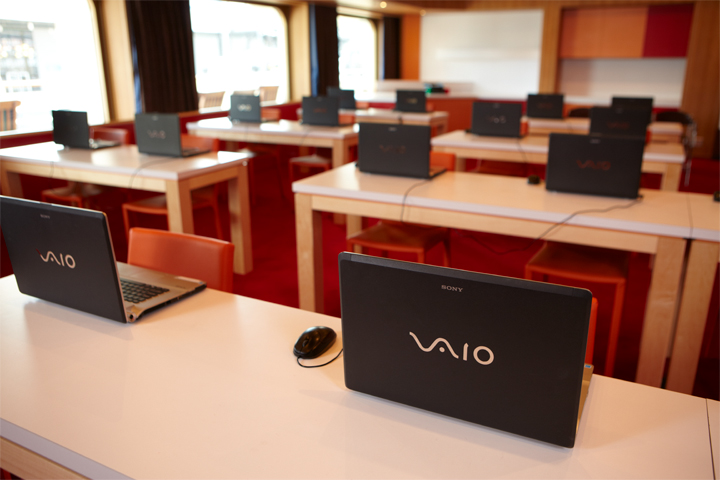
Digital Workshop
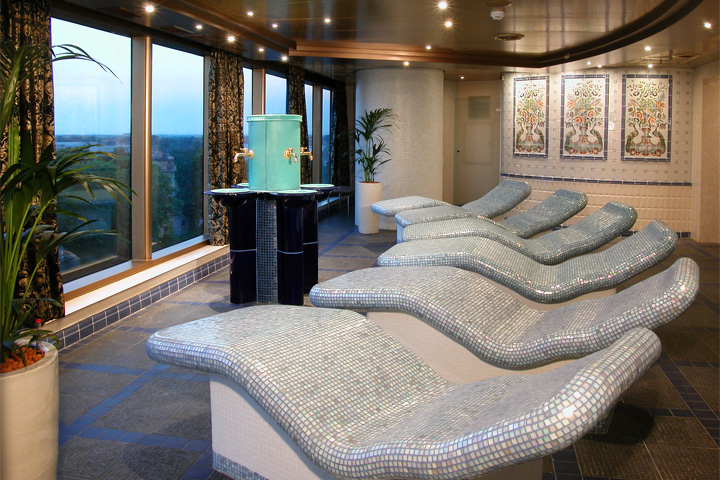
Greenhouse Spa
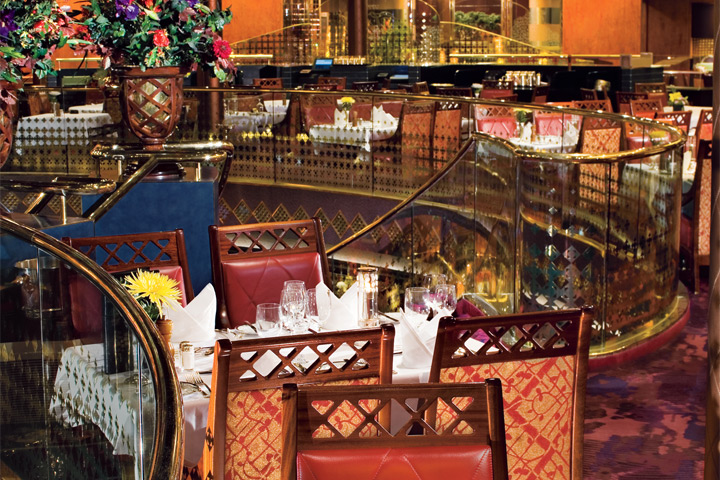
Dining Room
Dining Room: For breakfast, lunch or an unforgettable five-course dinner, the elegant main Dining Room is your destination for sophisticated dining, with menu selections from classic favorites to vegetarian options, to dishes inspired by the regions you’ll visit.
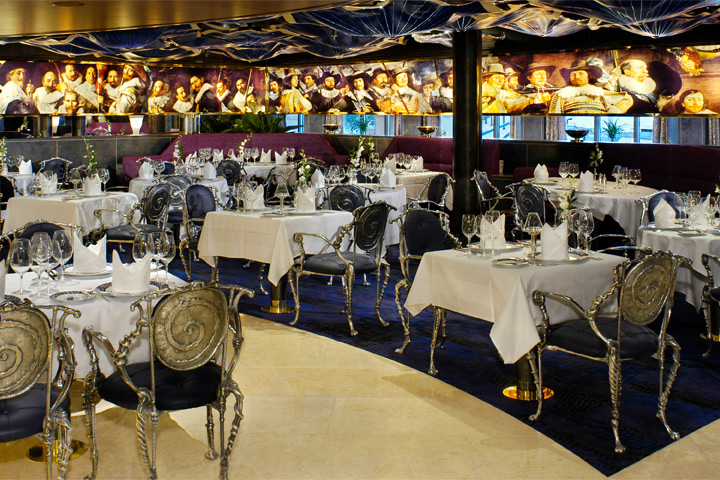
Pinnacle Grill
Pinnacle Grill: Enjoy dishes inspired by America’s Pacific Northwest, such as king salmon from Alaska and choice, responsibly raised beef from Washington State’s Double R Ranch. Complement your meal with a selection of boutique wines from the Pacific Northwest and other celebrated vineyards from around the world. This restaurant is available for an additional cost.
Canaletto: This authentic Italian restaurant offers a menu that celebrates spartire (Italian for "sharing"). Try braised chicken cacciatore "al forno," branzino ai ferri or a classic Italian pasta: spaghetti pomodoro or garlic shrimp-infused ravioli, perhaps. Buon appetito! This restaurant is available for an additional cost.
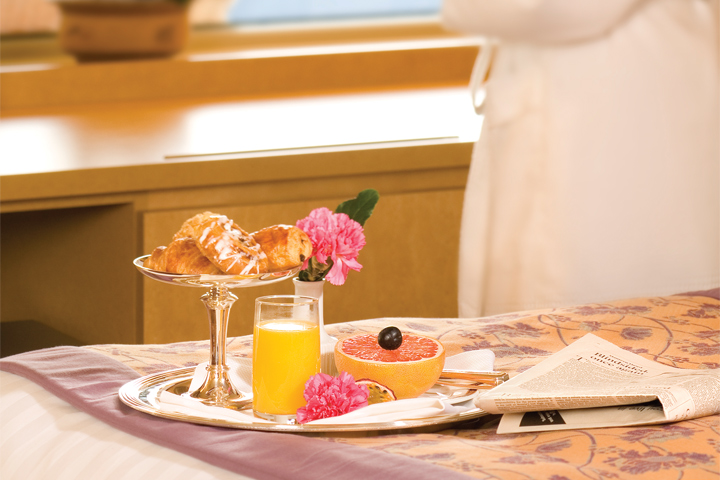
Room Service
Lido Market: Lido Market provides a fresh, new approach to casual dining for breakfast, lunch or dinner, with a panoramic view of the sea. A modern marketplace with different themed stations, the Lido offers a curated selection of delicious options to grab on the go or to have quickly made to order.
Dive-In: Dive in to a grilled burger on brioche or a Nathan’s Famous gourmet hot dog. For alfresco dining by the pool, Dive-In has it all, including lighter fare like the grilled chicken breast sandwich and vegetarian-friendly portabella mushroom stack.
Explorations Café: A comfortable, coffeehouse environment offering espresso drinks and pastries. This restaurant is available for an additional cost.
Room Service: Complimentary 24-hour dining in the comfort of your stateroom.
Staterooms feature premium massage showerheads, fine linens and fresh fruit upon request.

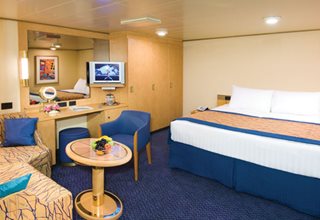
Category: MM
Amenities
Category: N
Amenities
Category: M
Amenities
Category: L
Amenities
Category: K
Amenities
Category: J
Amenities
Category: I
Amenities
Elegant staterooms feature luxurious bedding, premium massage showerheads, a porthole or a window and fresh fruit upon request.
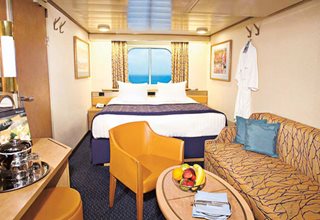
Category: H
Amenities:
Category: G
Amenities:
Category: F
Amenities:
Category: E
Amenities:
Category: D
Amenities:
Category: C
Amenities:
Category: DD
Amenities:
Category: HH
Amenities:
Spacious staterooms have a private balcony, whirlpool bath with shower and walk-in closet.
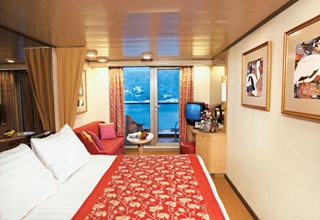
Category: VE
Amenities
Category: VF
Amenities
Category: VH
Amenities
Category: VA
Amenities
Category: VB
Amenities
Category: VC
Amenities
Category: VD
Amenities
Luxurious suites feature a whirlpool bath, large sitting area, private balcony, floor-to-ceiling windows and more. Select suites feature a dressing room.
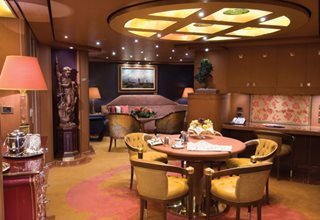
Category: PS
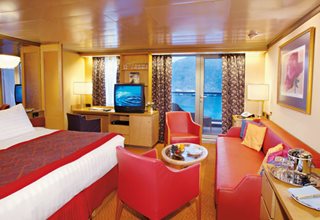
Category: SY
Amenities
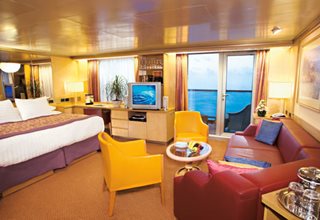
Category: SB
Amenities
Category: SC
Amenities
Category: SS
Amenities
Category: SA
Amenities
Category: SZ
Amenities


| Symbol | Description |
|---|---|
 | Suites SC6175 and SC6164 are fully accessible, bathtub and roll-in shower; Suite SS6108 and staterooms I8037, VB6004, VB6003, D1100, C1082, C1081, J1074, K1012, and K1011 are fully accessible, roll-in shower only |
 | Shower only |
 | Single sink vanity |
 | Partial sea view |
 | 2 lower beds |
 | Triple (2 lower beds, 1 sofa bed) |
 | Connecting rooms |
 | Staterooms have solid steel verandah railings instead of clear-view plexiglass railings |
 | Fully obstructed view |
 | Fully accessible with single side approach to the bed, bathtub, and roll-in shower |
 | Ambulatory accessible, roll-in shower only |
 | Quad (2 lower beds, 1 sofa bed, 1 upper) |
*Price shown is per person based on double occupancy and is valid for select stateroom categories only. Click on the Terms & Conditions link below for details.
†One Digital Costco Shop Card per room/stateroom, per stay. The exact amount of the Digital Costco Shop Card will be calculated during the booking process. The Digital Costco Shop Card promotion is nontransferable and may not be combined with any other promotion. A Digital Costco Shop Card will arrive by email approximately 10 days after the start of your cruise. Click on the Terms & Conditions link below for additional information.
Ship's registry: The Netherlands
Package ID: HALOOSEUR20260603
Book this cruise with Costco Travel and receive a Digital Costco Shop Card. The Digital Costco Shop Card is a convenient payment option in our warehouses and on Costco.ca.

We are processing your payment.
Do not refresh your browser or exit this page.


|
No Image Available |
 United States
 Australia