

 Help Centre

 United States
 Canada
 Australia
Coupon Override
Please Call
For drivers under the age of 25, additional fees and/or restrictions may apply.
For information and assistance in completing your reservation, please call:
1-855-863-0357Sorry
We're unable to find your location.

Asia Africa and Middle East: Grand Circle Japan With Okinawa & Taiwan


Executive Member Benefit
Executive Members receive an annual 2% Reward, up to $1,250, on qualified Costco Travel purchases

Digital Costco Shop Card
Member Exclusive: Digital Costco Shop Card with every Princess Cruises® sailing†
Sailing Itinerary
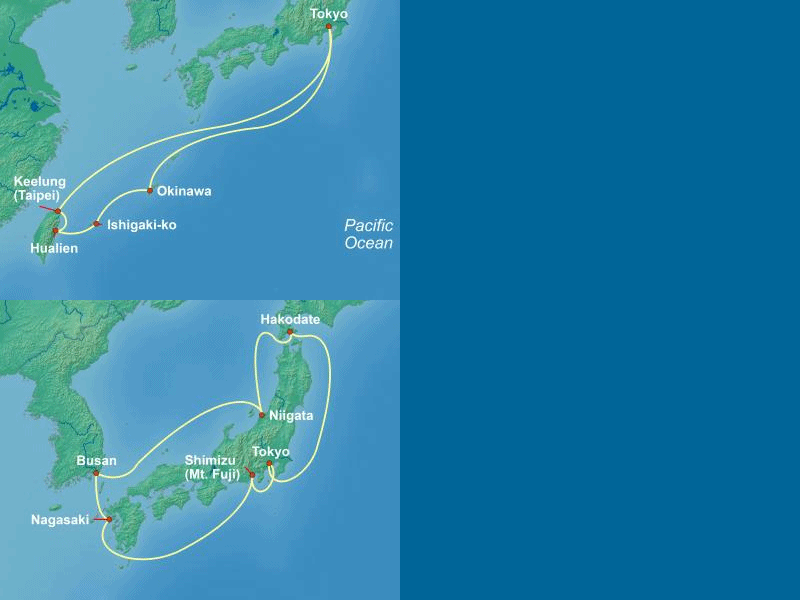
Note: Cruise itineraries are subject to change. Please verify ports and times directly with the cruise line.

Overview


Describing Tokyo to someone who has never been here is a formidable task. After all, how do you describe a city that--as one of my friends visiting Tokyo for the first time put it--seems like it's part of another planet? To be sure, Tokyo is very different from Western capitals, but what sets it apart is its people. Approximately 12 million people reside within Tokyo's 1,200,000,000 sq. km (800 sq. miles), and almost one-fourth of Japan's total population lives within commuting distance of the city. This translates into a crush of humanity that packs the subways, crowds the sidewalks, and fills the department stores beyond belief. In some parts of the city, the streets are as crowded at 3 am as they are at 3 pm. With its high-energy, visual overload, Tokyo makes even New York seem like a sleepy, laid-back town. And yet, despite its limited space for harmonious living, Tokyo remains one of the safest cities in the world, with remarkably little crime or violence. No matter how lost I may become, I know that people will go out of their way to help me. Hardworking, honest, and helpful to strangers, the Japanese are their country's greatest asset. With Tokyo so densely packed, it comes as no shock to learn that land here is more valuable than gold and that buildings are built practically on top of each other, shaped like pieces in a jigsaw puzzle to fit the existing plots of real estate. More than perhaps any other city in the world, Japan's capital is a concrete jungle, with a few parks but not many trees to break the monotony, and it stretches on and on as far as the eye can see. Fires, earthquakes, wars, the zeal for modernization, and the price of land have taken their toll on the city, eradicating almost all evidence of previous centuries. It's as though Tokyo was born only this morning, with all the messy aftermath of a city conceived without t plan and interested only in the future. Thus, first-time visitors to Tokyo are almost invariably disappointed. They come expecting an exotic Asian city, but instead find a megalopolis Westernized to the point of drabness. Used to the grand edifices and monuments of Western cities, they look in vain for Tokyo's monuments to its past--ancient temples, exquisite gardens, imperial palaces, or whatever else they've imagined. Instead, they find what may be, quite arguably, one of the ugliest cities in the world. So, while Tokyo is one of my favorite cities, it's an appreciation that came only with time. When I first moved here, I was tormented by the unsettling feeling that I was somehow missing out on the "real" Tokyo. Even though I was living and working here, Tokyo seemed beyond my grasp, elusive, vague, and undefined. I felt that the meaning of the city was out there somewhere if only I knew where to look. With time, I finally learned that I needn't look farther than my front window. Tokyo has no center but rather is made up of a series of small towns and neighborhoods clustered together, each with its history, flavor, and atmosphere. There are narrow residential streets, ma-and-pa shops, fruit stands, and stores. There's the neighborhood tofu factory, the lunch-box stand, the grocery shop, and the tiny police station, where the cops know the residents by name and patrol the area by bicycle. There are carefully pruned bonsai trees gracing sidewalks, women in kimonos bowing and shuffling down streets, and wooden homes on impossibly narrow streets. Walk in the old downtown neighborhoods of Asakusa or Yanaka and you're worlds apart from the trendy quarters of Harajuku or the high-rises of Shinjuku. Neighborhoods like these make Tokyo lovable and livable. What's more, once visitors get to know Tokyo better, they learn that you can't judge Tokyo by what it looks like on the outside, for this is a city of interiors. Even those concrete monsters may house interiors that are fascinating in design and innovation. In the basement of that drab building could well be a restaurant with wooden beams, mud walls, and thatched ceiling, imported intact from a farmhouse in the Japan Alps; on its roof could be a small Shinto shrine, while the top floor could house a high-tech bar or a sophisticated French restaurant. And beneath Tokyo's concrete shell is a thriving cultural life left very much intact. If,f you're interested in Japan's performing arts as well as such diverse activities as the tea ceremony or sumo, Tokyo is your best bet for offering the most at any one time. Tokyo is also rich in museums and claims the largest repository of Japanese art in the world. It also gets my vote as the pop-art capital of the world; if you're into kitsch, you'll be in high heaven. I can't imagine being bored here, even for just a minute.
Overview

Keelung, officially known as Keelung City, is a major port city situated in the northeastern part of Taiwan. It borders New Taipei with which it forms the Taipei–Keelung metropolitan area, along with Taipei itself. Nicknamed the Rainy Port for its frequent rain and maritime role, the city is Taiwan's second-largest seaport. Keelung City is located in the northern part of Taiwan Island. It occupies an area of 132.76 km2 and is separated from its neighboring county by mountains in the east, west, and south. The northern part of the city faces the ocean and has been a great deep-water harbor since early times. Keelung has a humid subtropical climate with a yearly rainfall average of upwards of 3,700 millimeters. It has long been noted as one of the wettest and gloomiest cities in the world; the effect is related to the Kuroshio Current. Although it is one of the coolest cities in Taiwan, winters are still short and warm, whilst summers are long, relatively dry, and hot, temperatures can peek above 26°C during a warm winter day, while it can dip below 27 °C during a rainy summer day, much like the rest of northern Taiwan. However, its location on northern mountain slopes means that due to orographic lift, rainfall is heavier during fall and winter, the latter during which a northeasterly flow prevails. During summer, southwesterly winds dominate and thus there is a slight rain shadow effect. Fog is most serious during winter and spring when relative humidity levels are also highest.
Overview

Hualien County is a county on the east coast of Taiwan. It is the largest county by area, yet due to its mountainous terrain, has one of the lowest populations in the country. The county seat and largest city is Hualien City.Most of the population resides in the Huadong Valley, which runs north to south, sandwiched between the Central and Hai'an mountain ranges. Due to the rural nature of the county, Hualien attracts many visitors for its natural beauty, which includes Taroko Gorge, Qingshui Cliff, and Qixingtan Beach.
Overview

Harbor(s) - a haven or space of deep water so sheltered by the adjacent land as to afford a safe anchorage for ships
Overview

Okinawa City links the northern and southern parts of the island, which makes it the core for business and medical leaders, cultural programs, and government services.Okinawa City has mostly plateau land, although some parts are very inclined. Okinawa City is known for its reputation of being a music town, giving birth to a variety of bands and singers throughout the years, and also for its famous Annual Okinawa All-Island Eisa Festival, which now has become a traditional annual event. In the eastern part of Okinawa City, we have the Nakagusuku Bay Development Project, and with the maintenance of the highways, Okinawa City is on Japan’s Southern Island located on Asia’s Pacific Sea having a high possibility of transportation growth in the future.
Overview
Describing Tokyo to someone who has never been here is a formidable task. After all, how do you describe a city that--as one of my friends visiting Tokyo for the first time put it--seems like it's part of another planet? To be sure, Tokyo is very different from Western capitals, but what sets it apart is its people. Approximately 12 million people reside within Tokyo's 1,200,000,000 sq. km (800 sq. miles), and almost one-fourth of Japan's total population lives within commuting distance of the city. This translates into a crush of humanity that packs the subways, crowds the sidewalks, and fills the department stores beyond belief. In some parts of the city, the streets are as crowded at 3 am as they are at 3 pm. With its high-energy, visual overload, Tokyo makes even New York seem like a sleepy, laid-back town. And yet, despite its limited space for harmonious living, Tokyo remains one of the safest cities in the world, with remarkably little crime or violence. No matter how lost I may become, I know that people will go out of their way to help me. Hardworking, honest, and helpful to strangers, the Japanese are their country's greatest asset. With Tokyo so densely packed, it comes as no shock to learn that land here is more valuable than gold and that buildings are built practically on top of each other, shaped like pieces in a jigsaw puzzle to fit the existing plots of real estate. More than perhaps any other city in the world, Japan's capital is a concrete jungle, with a few parks but not many trees to break the monotony, and it stretches on and on as far as the eye can see. Fires, earthquakes, wars, the zeal for modernization, and the price of land have taken their toll on the city, eradicating almost all evidence of previous centuries. It's as though Tokyo was born only this morning, with all the messy aftermath of a city conceived without t plan and interested only in the future. Thus, first-time visitors to Tokyo are almost invariably disappointed. They come expecting an exotic Asian city, but instead find a megalopolis Westernized to the point of drabness. Used to the grand edifices and monuments of Western cities, they look in vain for Tokyo's monuments to its past--ancient temples, exquisite gardens, imperial palaces, or whatever else they've imagined. Instead, they find what may be, quite arguably, one of the ugliest cities in the world. So, while Tokyo is one of my favorite cities, it's an appreciation that came only with time. When I first moved here, I was tormented by the unsettling feeling that I was somehow missing out on the "real" Tokyo. Even though I was living and working here, Tokyo seemed beyond my grasp, elusive, vague, and undefined. I felt that the meaning of the city was out there somewhere if only I knew where to look. With time, I finally learned that I needn't look farther than my front window. Tokyo has no center but rather is made up of a series of small towns and neighborhoods clustered together, each with its history, flavor, and atmosphere. There are narrow residential streets, ma-and-pa shops, fruit stands, and stores. There's the neighborhood tofu factory, the lunch-box stand, the grocery shop, and the tiny police station, where the cops know the residents by name and patrol the area by bicycle. There are carefully pruned bonsai trees gracing sidewalks, women in kimonos bowing and shuffling down streets, and wooden homes on impossibly narrow streets. Walk in the old downtown neighborhoods of Asakusa or Yanaka and you're worlds apart from the trendy quarters of Harajuku or the high-rises of Shinjuku. Neighborhoods like these make Tokyo lovable and livable. What's more, once visitors get to know Tokyo better, they learn that you can't judge Tokyo by what it looks like on the outside, for this is a city of interiors. Even those concrete monsters may house interiors that are fascinating in design and innovation. In the basement of that drab building could well be a restaurant with wooden beams, mud walls, and thatched ceiling, imported intact from a farmhouse in the Japan Alps; on its roof could be a small Shinto shrine, while the top floor could house a high-tech bar or a sophisticated French restaurant. And beneath Tokyo's concrete shell is a thriving cultural life left very much intact. If,f you're interested in Japan's performing arts as well as such diverse activities as the tea ceremony or sumo, Tokyo is your best bet for offering the most at any one time. Tokyo is also rich in museums and claims the largest repository of Japanese art in the world. It also gets my vote as the pop-art capital of the world; if you're into kitsch, you'll be in high heaven. I can't imagine being bored here, even for just a minute.
Overview

Hakodate is a city and port located in Oshima. It is the capital city of Oshima Subprefecture. The city is overlooked by Hakodateyama (Mount Hakodate), a lumpy, totally-forested mountain. The summit of the mountain is easily reached by either hiking trail cable car, or car. The nighttime view from the summit is renowned all over Japan as one of the loveliest sights in the country. A not-so-well-known local nickname for the bumpy mountain is Gagyuzan ("Mount Cow's-back"), which alludes to the way the mountain's shape resembles that of a resting cow. Hakodate is home to the famous European-style Goryokaku fort, which was built in the shape of a five-pointed star in 1866. It is now used as a public park. The park is a popular spot in Hokkaido for hanami (cherry blossom viewing). The small but bustling city is also famous as the site of Hijikata Toshizo's last stand. The city is also known for Hakodate Shio Ramen, where instead of having pork cutlet placed inside the soup, sliced squid is used. On a similar note, Hakodate's city fish is the squid. Every year (around July) the city gets together for the Hakodate Port Festival. Hordes of citizens gather in the streets to dance a wiggly dance known as the Ika-odori (Squid Dance), the name of which describes the dance appropriately. The glowing lights of squid-catching boats can be seen in the waters surrounding the city.
Overview

Niigata City is the capital of Niigata Prefecture. It is the largest Japanese city along the coast of the Sea of Japan. Niigata lies on almost the same latitudinal coordinates as San Francisco, Tiensin, and Lisbon, and is located approximately 300km northwest of Tokyo, which can be reached in 1 hour and 40 minutes by the Joetsu Shinkansen bullet train or in about 3 hours and 30 minutes by car on the Kan-etsu Expressway. Niigata was a prosperous port city during the Edo period because it lies on a key point along trade routes in the Sea of Japan. In 1858, when the Japan-U.S.A. Treaty of Amity and Commerce was signed, Niigata was designated as one of five ports in Japan to conduct trade with the outside world. Niigata's economy is supported by a high proportion of tertiary industries (commerce and service) and a large petrochemical industry that utilizes Niigata's convenient port access. Agricultural production occurs mainly in the suburbs. Although rice is the major crop, watermelons, Japanese radishes, and flowers are also popular items of cultivation. Niigata has rich coastal fisheries and much effort is made to maximize the harvests of mackerel, horse mackerel, and sagittated ccalamari(squid). The Joetsu Shinkansen bullet train and the Kan-etsu, Hokuriku, and Ban-etsu Expressways make up a high-speed transportation system. In addition, there are regular international flights from Niigata to Khabarovsk, Vladivostok, Irkutsk, Seoul, Shanghai, Xi'an, Harbin, Guam, a nd Honolulu. The port of Niigata offers a regular container service to Nakhoda, and there are regular passenger services to such places as Busan, Dalian, and Shanghai. International exchanges with neighboring countries such as Russia, South Korea, and China are constantly expanding. Niigata is a city committed to continue developingevenl more.
Overview

Busan/Pusan is Korea's second largest city. Tourists often come to this region to hike and to visit the Buddhist Temples located deep within the region's mountains. The Beomeosa Temple, founded in 678 AD, is perhaps one of the most frequented temples in the area and is always packed with worshipers and tourists. For art buffs, Busan offers several museums and historical buildings. If scenery is your thing, try visiting the Dongbaek Island, or bird watch at the Nakdong river estuary.
Overview

Nagasaki is the capital and the largest city of Nagasaki Prefecture located at the south-western coast of Kyushu. Nagasaki lies at the head of a long bay that forms the best natural harbor on the southern Japanese home island of Kyushu. The main commercial and residential area of the city lies on a small plain near the end of the bay. Two rivers divided by a mountain spur form the two main valleys in which the city lies. The heavily built-up area of the city is confined by the terrain to less than 4 square miles out of a total of about 35 square miles in the city as a whole. The city was rebuilt after the war, albeit dramatically changed, as any city would be after such colossal damage. New temples were built and new churches as well, since the Christian presence never died out and even increased dramatically after the war. Some of the rubble was left as a memorial, such as a one-legged torii gate and a stone arch near ground zero. New structures were also raised as memorials, such as the Atomic Bomb Museum. Nagasaki remains first and foremost a port city, supporting a rich shipping industry and setting a strong example of perseverance and peace.
Overview

Blessed with a mild climate throughout the year, Shimizu is known for producing mandarin oranges, tea, and strawberries. On the coast, there is a pine-tree grove on a sand spit called Miho no Matsubara which is often mentioned in legends. From the small mountain called Nihondaira tourists can enjoy a superb view of Mt. Fuji and the light-filled city at night. Picking strawberries during the winter and spring months is a popular pastime.
Overview
Describing Tokyo to someone who has never been here is a formidable task. After all, how do you describe a city that--as one of my friends visiting Tokyo for the first time put it--seems like it's part of another planet? To be sure, Tokyo is very different from Western capitals, but what sets it apart is its people. Approximately 12 million people reside within Tokyo's 1,200,000,000 sq. km (800 sq. miles), and almost one-fourth of Japan's total population lives within commuting distance of the city. This translates into a crush of humanity that packs the subways, crowds the sidewalks, and fills the department stores beyond belief. In some parts of the city, the streets are as crowded at 3 am as they are at 3 pm. With its high-energy, visual overload, Tokyo makes even New York seem like a sleepy, laid-back town. And yet, despite its limited space for harmonious living, Tokyo remains one of the safest cities in the world, with remarkably little crime or violence. No matter how lost I may become, I know that people will go out of their way to help me. Hardworking, honest, and helpful to strangers, the Japanese are their country's greatest asset. With Tokyo so densely packed, it comes as no shock to learn that land here is more valuable than gold and that buildings are built practically on top of each other, shaped like pieces in a jigsaw puzzle to fit the existing plots of real estate. More than perhaps any other city in the world, Japan's capital is a concrete jungle, with a few parks but not many trees to break the monotony, and it stretches on and on as far as the eye can see. Fires, earthquakes, wars, the zeal for modernization, and the price of land have taken their toll on the city, eradicating almost all evidence of previous centuries. It's as though Tokyo was born only this morning, with all the messy aftermath of a city conceived without t plan and interested only in the future. Thus, first-time visitors to Tokyo are almost invariably disappointed. They come expecting an exotic Asian city, but instead find a megalopolis Westernized to the point of drabness. Used to the grand edifices and monuments of Western cities, they look in vain for Tokyo's monuments to its past--ancient temples, exquisite gardens, imperial palaces, or whatever else they've imagined. Instead, they find what may be, quite arguably, one of the ugliest cities in the world. So, while Tokyo is one of my favorite cities, it's an appreciation that came only with time. When I first moved here, I was tormented by the unsettling feeling that I was somehow missing out on the "real" Tokyo. Even though I was living and working here, Tokyo seemed beyond my grasp, elusive, vague, and undefined. I felt that the meaning of the city was out there somewhere if only I knew where to look. With time, I finally learned that I needn't look farther than my front window. Tokyo has no center but rather is made up of a series of small towns and neighborhoods clustered together, each with its history, flavor, and atmosphere. There are narrow residential streets, ma-and-pa shops, fruit stands, and stores. There's the neighborhood tofu factory, the lunch-box stand, the grocery shop, and the tiny police station, where the cops know the residents by name and patrol the area by bicycle. There are carefully pruned bonsai trees gracing sidewalks, women in kimonos bowing and shuffling down streets, and wooden homes on impossibly narrow streets. Walk in the old downtown neighborhoods of Asakusa or Yanaka and you're worlds apart from the trendy quarters of Harajuku or the high-rises of Shinjuku. Neighborhoods like these make Tokyo lovable and livable. What's more, once visitors get to know Tokyo better, they learn that you can't judge Tokyo by what it looks like on the outside, for this is a city of interiors. Even those concrete monsters may house interiors that are fascinating in design and innovation. In the basement of that drab building could well be a restaurant with wooden beams, mud walls, and thatched ceiling, imported intact from a farmhouse in the Japan Alps; on its roof could be a small Shinto shrine, while the top floor could house a high-tech bar or a sophisticated French restaurant. And beneath Tokyo's concrete shell is a thriving cultural life left very much intact. If,f you're interested in Japan's performing arts as well as such diverse activities as the tea ceremony or sumo, Tokyo is your best bet for offering the most at any one time. Tokyo is also rich in museums and claims the largest repository of Japanese art in the world. It also gets my vote as the pop-art capital of the world; if you're into kitsch, you'll be in high heaven. I can't imagine being bored here, even for just a minute.
Onboard the Diamond Princess
Diamond Princess
Costco Member Reviews

Year Built: 2004
Year Refurbished: 2024
Double Occupancy Capacity: 2,670
Diamond Princess® is a luxury destination in itself. Take in the view from one of nearly 750 balcony staterooms. Indulge in a hot stone massage at the renowned Lotus Spa®, enjoy fine dining in a formal or relaxed atmosphere and make it a cruise to remember.
Onboard Activities
Activities & Services (included in cruise)

Movies
- Art Gallery
- Bars/Lounges
- Beauty Salon
- Business Center
- Card Room
- Casino
- Children's Indoor Play Area
- Children's Outdoor Play Area
- Disco/Nightclub
- Duty-Free Shops/Boutiques
- Educational Classes
- Elevators
- Fitness Center
- Fitness Classes
- Game Arcade
- Infirmary/Medical Center
- Library
- Miniature Golf
- Movies Under the Stars®
- Organized Age-Specific Activities
- Pool - Adults Only
- Pool - Children's
- Pool - Indoor
- Pool - Indoor/Covered
- Pool - Outdoor
- Religious Services
- Self-Service Laundromat
- Sports Facilities
- Teen Center or Disco
- Teen Programs
- Theaters/Show Lounge
- Wedding/Vow Renewal
- Whirlpool/Jacuzzi
Activities & Services (available for an extra fee)

Full-Service Spa
- Babysitting
- Dry Cleaning/Laundry Service
- Educational Programs
- Full-Service Spa
- Internet Center
- Sauna/Steam Room
- Spa Services/Massage
Dining

Dining Room
Main Dining
International Dining Room: After final payment, through the MedallionClass® app, you may request your dining preference with Dine My Way℠. Customize your dining experiences nightly by choosing your seating time, dining companions and dietary needs.
Pacific Moon Dining Room: After final payment, through the MedallionClass® app, you may request your dining preference with Dine My Way℠. Customize your dining experiences nightly by choosing your seating time, dining companions and dietary needs.
Santa Fe Dining Room: After final payment, through the MedallionClass® app, you may request your dining preference with Dine My Way℠. Customize your dining experiences nightly by choosing your seating time, dining companions and dietary needs.
Savoy Dining Room: After final payment, through the MedallionClass® app, you may request your dining preference with Dine My Way℠. Customize your dining experiences nightly by choosing your seating time, dining companions and dietary needs.
Vivaldi Dining Room: After final payment, through the MedallionClass® app, you may request your dining preference with Dine My Way℠. Customize your dining experiences nightly by choosing your seating time, dining companions and dietary needs.

Sabatini's
Specialty Dining
Chef’s Table Experience: Taking dining to a new level, the Chef’s Table Experience includes pre-dinner cocktails and hors d’oeuvres in the galley for you and a limited number of fellow guests. After your executive chef describes the specially designed menu for the night, participants are escorted to an intimate table for the main course, including pairing suggestions. This restaurant is available for an additional cost. Limited capacity, reservations required.
Kai Sushi: An exquisitely decorated traditional sushi bar, serving up sushi and sashimi expertly prepared before your eyes. Dine at the sushi bar or enjoy an elegant restaurant experience. This restaurant is available for an additional cost.
Sabatini's: An upscale authentic Italian dining experience in a remarkable eight-course meal. The menu features both local seafood specialties and other regional favorites. This restaurant is available for an additional cost.
Sterling Steakhouse℠: An upscale and more refined approach to the traditional steakhouse, this venue features some of the best, most tender cuts of beef, such as New York and porterhouse, plus a prime rib carving station. This restaurant is available for an additional cost.

Prego Pizzeria
Casual Dining
Horizon Court: 24-hour casual buffet dining.
La Patisserie: Casual sidewalk café-style setting for cappuccino, espresso and other coffee specialties, as well as fresh pastries throughout the day. This restaurant is available for an additional cost.
Prego Pizzeria: Poolside pizzeria serving fresh pizza by the slice.
Trident Grill: Follow your nose to the Trident Grill where the burgers are flipping and the hotdogs roasting, served with a variety of fixin’s and crisp fries. Veggie burgers, bratwurst and grilled chicken breast are also served and all are sure to hit the spot when you are relaxing out on deck.
Room Service: Call for room service delivery or order through OceanNow® in the Princess MedallionClass® app any time of the day or night. Guests with the latest Princess Plus and Princess Premier packages enjoy OceanNow and room service delivery with no charge. Otherwise, this dining option is available for an additional cost. To order, guests can press the "Room Service" button on their stateroom phone, or order through OceanNow.
Staterooms
Staterooms feature a refrigerator, spacious closet and bathroom with shower.
- Interior (Category: IF)

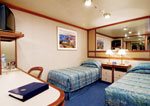
Category: IF
Approximately 168 sq. ft., this well-appointed interior stateroom provides fine amenities.
- Interior (Category: ID)
Category: ID
Approximately 168 sq. ft., this well-appointed interior stateroom provides fine amenities.
- Interior (Category: IE)
Category: IE
Approximately 168 sq. ft., this well-appointed interior stateroom provides fine amenities.
- Interior (Category: IB)
Category: IB
Approximately 168 to 182 sq. ft., this well-appointed interior stateroom provides fine amenities.
- Interior (Category: IC)
Category: IC
Approximately 168 to 182 sq. ft., this well-appointed interior stateroom provides fine amenities.
- Interior (Category: IA)
Category: IA
Approximately 168 sq. ft., this well-appointed interior stateroom provides fine amenities.
Nicely-appointed staterooms feature a picture window, spacious closet and bathroom with shower.
- Oceanview (obstructed view) (Category: OZ)
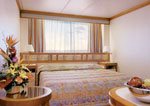
Category: OZ
Approximately 183 sq. ft., this well-appointed stateroom features a picture window with an obstructed view.
- Oceanview (obstructed view) (Category: OY)
Category: OY
Approximately 183 sq. ft., this well-appointed stateroom features a picture window with an obstructed view.
- Oceanview (Category: OF)
Category: OF
Approximately 183 to 194 sq. ft., this well-appointed stateroom features a picture window for memorable views.
- Oceanview (obstructed view) (Category: OV)
Category: OV
Approximately 183 sq. ft., this well-appointed stateroom features a picture window with an obstructed view.
- Oceanview (obstructed view) (Category: OW)
Category: OW
Approximately 183 sq. ft., this well-appointed stateroom features a picture window with an obstructed view.
- Premium Oceanview (Category: O5)
Category: O5
Approximately 200 sq. ft., this well-appointed stateroom features a forward-facing cabin for memorable views.
- Oceanview (Category: OC)
Category: OC
Approximately 194 sq. ft., this well-appointed stateroom features a picture window for memorable views.
Staterooms feature a private balcony, spacious walk-in closet, desk and bathroom with shower.
- Balcony (Category: BE)
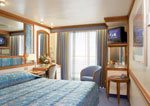
Category: BE
Approximately 237 to 277 sq. ft. including balcony, this stateroom provides outstanding views from a private balcony.
- Balcony (Category: BF)
Category: BF
Approximately 237 sq. ft. including balcony, this cabin provides outstanding views from a private balcony.
- Balcony (Category: BC)
Category: BC
Approximately 237 sq. ft. including balcony, this cabin provides outstanding views from a private balcony.
- Premium Balcony (Category: B4)
Category: B4
Approximately 237 to 277 sq. ft. including balcony, this cabin provides dramatic wake views from a rear-facing private balcony.
- Balcony (Category: BD)
Category: BD
Approximately 237 to 277 sq. ft. including balcony, this cabin provides outstanding views from a private balcony.
- Balcony (Category: BA)
Category: BA
Approximately 237 sq. ft. including balcony, this cabin provides outstanding views from a private balcony.
- Premium Balcony (Category: B2)
Category: B2
Approximately 277 sq. ft. including balcony, this cabin provides outstanding views from a private balcony.
- Balcony (Category: BB)
Category: BB
Approximately 237 sq. ft. including balcony, this cabin provides outstanding views from a private balcony.
Features private balcony and sitting room, two TVs, walk-in closet and bathroom with tub and shower.
- Grand Suite with Balcony (Category: S1)
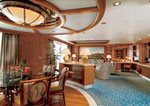
Category: S1
Approximately 1,329 sq. ft. including balcony, the Grand Suite features an expansive cabin and oversized aft-facing balcony. Enjoy exclusive suite-only upgrades and benefits.
- Mini-Suite with Balcony (Category: MD)
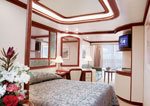
Category: MD
Approximately 354 sq. ft. including balcony, this spacious cabin provides a seating area with sofa bed, and full bath with combination tub and shower.
- Mini-Suite with Balcony (Category: ME)
Category: ME
Approximately 354 sq. ft. including balcony, this spacious cabin provides a seating area with sofa bed, and full bath with combination tub and shower.
- Mini-Suite with Balcony (Category: MB)
Category: MB
Approximately 354 sq. ft. including balcony, this spacious cabin provides a seating area with sofa bed, and full bath with combination tub and shower.
- Two-Bedroom Family Suite with Balcony (Category: S8)
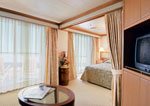
Category: S8
Approximately 613 sq. ft. including balcony, the Two Bedroom Family Suite features 2 bedrooms to accommodate up to 6 passengers. Enjoy exclusive suite-only upgrades and benefits.
- Vista Suite with Balcony (Category: S6)
Category: S6
Approximately 525 to 548 sq. ft. including balcony, the Vista Suite features a spacious cabin and aft-facing balcony. Enjoy exclusive suite-only upgrades and benefits.
- Premium Reserve Collection Mini-Suite with Balcony (Category: M1)
Category: M1
Approximately 354 sq. ft. including balcony, this spacious cabin provides a seating area with sofa bed, and full bath with combination tub and shower.
- Penthouse Suite with Balcony (Category: S4)
Category: S4
Approximately 555 sq. ft. including balcony, the Penthouse Suite features a spacious cabin and separate seating area with a sofa bed. Enjoy exclusive suite-only upgrades and benefits.
- Premium Suite with Balcony (Category: S5)
Category: S5
Approximately 705 sq. ft. including balcony, the Premium Suite features a spacious cabin and separate seating area with a sofa bed. Enjoy exclusive suite-only upgrades and benefits.
- Owner's Suite with Balcony (Category: S2)
Category: S2
Approximately 692 sq. ft. including balcony, the Owner's Suite features an expansive cabin and oversized aft-facing balcony. Enjoy exclusive suite-only upgrades and benefits.
- Penthouse Suite with Balcony (Category: S3)
Category: S3
Approximately 525 to 572 sq. ft. including balcony, the Penthouse Suite features a spacious cabin and aft-facing balcony. Enjoy exclusive suite-only upgrades and benefits.
Deck Plan

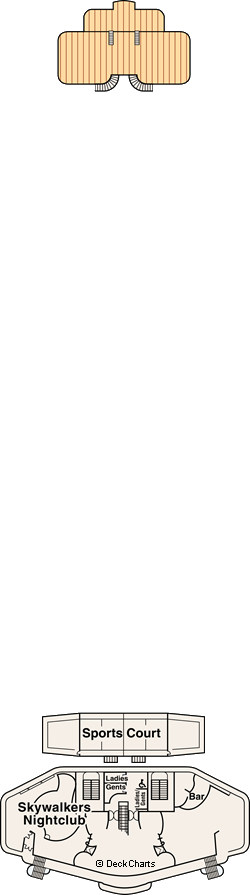
| Symbol | Description |
|---|---|
 | Will accommodate a rollaway |
 | Two lower beds not convertible to queen, shower only |
 | Will accommodate third and fourth person |
 | Two-bedroom family suite (connecting staterooms with private balcony, accommodates up to six persons) |
 | Balcony access when in port only |
 | Will accommodate third person |
 | Fully accessible stateroom, roll-in shower only |
 | Connecting staterooms |
Ship Facts

- Ship Name: Diamond Princess
- Ship Name: Diamond Princess
- Year Built: 2004
- Year Refurbished: 2024
- Year Entered Present Fleet: 2004
- Ship Class: Diamond
- Maximum Capacity: 2,670
- Number of Passenger Decks: 14
- Number of Crew: 1,100
- Officers' Nationality: British/Italian
- Ocean-View without Balcony: 220
- Ocean-View with Balcony: 522
- Total Inside Staterooms: 377
- Tonnage (GRT): 115,875
- Capacity Based on Double Occupancy: 2,670
- Country of Registry: Bermuda
- Total Staterooms: 1,337
- Suites with Balcony: 216
- Crew/Hotel Staff Nationality: International
Costco Member Reviews
Available Dates & Prices
Terms & Conditions
*Price shown is per person based on double occupancy and is valid for select stateroom categories only. Click on the Terms & Conditions link below for details.
†One Digital Costco Shop Card per room/stateroom, per stay. The exact amount of the Digital Costco Shop Card will be calculated during the booking process. The Digital Costco Shop Card promotion is nontransferable and may not be combined with any other promotion. A Digital Costco Shop Card will arrive by email approximately 10 days after the start of your cruise. Click on the Terms & Conditions link below for additional information.
Ship's registry: Bermuda
Package ID: PCLDIAASI20280621
Digital Costco Shop Card
Book this cruise with Costco Travel and receive a Digital Costco Shop Card. The Digital Costco Shop Card is a convenient payment option in our warehouses and on Costco.ca.



 You have unsaved preference changes.