Help Centre



For drivers under the age of 25, additional fees and/or restrictions may apply.
For information and assistance in completing your reservation, please call:
1-855-863-0357We're unable to find your location.


All onboard gratuities
Select complimentary shore excursions**
Unlimited beverages, including fine wines and premium spirits served throughout the ship
Complimentary dining venues
Complimentary in-suite bar
Complimentary caviar
Complimentary Wi-Fi packages with unlimited minutes
Welcome bottle of Champagne

Executive Members receive an annual 2% Reward, up to $1,250, on qualified Costco Travel purchases

Member Exclusive: Digital Costco Shop Card with every Seabourn® sailing†

Note: Cruise itineraries are subject to change. Please verify ports and times directly with the cruise line.

Today Piraeus is the home base of Greek shipping, the largest commercial fleet in the world, apace bound to the sea like few others. The harbors of Zea and Mikrolimano as well as Phaliro play host to countless yachts and sailing craft throughout the year. Piraeus was known in medieval times as Porto Leone, a name due to the enormous stone lion, which guarded the port's entrance. Today, the life of Piraeus is centered on its three ports: the main, central one, and those of Zea and Mikrolimano. You can walk around the central harbor, shared by cargo and passenger ships alike, and watch the constant comings and goings of goods and people from around the world. Having completed your tour of the central harbor of Piraeus you will then head south traversing the peninsula and arriving at Peiraiki, one of the most picturesque neighborhoods in the city. Here one finds the harbor of Zea, one of the largest marinas in the Mediterranean. If the night finds you in the area, you can try one of the many bars found nearby. You can continue your tour along the waterfront heading towards Kastella but a small deviation toward the city center will be useful for then you can visit the verdant square of the municipal Theatre with cafeterias and shops of all kinds surrounding it. The magnificent building housing the Municipal Theatre as well as the Town Hall and the Library complete the picture presented by the main square in the city. Piraeus's little natural harbors are among its busiest and most touristy areas: Mikrolimano, Passalimani, Zea, Freatida, and Hatzikiriakio. Countless seaside tavernas provide delicious seafood washed down with the uniquely Greek drink, ouzo. The fresh smell of the sea and the sounds made by the assortment of caiques, yachts, and sailing ships, which are moored next to the tables, complete the enjoyment of the food Beyond the port, the most impressive spots are the hills of Profitis Ilias and Kastela with their neoclassical mansions and modern buildings which look as they are hanging over the sea.
In this modern town of 10.000 population, the whole beauty seemed simple painting. Nafplio there was the first capital town of the younger Greece and today Nome Argolida. It is 147 Km. Away from Athens. The town is strong, concrete, under the imposing Rocks of Palamidiou, the most thundering and complex Venetian Castle East - at least - Mediterranean, enlarged land from his extension, the castle of Akronafplia a (point that was building from the first town of the ancient world), but to the water of the Gulf there is the third castle, Mpourtzi. Nafplio is not History. It is a town - civilization. Nafplio, Nafplia, and Nome Argolida are the most popular tourist locations in Greece, with tourist movement all year. About 1.5 million visitors are passing in every tourist period from here. But the town and the region don't live only from the tourism.Nafplio has his own economic life, with industries and agricultural productions from the most important in Greece. It is the basic part of the production of citrus fruits in the country, with also respective industry. The old medieval and neoclassic town, with the stoned roads, the wooden balconies, the boukamvilies to overflow from the internal yards, the ancient fountains the square of Fundamental with the old Turkish Hamam (today cinema-theatre) and Cafe, the everywhere present of Palamidiou to offer you a beautiful feeling of security - not from the enemy, but anything it is truth and not to your dream, give you all these the impression of a dreaming scene.
Kotor is a fortified town on Montenegro’s Adriatic coast, in a bay near the limestone cliffs of Mt. Lovcen. Characterized by winding streets and squares, its medieval old town has several Romanesque churches, including Kotor Cathedral. It's also home to the Maritime Museum, which explores local seafaring history. Sveti Ðorde, one of 2 tiny islands off the ancient town of Perast, features a centuries-old church.
The town of Korcula, the historical centre of the island, has a very nice location in the Peljesac Channel. It is also known for its outstanding cultural and historical heritage and a long tradition in seafaring, shipbuilding and stone masonry. It is the birthplace of the adventurer and traveller Marco Polo. Today Korcula is an important tourist centre. Tourism has a years-long tradition on the island. The first modern hotel, Korcula, was opened in 1912, in a building erected in 1871. Hotel guests have been enjoying the sunset at the hotel terrace for decades, which is a unique experience in the early summer.Visitor opportunities on the island of Korcula include various types of accommodation - hotels, apartments, campsites, and marina; sports and recreational facilities, especially interesting water sports; organized excursions and a rich cultural life and entertainment programs. Cultural events of "Moreska" and "Kumpanija" have become world-famous. The gastronomic offer includes famous fish specialities and exquisite, top-class local wines (Posip, Rukatac, Grk, Plavac), due to which Korcula is also called "the island of wines". The local cuisine is also famous for traditional cakes and sweets, such as "cukarini", "krostule" and "prikle".Korcula has numerous tennis courts. Windsurfing and yachting equipment may be rented. Interesting excursions are one-day or longer sailing or yachting tours and diving expeditions led by professional divers.The most important cultural event is the traditional chivalrous game called "Moreska". It has been performed in Korcula since the 15th century and is of Spanish origin. It is a battle between the army of the White King and the army of the Black King, who fight for the princess abducted by the Black King. After a fierce fight with swords, in seven battle figures and a dramatic dialogue, the White King defeats the Black King and sets the princess free. The fight is accompanied by a battle march performed by a brass band.Moreska is performed every year on the 29th of July, together with the celebration of St. Todor, but also on several occasions during the tourist season.Other traditional feasts in Korcula include the carnival, which starts on the Epiphany, and the Holy Week, with the procession of guilds - especially impressive is the procession on Good Friday. -Other religious feasts are the day of Sts. Peter and Paul (29th of June) with bonfires, the festivities of the Assumption of Our Lady (15th of August) and the feast of St. Martin, with baptizing of young wine (in November). Many cultural and sports events take place during the summer months: music festivals, theatre and folk music performances, sports contests, yachting regattas, etc.Korcula ACI Marina has 220 berths in the sea and 100 places on the ground.Korcula, a town and port on the northeastern coast of the island of Korcula, is situated on a small peninsula which is connected with the island by a narrow isthmus; population 3,232. The surrounding coastal area is covered with pine forests. East of the port is a small group of islets. The climate is mild; the average air temperature in January is 9.8 °C and in July 26.9 °C; the island is famous for its long insolation. The economy is based on farming, growing of vines, olives and fruit, fishing, shipbuilding, stone processing, tourism and nautical tourism. The regional road connects the town of Korcula with all major places on the island. The port consists of the western and the eastern part. Korcula Marina is located in a cove on the eastern side of the town. Korcula has regular ferry lines with the mainland (Korcula - Orebic).
The best view of Hvar Town is from the sea, the tiny town centre contoured around the bay, grainy-white and brown with green splashes of palms and pines bursting from every crack and cranny. At the centre, the creamy brown main square cuts its way in, flanked by the arcaded bulk of the Venetian arsenal. The upper storey of the arsenal was added in 1612 to house the city theatre ( kazalite; daily: summer 10am-noon & 8-111 pm winter 10am-noon; 10kn), the oldest in Croatia and one of the first in Europe. It's since been converted to a cinema, but the painted Baroque interior has survived pretty much intact. The square culminates in the skeletal campanile of Hvar's Cathedral (no fixed opening times, but usually open mornings), a sixteenth-century construction with an eighteenth-century facade that's a characteristic mixture of Gothic and Renaissance styles. Inside is routine enough, but the Bishop's Treasury (Riznica; daily: summer 9 am-noon & 7 pmpm; winter 10am-noon; 10kn) is worth the entry fee for its small but fine selection of chalices, reliquaries and embroidery. Look out for a nicely worked sixteenth-century crozier, carved into a serpent, encrusted with saints and embossed with a figure of the Virgin attended by Moses and an Archangel. The rest of the old town backs away from the piazza in an elegant confusion of twisting lanes and alleys. Up above, the Fortress (Kastil; June-Sept dai 8 am8 pm-8 pm; 10kn) is a good example of sixteenth-century military architecture. The views over Hvar and the islands beyond are well worth the trek to the top. From the fort, you can pick out the fifteenth-century Franciscan Monastery (Franjevacki samostan; Mon-Fri 10am-noon & 5-7 pm; 10kn), to the left of the harbour, a sliver of white against the blue of the sea. The monastery has a small collection of paintings, mostly obscure Venetian, which includes a tender, dark and modernistic Ecce Homo by Leandro Bassano and, stretching right across one wall, a melodramatic, almost life-size Last Supper attributed to Matteo Ingoli. Next door, the monastic church is pleasingly simple, with beautifully carved choir stalls and a fanciful partition dating from 1583; look out for the extravagant dragon candleholders.The beaches nearest to Hvar town are rocky and crowded, and it's best to make your way towards the Pakleni otoci (the Islands of Hell), just to the west of Hvar. Easily reached by water taxi from the harbour (about 15kn each way), the Pakleni are a chain of eleven wooded islands, only three of which have any facilities (simple bars and restaurants): Jerolim island, the nearest, offers nudist bathing; next is Marinkovac - partly nudist, but with a main beach, U Stipanska; then Sv Klement, the largest of the islands - here, most people head for Palmizana, one of its most attractive coves with a fine shingle beach. Bear in mind that camping is forbidden throughout Pakleni.
Vodice is a town in the Šibenik-Knin County, Croatia. It borders the Adriatic Sea and has a population of 8,875.
Piran is a resort city on Slovenia’s Adriatic coast, known for its long pier and Venetian architecture. Tartini Square is flanked by the Gothic red Venetian House and the frescoed Tartini House. The latter is the birthplace of violinist Giuseppe Tartini. The 19th-century town hall has a stone lion, a symbol of the former Republic of Venice. St. George’s Cathedral, nearby, has 17th-century paintings and marble altars.
Terminal Fusina is a hamlet in Metropolitan Venice. Terminal Fusina is situated southeast of Moranzani and northeast of Lago del Duro.
Rovinj is a Croatian fishing port on the west coast of the Istrian peninsula. The old town stands on a headland, with houses tightly crowded down to the seafront. A tangle of cobbled streets leads to the hilltop church of St. Euphemia, whose towering steeple dominates the skyline. South of the old town is Lone Bay, one of the area’s pebble beaches. The Rovinj archipelago’s 14 islands lie immediately off the mainland.
Vis Town has attractively sited a sedate arc of grey-brown houses stretching around a deeply indented bay, above which looms a steep escarpment covered with the remains of abandoned agricultural terraces. The most attractive parts of town are east of the ferry landing in the suburb of Ku a largely sixteenth-century tangle of narrow cobbled streets overlooked by the summer houses built by nobles from Hvar. There are no specific buildings to visit, although the stone balconies and staircases give the place an undeniably aristocratic air. Heading west around the bay soon brings you to a small peninsula, from which the campanile of the Franciscan monastery of St Hieronymous (Sveti Jere) rises gracefully alongside a huddle of cypresses. The town's small pebbly beach is just beyond.
If you've ever wondered what sort of prize you'd get for saving Europe, look no further than Valletta. Named after La Valette, the Grandmaster who masterminded Malta's successful stand against the Turkish siege of 1565, Valletta became the city of the Knights of the Order of St John and the seat of Malta's government. While traveling through the Mediterranean, Sir Walter Scott described Valletta as 'the city built by gentlemen for gentlemen'. Today it's a beautifully preserved 16th-century walled city, small enough to cover in a few hours without sweating too much in the Mediterranean sun. The streets were carefully laid out to channel cool breezes in from the harbour. Situated on the northeast coast of Malta, Valletta is the capital and is built on the promontory of Mount Sciberras which juts out into the middle of a bay. This dissects the bay into two deep harbors: the Grand Harbour to the east and the Marsamxett to the west. Valletta is a rough rectangle at the tip of a peninsula on the coast, just a few hundred meters across in either direction, and thus surrounded by water on its northern, eastern, and southern sides. The city was named after Jean Parisot de la Valette who was the Grand Master of the Order of the Knight Hospitallers (Knights of Saint John of Jerusalem). This famed religious order of hospitallers was founded in Jerusalem in the 11th century and made their base in Malta after they were expelled from Rhodes by the Ottoman Turks. During the time of Grand Master La Valette, in 1565, the Knights and the Maltese managed to suppress a siege on the island by the forces of Süleyman the Magnificent, Sultan of the Ottoman Empire in what was to become known as one of history's greatest sieges. Following the siege, the building of the city began in the same year 1565 to create a base for the defense of the island. Although Grand Master La Valette managed to lay the first stone, he died before its completion. Most of the embellishments of Valletta were done during the time of Grand Master La Cassiere, especially the magnificent St John's Co-Cathedral. The reign of the Knights of St John eventually came to an end with the successful invasion by Napoleon who occupied Malta on his way to Egypt. A Maltese revolt against the French garrison was the catalyst for the occupation of Valletta by the British in 1800. Valetta is also the spot where the Italian fleet surrendered to the Allies in 1943. Valletta's network of streets is laid out in an orthogonal grid dominated by a main artery that crosses the length of the entire city and opens up into a series of squares at its geometric center, around the Palace of the Grand Masters. The city architecture is inspired by Italian Renaissance planning principles and served as an early model of urban design. Valletta is one of the most important planned towns of the Renaissance. It equals in its noble architecture, any capital in Europe, while its timeless beauty and artistic treasures make it a well-deserved World Heritage site. There are several superb museums here as well as historical sites that are worth visiting. The main thoroughfare in the city is Republic Street. You'll find all the main shops and character-filled side streets leading off from here. For those interested in shopping, Merchant's Street and Lucia Street are the places to go for the most interesting merchandise. Lucia Street is famous for the exquisite silver and gold filigree jewelry sold there. Merchant Street specializes in souvenirs and is also home to a large open market.
Giardini Naxos is a well-famous seaside resort on the landward side of the lungo mare, a long road running alongside the shore from Capo Schisò north-west to Taormina. For a long time, the “garden town” merely served as a sheltered anchorage for nearby Taormina. The epithet originates from the cotton and sugar cane plantations which, through the centuries, were replaced by citrus orchards. This for a long time provided the best source of income until, in the 1950s, the place developed into an important holiday resort, thanks partly to the attraction of nearby Taormina, which provides a splendid backdrop.
Lipari is the biggest of the Aeolian Islands, near Sicily, and the main town of the island. It has approximately 11,000 inhabitants and during the tourist season (May-September) its population reaches up to 200,000. It is supposed (H. Pichler) that the island was created by a succession of four volcanic movements.Its history is indeed very ancient (and rich in passages) and is witnessed by the recent retrievals of several necropolises and other archaeological treasures. The man seems to have inhabited the island already in 5000 BC. It was, with Sardinia, one of the few centers of the commerce of obsidian. An interesting Aeolian Museum has recently been created to collect a relevant part of the retrievals (see here - in Italian). During Fascism, it was a destination for the confinement of political opposition; among them, Emilio Lussu, Carlo Rosselli, and Giuseppe Ghetti. According to a local legend, the name "Lipari" should be derived from "Liparus", the leader of a people coming from Campania that invaded the then desert island around the 13th century BC.
Sorrento is a coastal town in southwestern Italy, facing the Bay of Naples on the Sorrentine Peninsula. Perched atop cliffs that separate the town from its busy marinas, it’s known for sweeping water views and Piazza Tasso, a cafe-lined square. The historic center is a warren of narrow alleys that's home to the Chiesa di San Francesco, a 14th-century church with a tranquil cloister.
Located about 80 kilometers northwest of Rome, the Port of Civitavecchia is the port of Rome and a busy ferry and cargo port serving Italy and southern Europe. Lying on Italy’s eastern shores on the Tyrrhenian Sea, the Port of Civitavecchia has excellent direct connections to Rome. It is an important cruise and ferry port with regular passage to Sardinia, Malta, Sicily, Tunis, and Barcelona. Fishing is of secondary importance to the Port of Civitavecchia. In addition to ocean-going traffic, the Port of Civitavecchia also contains a thermoelectric center and metallurgical works. In 2006, over 51 thousand people called the Port of Civitavecchia home. The Port of Civitavecchia was built on an earlier Etruscan settlement. Emperor Trajan founded the Port of Civitavecchia in the early 2nd Century, calling it Centumcellae. Today, Trajan’s Port is preserved within today’s Port of Civitavecchia. A busy growing town during the late Roman era, the Port of Civitavecchia was attacked by Vandals and then destroyed by the Saracens in 828 AD. Residents escaped to the nearby Allumiere Mountains where Pope Leo IV built a walled town in 854. Eventually, the people returned to Civitavecchia (the name means “old city”). At the end of the 15th Century, the Port of Civitavecchia was under frequent attack by pirates. The naval arsenal was constructed in 1508. Pope Paul III commissioned the building of the keep, which was designed by Donato Bramante and then finished by Michelangelo in 1537, to protect the Port of Civitavecchia from pirate attacks. In 1696, Civitavecchia became a free port under Pope Innocent XII. Because it was Rome’s main port, the French occupied the Port of Civitavecchia in 1849. The Port of Civitavecchia was linked to Rome by the Rome and Civitavecchia Rail Road in 1859. When the Port of Civitavecchia became part of the Kingdom of Italy in 1870, it was one of the Papal State’s most strongly fortified towns when Papal troops welcomed General Nino Bixio on behalf of the Italian unification forces into the Port of Civitavecchia fortress. World War II brought destruction to as much as three-quarters of the Port of Civitavecchia. Reconstruction enlarged the Port of Civitavecchia beyond its pre-war area. The Authority Portuale Civitavecchia (Port of Rome) is responsible for managing and operating the Port of Civitavecchia as well as the ports of Fiumicino and Gaeta. The modern Port of Civitavecchia is at the center of rail, road, and air networks that link it with central Italy and the world. The Port of Civitavecchia can handle about 11 million tons of cargo per year and over 1.5 million passengers. Cargoes include forest products, cereals, iron and steel, chemicals, automobiles, containers, and liquid bulk. In 2007, the Port of Civitavecchia welcomed 856 cruise vessels carrying 1.6 million passengers, and the total number of passengers using ferries and cruise vessels was 3.8 million. In 2007, the Port of Civitavecchia handled a total of 7.7 million tons of cargo. This total included 1.5 million tons of liquid bulk, 1.7 million tons of solid bulk, 4.6 million tons of packages, and 31.1 thousand TEUs of containerized cargo. The Port of Civitavecchia contains 28 berths of a total of 5.6 thousand meters in length alongside depths from 6 to 18 meters. Port properties include five warehouses containing 36 thousand square meters for handling and storing cargo. The intermodal terminal includes seven thousand square meters of storage space and 12.5 thousand square meters for loading/unloading rail cars and parking. The Port of Civitavecchia is one of the busiest ferry ports in the world. Just 80 kilometers northwest of Rome, it is the main tourist destination for people traveling to the Eternal City. It is also a central port for ferries carrying passengers to more local destinations. The ferry terminal offers a complete line of amenities. Different ferry companies offer services to various destinations. Moby Lines handles crossings to Olbia, Sardinia. Corsica Sardinia Ferries runs services to Golfo Aranci. Grimaldi Ferries carries passengers to Barcelona and Tunis, and Grand Navi Veloci operates a route to Tunis. Ferrovie dello Stato operates a combined rail-ferry service to Golfo Aranci.
Bastia is a city on the French island of Corsica. Bars and restaurants line the Old Port, with the twin-towered Church of St. Jean-Baptiste rising behind it. Terra Nova, a centuries-old citadel with ramparts, was built by Genoese rulers. Nearby is the Cathedral of Ste. Marie, filled with paintings and marble statues. The Governor’s Palace houses the Bastia Museum, showcasing the city’s history.
Calvi is a town on the northwest coast of Corsica. It's known for its beaches and crescent-shaped bay. A medieval citadel overlooks the marina from the bay's western end and is home to the Baroque St-Jean-Baptiste Cathedral and cobbled streets. Restaurants line the harbor on the Quai Landry esplanade. Perched on a high hill a short distance inland, the chapel of Notre Dame de la Serra has panoramic views of the area.
Olbia is a coastal city in northeast Sardinia, Italy. It’s known for the medieval San Simplicio basilica, and cafes dotting central squares like Piazza Matteotti. On the palm-lined waterfront to the east, the Museo Archeologico di Olbia has exhibits ranging from Nuragic artifacts to Roman warships. The hilltop Nuraghe Riu Mulinu is an archaeological complex with views of the Gulf of Olbia.
La Goulette is the port of Tunis, the capital of Tunisia. The Kasbah fortress was built in 1535 by Charles I of Spain but was captured by the Ottoman Turks in 1574.
Palermo, Sicily’s main port, nestles in the middle of a wide bay enclosed, to the north, by the Pellegrino Mount and, to the south, by Capo Zafferano. It lies on the edge of a very fertile plain that was called in the 15th century Conca D’Oro (meaning the golden shell or horn of plenty) on account of its lush citrus plantations, palm trees, and olive groves. At one time it was a favorite haunt of writers, poets, and artists, who were enraptured by its eastern atmosphere and beauty. Built and grown over centuries, Palermo conveys a range of diverse cultures and traditions. It suffered heavy damages during the Second World War bombings, its old quarters destroyed and never completely rebuilt. Also, the construction of large modern crumbling buildings in the suburbs has done nothing to improve the city’s image. Nevertheless, it has preserved much of the priceless heritage handed down by the people who populated it. They left indelible traces not only in its artistic patrimony but in its very vital rhythm of life. Palermo becomes particularly lively in July during the Festival of the Patron Saint Rosalie, celebrated with a program of events lasting five whole days.
Amalfi is a town in a dramatic natural setting below cliffs on Italy’s southwest coast. Between the 9th and 11th centuries, it was the seat of a powerful maritime republic. The Arab-Norman Sant'Andrea cathedral at the heart of town, with its striped Byzantine facade, survives from this era. The Museo Arsenale Amalfi is a medieval shipyard-turned-exhibition space.
Located about 80 kilometers northwest of Rome, the Port of Civitavecchia is the port of Rome and a busy ferry and cargo port serving Italy and southern Europe. Lying on Italy’s eastern shores on the Tyrrhenian Sea, the Port of Civitavecchia has excellent direct connections to Rome. It is an important cruise and ferry port with regular passage to Sardinia, Malta, Sicily, Tunis, and Barcelona. Fishing is of secondary importance to the Port of Civitavecchia. In addition to ocean-going traffic, the Port of Civitavecchia also contains a thermoelectric center and metallurgical works. In 2006, over 51 thousand people called the Port of Civitavecchia home. The Port of Civitavecchia was built on an earlier Etruscan settlement. Emperor Trajan founded the Port of Civitavecchia in the early 2nd Century, calling it Centumcellae. Today, Trajan’s Port is preserved within today’s Port of Civitavecchia. A busy growing town during the late Roman era, the Port of Civitavecchia was attacked by Vandals and then destroyed by the Saracens in 828 AD. Residents escaped to the nearby Allumiere Mountains where Pope Leo IV built a walled town in 854. Eventually, the people returned to Civitavecchia (the name means “old city”). At the end of the 15th Century, the Port of Civitavecchia was under frequent attack by pirates. The naval arsenal was constructed in 1508. Pope Paul III commissioned the building of the keep, which was designed by Donato Bramante and then finished by Michelangelo in 1537, to protect the Port of Civitavecchia from pirate attacks. In 1696, Civitavecchia became a free port under Pope Innocent XII. Because it was Rome’s main port, the French occupied the Port of Civitavecchia in 1849. The Port of Civitavecchia was linked to Rome by the Rome and Civitavecchia Rail Road in 1859. When the Port of Civitavecchia became part of the Kingdom of Italy in 1870, it was one of the Papal State’s most strongly fortified towns when Papal troops welcomed General Nino Bixio on behalf of the Italian unification forces into the Port of Civitavecchia fortress. World War II brought destruction to as much as three-quarters of the Port of Civitavecchia. Reconstruction enlarged the Port of Civitavecchia beyond its pre-war area. The Authority Portuale Civitavecchia (Port of Rome) is responsible for managing and operating the Port of Civitavecchia as well as the ports of Fiumicino and Gaeta. The modern Port of Civitavecchia is at the center of rail, road, and air networks that link it with central Italy and the world. The Port of Civitavecchia can handle about 11 million tons of cargo per year and over 1.5 million passengers. Cargoes include forest products, cereals, iron and steel, chemicals, automobiles, containers, and liquid bulk. In 2007, the Port of Civitavecchia welcomed 856 cruise vessels carrying 1.6 million passengers, and the total number of passengers using ferries and cruise vessels was 3.8 million. In 2007, the Port of Civitavecchia handled a total of 7.7 million tons of cargo. This total included 1.5 million tons of liquid bulk, 1.7 million tons of solid bulk, 4.6 million tons of packages, and 31.1 thousand TEUs of containerized cargo. The Port of Civitavecchia contains 28 berths of a total of 5.6 thousand meters in length alongside depths from 6 to 18 meters. Port properties include five warehouses containing 36 thousand square meters for handling and storing cargo. The intermodal terminal includes seven thousand square meters of storage space and 12.5 thousand square meters for loading/unloading rail cars and parking. The Port of Civitavecchia is one of the busiest ferry ports in the world. Just 80 kilometers northwest of Rome, it is the main tourist destination for people traveling to the Eternal City. It is also a central port for ferries carrying passengers to more local destinations. The ferry terminal offers a complete line of amenities. Different ferry companies offer services to various destinations. Moby Lines handles crossings to Olbia, Sardinia. Corsica Sardinia Ferries runs services to Golfo Aranci. Grimaldi Ferries carries passengers to Barcelona and Tunis, and Grand Navi Veloci operates a route to Tunis. Ferrovie dello Stato operates a combined rail-ferry service to Golfo Aranci.
Costco Member Reviews
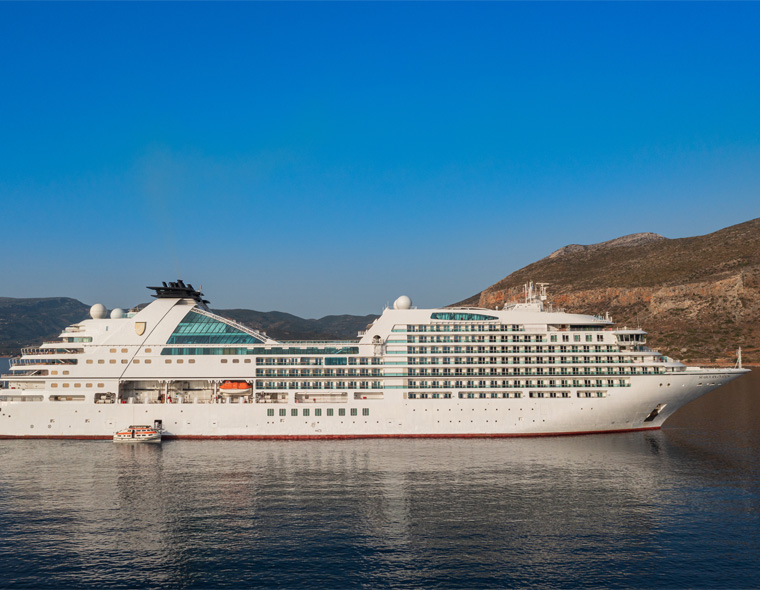
This graceful ship offers 300 veranda suites, additional dining venue Sushi, and The Retreat – an exclusive sanctuary with private cabanas plus a Spa Treatment Cabana. Guests can enjoy the same unmatched standard of heartfelt, intuitive service that is Seabourn’s signature.
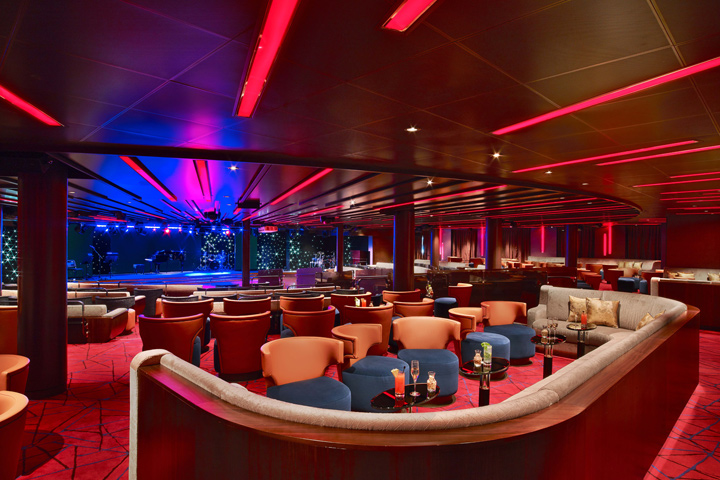
Theater
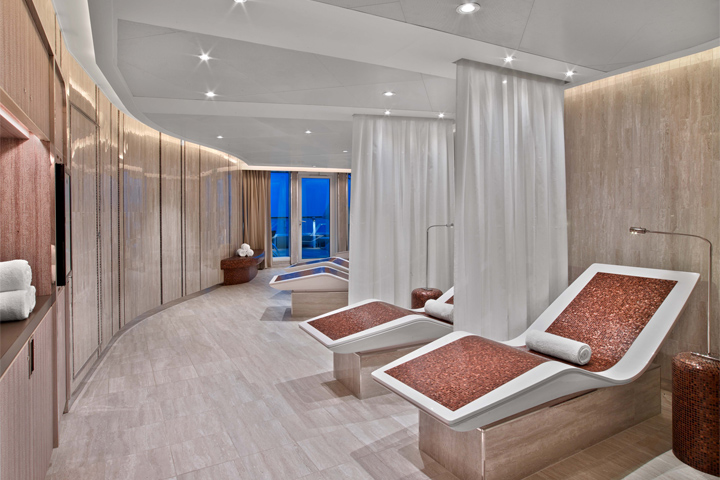
Spa
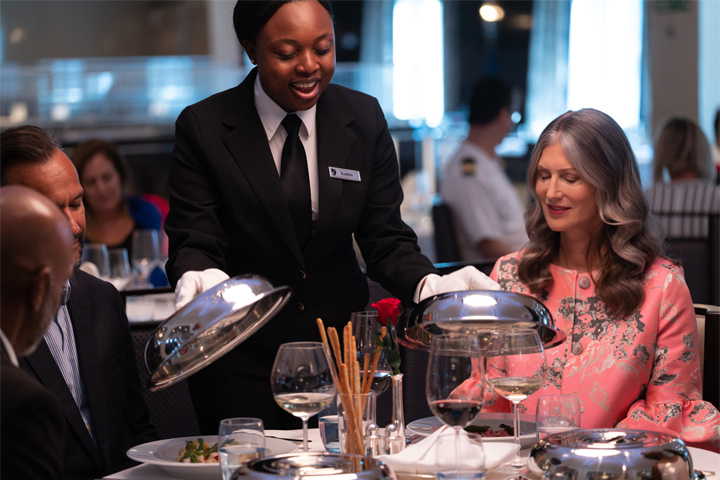
Main Dining
The Restaurant: Come when you like, with whom you please, and be seated as you wish. The room is beautiful, the cuisine is exquisite, and the service is simultaneously flawless, friendly and fun.
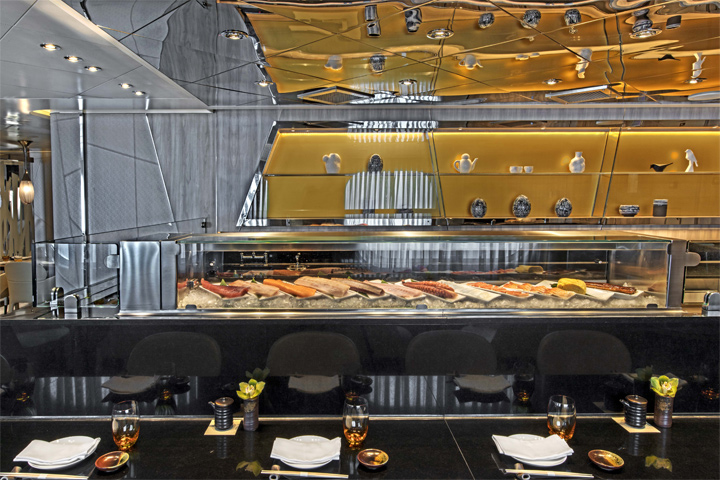
Sushi
Coffee Bar: Enjoy a specialty crafted espresso just the way you like it.
Earth & Ocean: Each evening, the skilled chefs create an imaginative array of fresh, inventive dishes—a sophisticated menu celebrating eclectic traditional flavors from around the world, served in a relaxed setting under the stars for a distinctive dining experience unlike any other on board.
Observation Bar: A stunning round lounge with a square bar and panoramic views. Early Risers’ Coffee and Tea is served here every morning, and piano music makes it a great choice for drinks and conversation before and after dinner.
Seabourn Square: Whether you're looking for a place to enjoy your newspaper in the morning or want to socialize with your fellow passengers, Seabourn Square is what you're looking for. This inviting lounge offers plush seating, cocktail tables, a library, computer terminals, a coffee bar, and Guest Services staff.
Solis: Offering light, modern Mediterranean cuisine bursting with color and character, prepared fresh and entirely from scratch.
The Club: Open for afternoon tea then transforms into a dance club in the evening. Socialize while enjoying cocktails, live music, and great company.
The Colonnade: The more casual, indoor/outdoor alternative features an open kitchen, lavish buffets or table service for breakfasts and lunch, and serves regionally themed, bistro-style dinners with table service nightly.
The Patio: Relaxed poolside dining offering luncheon buffets, salads, soups, grilled specialties and freshly baked pizza. Dinners feature a full menu in an alfresco setting.
Sky Bar: A place to enjoy a refreshing tropical beverage during the day, or an evening cocktail under the stars.
Sushi: Seabourn researched ingredients and developed a menu that is an ideal blend of authenticity to maintain the root of the cuisine and a twist of Seabourn’s culinary expertise. The sushi concept is a modern line that is steeped in tradition and uses some of the finest ingredients. Hamachi, tuna, shrimp and other fresh fish products will be shipped from Japan to Sushi and served à la carte for dinner. The menu features caviar and small plates, along with a selection of maki rolls, sushi and sashimi, and salads.
In-Suite Dining: A varied menu available around the clock for service in your suite. You may also order dinner from The Restaurant menu and have your meal served, course by course, in your suite or on your veranda.
All Veranda Suites feature a full-length window and glass door to private veranda, comfortable living area, queen-size bed or two twin beds, dining table for two, walk-in closet, interactive flat-screen television with music and movies, fully stocked bar and refrigerator, makeup vanity, spacious bathroom with separate tub and shower.

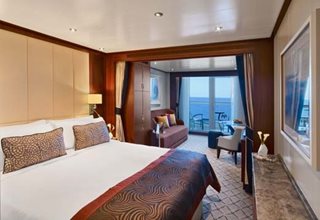
Category: OB
This category can be booked for a special rate, guaranteed to you. Please note that the category is not associated at the time of booking with a specific stateroom, deck, bedding configuration or other particular settings. The assignment of an actual cabin will be performed during your check-in. The cabin can be anywhere on the ship.
Category: SV
This category can be booked for a special rate, guaranteed to you. Please note that the category is not associated at the time of booking with a specific stateroom, deck, bedding configuration or other particular settings. The assignment of an actual cabin will be performed during your check-in. The cabin can be anywhere on the ship.
Category: RB
This category can be booked for a special rate, guaranteed to you. Please note that the category is not associated at the time of booking with a specific stateroom, deck, bedding configuration or other particular settings. The assignment of an actual cabin will be performed during your check-in. The cabin can be anywhere on the ship.
Category: V2
All Veranda Suites feature a full-length window and glass door to private veranda, comfortable living area, queen-size bed or two twin beds, dining table for two, walk-in closet, interactive flat-screen television with music and movies, fully stocked bar and refrigerator, makeup vanity, spacious bathroom with separate tub and shower.
Category: V1
All Veranda Suites feature a full-length window and glass door to private veranda, comfortable living area, queen-size bed or two twin beds, dining table for two, walk-in closet, interactive flat-screen television with music and movies, fully stocked bar and refrigerator, makeup vanity, spacious bathroom with separate tub and shower.
Category: V4
All Veranda Suites feature a full-length window and glass door to private veranda, comfortable living area, queen-size bed or two twin beds, dining table for two, walk-in closet, interactive flat-screen television with music and movies, fully stocked bar and refrigerator, makeup vanity, spacious bathroom with separate tub and shower.
Category: V3
All Veranda Suites feature a full-length window and glass door to private veranda, comfortable living area, queen-size bed or two twin beds, dining table for two, walk-in closet, interactive flat-screen television with music and movies, fully stocked bar and refrigerator, makeup vanity, spacious bathroom with separate tub and shower.
All Penthouse Suites on board feature a comfortable living area, glass door to private veranda, queen-size bed or two twin beds; walk-in closet with personal safe, two flat-screen TV with music and movies, fully stocked bar and refrigerator, writing desk with personalized stationary, makeup vanity, spacious bathroom with separate tub and shower, plush robes, slippers hair dryer and 110/220V AC outlets.
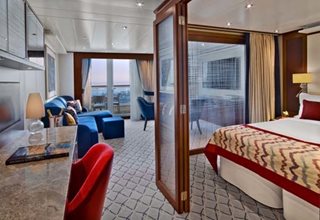
Category: PH
All Penthouse Suites on board feature a comfortable living area, glass door to private veranda, queen-size-bed or two twin beds; walk-in closet with personal safe, two flat-screen TV with music and movies, fully stocked bar and refrigerator, writing desk with personalized stationary, makeup vanity, spacious bathroom with separate tub and shower, plush robes, slippers, hair dryer, and 110/220V AC outlets.
Category: PG
This category can be booked for a special rate, guaranteed to you. Please note that the category is not associated at the time of booking with a specific stateroom, deck, bedding configuration or other particular settings. The assignment of an actual cabin will be performed during your check-in. The cabin can be anywhere on the ship.
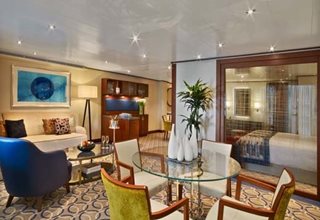
Category: O2
Suites on board feature a comfortable living area, private veranda, queen-size-bed or two twin beds; walk-in closet with personal safe, interactive flat-screen TV with music and movies, fully stocked bar and refrigerator, writing desk with personalized stationary, makeup vanity, spacious bathroom with separate tub and shower, plush robes, slippers, hair dryer, and 110/220V AC outlets.
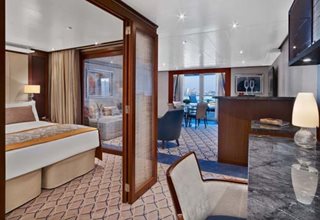
Category: PS
All Penthouse Suites on board feature a comfortable living area, glass door to private veranda, queen-size-bed or two twin beds; walk-in closet with personal safe, two flat-screen TV with music and movies, fully stocked bar and refrigerator, writing desk with personalized stationary, makeup vanity, spacious bathroom with separate tub and shower, plush robes, slippers, hair dryer, and 110/220V AC outlets.
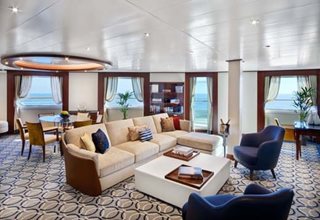
Category: SS
Suites on board feature a comfortable living area, private veranda, queen-size-bed or two twin beds; walk-in closet with personal safe, interactive flat-screen TV with music and movies, fully stocked bar and refrigerator, writing desk with personalized stationary, makeup vanity, spacious bathroom with separate tub and shower, plush robes, slippers, hair dryer, and 110/220V AC outlets.
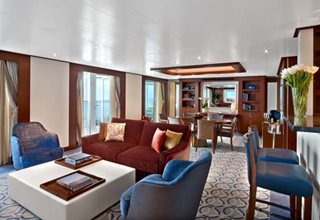
Category: WG
Suites on board feature a comfortable living area, private veranda, queen-size-bed or two twin beds; walk-in closet with personal safe, interactive flat-screen TV with music and movies, fully stocked bar and refrigerator, writing desk with personalized stationary, makeup vanity, spacious bathroom with separate tub and shower, plush robes, slippers, hair dryer, and 110/220V AC outlets.
Category: O1
Suites on board feature a comfortable living area, private veranda, queen-size-bed or two twin beds; walk-in closet with personal safe, interactive flat-screen TV with music and movies, fully stocked bar and refrigerator, writing desk with personalized stationary, makeup vanity, spacious bathroom with separate tub and shower, plush robes, slippers, hair dryer, and 110/220V AC outlets.
Category: GR
Suites on board feature a comfortable living area, private veranda, queen-size-bed or two twin beds; walk-in closet with personal safe, interactive flat-screen TV with music and movies, fully stocked bar and refrigerator, writing desk with personalized stationary, makeup vanity, spacious bathroom with separate tub and shower, plush robes, slippers, hair dryer, and 110/220V AC outlets.

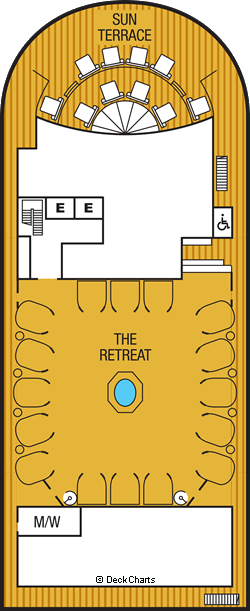
| Symbol | Description |
|---|---|
 | Veranda railings are part metal and part glass; the forward half of the railing is metal and aft half is glass with teak rail |
 | Obstructed port side view with larger veranda overlooking the center pool |
 | Subject to noise when anchoring; has all-metal veranda railings, limiting the view |
 | Shower only |
 | The veranda railings on Deck 5 are part metal and part glass from floor to teak rail; suites on Deck 5 have slightly larger verandas |
 | Third guest capacity suite |
 | Wheelchair accessible suite, roll-in shower only, wheelchair-accessible doorways |
 | Elevator |
*Price shown is per person based on double occupancy, is valid for select stateroom categories only and does include government taxes/fees and gratuities. Click on the Terms & Conditions link below for details.
**Select complimentary shore excursions are for full-fare guests only, capacity controlled and subject to availability. Shore excursion reservations are accepted on a first-come, first-served basis. Please note, available excursions vary by sailing date and day of the week. Government fees and taxes are included. Requested excursions may not be available at time of booking. Supplement will apply on Ventures by Seabourn®, optional shore excursions. Restrictions apply and penalties apply 36 hours prior to shore excursion start date.
†One Digital Costco Shop Card per room/stateroom, per stay. The exact amount of the Digital Costco Shop Card will be calculated during the booking process. The Digital Costco Shop Card promotion is nontransferable and may not be combined with any other promotion. A Digital Costco Shop Card will arrive by email approximately 10 days after the start of your cruise. Click on the Terms & Conditions link below for additional information.
Ship's registry: The Bahamas
Package ID: SBNOVAEUR20270605
Book this cruise with Costco Travel and receive a Digital Costco Shop Card. The Digital Costco Shop Card is a convenient payment option in our warehouses and on Costco.ca.

We are processing your payment.
Do not refresh your browser or exit this page.


|
No Image Available |
 United States
 Australia