

 Help Centre

 United States
 Canada
 Australia
Coupon Override
Please Call
For drivers under the age of 25, additional fees and/or restrictions may apply.
For information and assistance in completing your reservation, please call:
1-855-863-0357Sorry
We're unable to find your location.

Other: Africa's West Coast, Spain & France

All-Inclusive Cruise

All onboard gratuities
Select complimentary shore excursions**
Unlimited beverages, including fine wines and premium spirits served throughout the ship
Complimentary dining venues
Complimentary in-suite bar
Complimentary caviar
Complimentary Wi-Fi packages with unlimited minutes
Welcome bottle of Champagne

Executive Member Benefit
Executive Members receive an annual 2% Reward, up to $1,250, on qualified Costco Travel purchases

Digital Costco Shop Card
Member Exclusive: Digital Costco Shop Card with every Seabourn® sailing†
Sailing Itinerary

Note: Cruise itineraries are subject to change. Please verify ports and times directly with the cruise line.

Overview


The cityscape of Cape Town reflects a history rich in contrasts: governors and slaves, reformers and missionaries, empire builders and ordinary people who became extraordinary role models for a new democratic nation. Beside soaring modern blocks of glass and steel in the city centre, historic buildings - preserved and restored to their former glory - bear testimony to this past. The oldest existing building in South Africa, the Castle was built in 1666 to protect the new settlement at the Cape. Still operational as a military base, today its five imposing stone walls also house a museum with artifacts dating back to the 17th century and troops dressed in historic uniform parade on its cobbled grounds. Nearby, across the Grand Parade, stand the Drill Hall and Cape Town's Italian Renaissance-style City Hall, completed in 1905. The Slave Lodge, the second oldest building in Cape Town, has served many purposes in its nearly three centuries. Originally built as accommodation for the slaves of the Dutch East India Company, it was also Cape Town's first post office, a library and the Supreme Court. Today it is home to the SA Cultural History Museum and its displays of ceramics, toys, silver and textiles from Cape Town's past, as well as artifacts from ancient Egypt, Greece and Rome. The historic Company Gardens, established by Jan van Riebeeck in 1652 as a vegetable garden from which to supply fresh produce to passing ships, today offers city dwellers and office workers a peaceful refuge from the bustle of the city's commercial centre. A cobbled avenue, lined with oak trees, leads to the South African Museum, the South African National Gallery, the Bertram House Museum and the Jewish Museum, which is housed in the oldest synagogue in South Africa. Just beyond, South Africa's Parliament buildings stand in imposing array around the cobbles of Stal Plein ("plein" meaning "square"). Numerous other buildings of historic interest, such as Koopman de Wet House in Strand Street, Heritage Square in Bree Street, and many along the upper reaches of Long Street, are dotted throughout the city centre. Situated on the lower slopes of Signal Hill, the Bo-Kaap (literally "upper Cape") is home to many descendants of the Malay slaves brought to the Cape during the 17th century. Most of the families which inhabit its colourful rows of houses are devout Muslims, and the call to prayer can be heard in the narrow, cobbled streets throughout the day. The Bo-Kaap Museum portrays aspects of Cape Muslim culture. Robben Island is, after Alcatraz, possibly the best known prison island in the world. Having served over the centuries as a penal settlement, leper colony and lunatic asylum, its notoriety has, more recently, centred around the fact that President Nelson Mandela and many of his colleagues were imprisoned here during the apartheid era. Regular trips are made to the island, a world heritage site, by a ferry which departs from the V&A Waterfront. National monuments such as Onze Molen, along with Mostert's Mill in Mowbray one of the few original windmills still extant in the Cape Town area, and numerous old churches in Durbanville and Parow, reflect the origins of some of the early settlers in the Tygerberg area. Set in landscaped gardens, Rust-en-Vrede Cultural Centre in Durbanville - an old Cape Dutch complex dating back to 1850 - originally served as a prison, Drostdy (magistrates court), school and, ultimately, a private residence. Inside, creations by prominent South Africans are on exhibition in the Durbanville Clay Museum. A few kilometres away in Khayelitsha, the Mayibuye Centre Museum reflects the political turbulence and memorabilia of the apartheid era. Somerset West, in the Helderberg region, boasts many buildings and artifacts from South Africa's diverse cultural past. These include Vergelegen, built in 1700 by Governor Willem Adriaan van der Stel, the Nederduitse Gereformeerde Kerk built in 1820 (where "Onze Jan" Hofmeyer and other prominent South Africans are buried), the old bridge over the Lourens River built in 1845, the coachman's cottage and the Ou Pastorie and, at the Macassar Kramat, the last resting place of Sheikh Yusuf, who was brought to South Africa as a slave and introduced Islam, today one of the Cape's major religions - to the area. The historic farms in the Oostenberg countryside, dating back to the 18th century, serve as a reminder of the area's agricultural heritage. Many of these fine examples of early Cape Dutch architecture, such as Zevenwacht, Hazendal and Mooiplaas Wine Estates, are still operating wine farms, producing outstanding vintages for South Africa's thriving wine industry. Other, less imposing though no less important souvenirs of the area's rich history include the historic milestone in Van Riebeeck Road, Kuilsriver (now on display in the entrance hall to the Municipal Building), which once marked the distance on the road from Cape Town to what, in the late 17th century, was a cattle-post near the convergence of the Kuils and Bottleray Rivers Just beyond the row of stately palms that marks the entrance to Milnerton stands an old wooden bridge (1901) that, while no longer in use, still links Woodbridge Island to the mainland. A cast of the original Postal Stone can be seen at the library in Table View, and Ons Huisie Restaurant, a restored fisherman's cottage in Bloubergstrand, typifies the vernacular architectural style of this region. Further up the coast are the historic Moravian Mission Stations of Pella and Mamre with a church dating back to 1808, an old watermill, cook house, long house, shop and school. Built in 1685 for Simon van der Stel, then governor of the Cape, Groot Constantia is the oldest homestead in the Cape. Reflecting the gracious lifestyle of the late 18th century, the manor house incorporates priceless collections of exquisite Cape furniture from the mid-1800s as well as rare Chinese and Japanese porcelains and Delft ceramics. Situated along the False Bay Coast in the South Peninsula, the suburbs of Kalk Bay, St James and Muizenberg were fashionable seaside resorts during the early part of this century. Many of the beautiful residences in St James are, in fact, National Monuments, while Muizenberg is reputed to have been one of Rudyard Kipling's favourite places, and is where Cecil John Rhodes retired after the events leading up to the Anglo-Boer War. Period furniture and some of this extraordinary man's personal possessions may be viewed at Rhodes Cottage. Once a whaling station, Kalk Bay is now a working fishing harbour that reflects its cosmopolitan past in architecture, cuisine, arts and crafts.
Overview

Luderitz is a harbor town in the Karas Region of southern Namibia, lying on one of the least hospitable coasts in Africa. It is a port developed around Robert Harbour and Shark Island.The town is known for its colonial architecture, including some Art Nouveau work, and wildlife including seals, penguins, flamingos, and ostriches. It is also home to a museum and lies at the end of a currently decommissioned railway line to Keetmanshoop.
Overview

Walvis Bay is a city in Namibia and the name of the bay on which it lies. The town covers a total area of 29 square kilometres of land. The bay is a haven for sea vessels because of its natural deepwater harbour, protected by the Pelican Point sand spit, being the only natural harbour of any size along the country's coast. Being rich in plankton and marine life, these waters also drew large numbers of southern right whales, attracting whalers and fishing vessels.
Overview
Walvis Bay is a city in Namibia and the name of the bay on which it lies. The town covers a total area of 29 square kilometres of land. The bay is a haven for sea vessels because of its natural deepwater harbour, protected by the Pelican Point sand spit, being the only natural harbour of any size along the country's coast. Being rich in plankton and marine life, these waters also drew large numbers of southern right whales, attracting whalers and fishing vessels.
Overview

It is Angola's largest city, its chief port, and its administrative center. Manufacturers include processed foods, beverages, textiles, cement and other construction materials, plastic products, metalware, cigarettes, and shoes. Petroleum, found nearby, is refined in the city. Luanda has a natural harbor, with a fine port. The chief exports are coffee, cotton, sugar, diamonds, iron, and salt.
Overview

São Tomé and Príncipe, an African island nation close to the equator, is part of a volcano chain featuring striking rock and coral formations, rainforests, and beaches. On the larger island, São Tom is the Lagoa Azul lagoon. Ôbo Natural Park, a biodiverse jungle preserve, covers much of São Tomé and is distinguished by Pico Cão Grande, a skyscraperlike volcanic rock.
Overview

Cotonou is the most important city in Benin. Porto Novo is the official capital, but in economic activity, Cotonou takes the first place. Although the city itself doesn't boast too many sights it is a lively place and an ideal spot for planning trips to the region. From Cotonou, it is 20 minutes to Porto Novo with its museums and royal palace. The slave port of Ouidah with many historical sites and museums is 40 Kilometers west of Cotonou. To Abomey, the ancient capital of Dahomey it is 100 km. North. All main roads are paved and in good condition. Ganvie, "the Venice of Africa" a village built on stakes in the lake is a few kilometers north of Cotonou. The Boulevard St. Michel is the center of town and like its counterpart in Paris, it's a very busy street with lots of activities. At the end of the boulevard, you find the Dan Topeka market, and this is a good place to find transport to the other attractions.
Overview

Tema is a city on the Bight of Benin and the Atlantic coast of Ghana. It is located 25 kilometers east of the capital city; Accra, in the region of Greater Accra, and is the capital of the Tema Metropolitan District.
Overview

Takoradi and Sekondi together form one of the liveliest cities in Ghana. While Sekondi dates back to the 17th century, Takoradi was just a fishing village when it was chosen to become Ghana's first deep-water seaport. Since then it has boomed. It is a young and vibrant city. The heart of the city is a ssquarecalled Market Circle Bus stations, cheap hotels, and restaurants are all to be found in this area. Liberation Road, which leads southeast from here takes visitors to the port area via the Artisan Centre - a good place for souvenirs. In the port area, they will find the post office, the train station as well as banks and department stores. There is a good beach just 2 km south of thecentere, with a golf course and a sports club nearby.Some of the good hotels in Takoradi are: Africa Beach Hotel, Takoradi Beach Hotel, Valley Beach Hotel, etc. The "good" area to stay and have fun is Beach Road. It has a lot of joints where tourists will be able to have both fun and food.
Overview

Dakar is the capital of Senegal, in West Africa. It’s an Atlantic port on the Cap-Vert peninsula. Its traditional Medina quarter is home to the Grande Mosquee, marked by a towering minaret. The Musee Theodore Monod displays cultural artifacts including clothing, drums, carvings, and tools. The city’s vibrant nightlife is inspired by the local mbalax music.
Overview

Mindelo is considered by many capoverdean the real capital of the archipelago. The great names of Cape Verdian music, including Cesaria Evaron, come from the island of Sao Vicente. This charming harbour town is the most lively and cosmopolitan centre of Cabo Verde. It was not populated till the XIX century when the harbour was built by the y English in 1838 as a strategical point to keep here cool deposit for their ships. The town faces a long bay and the buildings stretch to the slopes of Mount Cara. There are still some buildings in the old English style, like the ferry ticket office and the siege of the Portuguese Consulate. From the fortress, tourists will have a wonderful panorama of the town. The beach of Sao Pedro is long and spectacular and, in the opinion of professionals, is one of the finest places in the world for speed windsurfing.Bust the most famous beach is "Baia das Gatas": white sand leading to deep blue water.There are a lot of events taking place on this island every year and visitors cannot forget the famous international music festival, very renowned in Africa and South America which takes place every August. Artists coming from various Countries create a magic atmosphere playing marvellous music from a stage facing the ocean, accompanied by dancers and a warm audience of tourists and locals. Visit the open market, near the harbour, famous for its daily fresh fish or the colourful "Mercado Municipal". But the real “Movida” of this town is during the night. In Mindelo the night is magic, with thousands of lights, people meeting in the main square "plaza" and then going from one bar to another, dancing, singing and drinking caipirinha and grog. Music creates an eternal atmosphere.
Overview

Las Palmas de Gran Canaria with its 400,000 inhabitants is a vibrant modern city which also has a contrasting historical centre with lovely old buildings and a well-developed tourist infrastructure to accommodate the most demanding visitor.Las Palmas de Gran Canaria has always been animportant junction and commercial center on the routes between Europe, Africa, and America. This international vocation has made it the ideal spot for holding meetings both at national and internationallevelsl.With good communications by air and sea and20 kilometers away from the city, its airport haa s dailylinks to the main cities in Europe and America.The city's endowment of cultural and leisure activitiesand the possibility of attending exhibitions, lectures,theatre and concerts all year round, providing afurther incentive to choose this city, giving whateverevent may be organized here even greater guarantee of success.It is worth noting that according to the North AmericanTravel Association journal, the capital of Gran Canariahas the best climate in the world, with an annualthe average temperature of 23ºC making possible the bathin its beaches at any time of the year.
Overview

Arrecife was once just a port - that of Teguise. There were two main fortresses, San Gabriel and San José with a third - Castillo de San Gabriel - located on a small island in front of Arrecife. The third fort was connected to the main one by a drawbridge. It was from these forts that the islanders tried (unsuccessfully in the end) to defend themselves against pirate attacks. A fourth castle, that of Castillo de San Juan, is home to the city's Museum of Contemporary Art. One of the museum's main attractions is the work of Cesar Manrique. Today, Arrecife is the island's capital. Of the 90,000 residents of Lanzarote, half reside in Arrecife. There's a wide promenade along the beachfront with palm trees and benches for enjoying the view. The wide, main street through the city is Léon y Castillo and most of the remaining streets of the city are narrow and form part of the one-way system. The Gran Hotel in Arrecife is the only high-rise building on the island. Since its construction, laws have been passed preventing any further high rises, and the hotel itself closed down and is currently unused. Leon y Castillo is the main shopping street and as you walk along away from the seafront, head to the right as you come to the end of this street and enjoy the view over El Charco. Here's a strange tip for you; if you're down by the fishing docks when the fisherman return (bearing in mind they can often be out for up to three weeks at a time) and have a plastic bag with you, the generous fisherman are known for giving away samples of their sardine catch. Barbecued sardines are a local favorite.
Overview

Casablanca, located in the central-western part of Morocco bordering the Atlantic Ocean, is the largest city in Morocco. It is also the largest city in the Maghreb, as well as one of the largest and most important cities in Africa, both economically and demographically. The leading Moroccan companies and international corporations doing business in the country have their headquarters and main industrial facilities in Casablanca. Recent industrial statistics show Casablanca retains its historical position as the main industrial zone of the country. The Port of Casablanca is one of the largest artificial ports in the world, and the second largest port in North Africa, after Tanger-Med 40 km east of Tangier. Casablanca also hosts the primary naval base for the Royal Moroccan Navy.
Overview

At the crossroads of Africa and Europe, the Mediterranean Sea, and the Atlantic Ocean, Tangier has an individual character. It is one of the oldest cities in Morocco. The Phoenicians and Carthaginians established trading posts here. The Romans made it a capital city. It was occupied by the Arabs and invaded by Vandals and Visigoths. Before the Spanish, the Portuguese controlled the town. In the early part of the 20th century, Tangier was an international city whose tax-free status and cosmopolitan image attracted European and American artists and writers. Although it has lost a little of its glamorous image, it is still a bustling city with an air of mystery surrounding it. For most visitors that arrive in Morocco by sea, it is their first point of contact with the country. The town beach has a great setting: it makes up a several-kilometer-long curve with the white houses of Tangier as a frame before it ends in the barren mountains of which there is nothing further north than sea and the European continent. One of the main centers of afternoon and early evening activities in Tangier is along the beach walk. Activities here are rather common, people walk up and down this avenue-sized street, looking at people and allowing others to look at them. There are several Atlantic beaches west of Tangier, which all offer a good alternative to the town beach. The setting of these beaches can be most attractive, with mountains on all sides, yet with a wide and clean beach with all necessary amenities. The medina of Tangier is a real one: Streets are narrow, houses in many different styles, and most of this medina is in good condition. That is proof that even people with some money both live and work here. The medina is quite big, and there are many commercial areas. Most of these serve the tourist traffic, and it is more difficult to find any areas where real handcraft is performed.
Overview

The city of Cadiz, which practically accounts for the whole of the municipal area, lies to the east of the bay of the same name, in an area that could be described as a half island, half peninsula, connected to the mainland by a slender, sandy strip. Its situation is responsible for its obvious maritime tendencies, and it has been dedicated to seafaring pursuits since its foundation. The Phoenicians, Greeks, Romans, and Arabs all passed through what is believed to be the world’s oldest city, and it was here that Spain’s first democratic Constitution was drawn up. Despite its essentially urban nature, it also boasts areas of natural interest, such as the beaches of La Cortadura and El Chato, as well as Santibanez Mud Flats, which are part of Cadiz Bay Natural Park. The city, popularly known as “La Tacita de Plata” (The Silver Cup), has an unmistakable marine flavor, and its people are famous for their good humor and hospitality, as witnessed by the famous carnival; it boasts monuments of great interest, such as the Cathedral, the city walls, Holy Cross Parish Church, the Genoese Park, Puerta de la Caleta, etc. All places of indubitable charm, to which we must add the city’s cuisine and beaches, famous for their beauty, such as La Caleta, Santa Maria del Mar, and La Victoria. History This legendary city was founded by the Phoenicians in 1100, although the oldest archaeological remains date back to around 800 B.C. Mythology links its foundation with Hercules and the legendary Tartessia. The Phoenicians called the city Gadir, meaning “closed area”. They built a commercial factory and a temple in honor of the god Melkart. In 206 B.C. it was joined with Rome as an allied city under the name Gades. This was the start of one of the most prosperous periods in Cadiz’s history, and it became one of the most important cities in the Roman Empire. In the Imperial age, it was known as “Augusta Urbs Julia Gaditana”. Its inhabitants were soon granted Roman citizenship. When the Moslem invasions began in the 8th century, it provided the armies with significant support by facilitating their passage, though it soon suffered a decline in importance which would prevail until the Christian conquest and re-settlement at the hands of Alfonso X, known as The Wise, between 1260 and 1262. During the 15th century, the city’s economic activity was based essentially on sea commerce, particularly in North Africa. In 1493, the Catholic Monarchs made Cadiz Crown property; it had belonged to the Ponce de Leon estate since 1470. With the discovery of America, Cadiz’s rise to greatness began, culminating in the 18th century. Its natural conditions meant that whenever ships couldn't berth in Seville, they could do so in Cadiz. In 1717, Seville’s Contracting House was moved to Cadiz, the monopoly of American trade traveling with it; however, this situation was short-lived, as the concession to trade with the New World was extended to twelve ports in 1778. The town center was consolidated in the 18th and 19th centuries when urban renovation was carried out and most of the monuments and buildings that we know today were built. La Isla del Leon, now San Fernando, was the setting for the earliest meetings of the famous Cadiz Cortes, general constituent assemblies set up to provide Spain with a Constitution during the War of Independence. Fleeing from the French, the Government took refuge near Cadiz, the only stronghold that the French were unable to capture during the whole of the war. Between 1810 and 1811, Government assemblies took place in La Isla de Leon Theatre; in February 1811, the proximity of Napoleon’s troops forced them to move to San Felipe de Neri Church in Cadiz, returning once more to La Isla de Leon before finally making their definitive journey back to Madrid in 1813. After the war, the city continued at the vanguard of liberalism, with its support for Riego in 1820 and its leading role in the face of the French invasion in 1823. In a similar vein, Cadiz was at the forefront of the 1868 uprising. At the end of the 19th century, the city’s economic decline began. A series of events including the loss of the colonial market, culminating in the 1898 Disaster, and the African War, among others, ushered in a crisis that was to have grave consequences.
Overview

Lisbon is Portugal’s hilly, coastal capital city. From the imposing São Jorge Castle, the view encompasses the old city’s pastel-colored buildings, Tagus Estuary, and Ponte 25 de Abril suspension bridge. Nearby, the National Azulejo Museum displays 5 centuries of decorative ceramic tiles. Just outside Lisbon is a string of Atlantic beaches, from Cascais to Estoril.
Overview

The port of Leixões (41º 11' N, 8º 42' W) serves the city of Porto and northern Portugal. It is an artificial harbor on the Atlantic Ocean, within the town of Matosinhos, 5.5 miles (9 km) northwest of central Porto. Porto is prevented by a sandbar from having a deepwater harbor of its own. The port is the largest in the north of Portugal and is one of the most important seaports in the country. About 25% of Portuguese trade and 14 million tons of cargo pass through the port every year. The port has high productivity levels and can handle 25 containers per hour, with 3,100 vessels calling each year.
Overview

Situated beside the Atlantic Ocean, A Coruna is a historic city whose history has maintained close links with its old fishing and commercial port. The peninsula on which the Old City stands also contains the Tower of Hercules, one of the symbols of the city, which is an interesting Romanesque collection of streets, squares, and medieval churches. The Aquarium Finisterrae, the Domu, and the Science Museum are some of the places that show the more modern, recreational side of the provincial capital, which offers one of its most beautiful facets on the wide beaches of Riazor and Orzán. All this is completed with recognition throughout the country, marked by the excellence of its seafood and meats coming from the inland parts of the province. The Aquarium Finisterrae, the Domus, and the Science Museum are some of the places that show the more modern, recreational side of the provincial capital, which offers one of its most beautiful facets on the wide beaches of Riazor and Orzán. All this is completed with cuisine recognized throughout the country, marked by the excellence of its seafood and meats coming from the inland parts of the province. The harbor has always been the scene of some of the most important historical events in the city, like the defeat of the English privateer Francis Drake in 1589 thanks to the resistance of the people of Coruña, led by the heroine María Pita. The city's most important civil buildings also deserve a visit. The City Hall is situated in the Plaza de María Pita, the nerve center of the city. It is an elegant, monumental building built at the beginning of the 20th century, characterized by its porches and galleries and by three towers finished with attractive cupolas. Another sight not to be missed in the center of A Coruna is the San Carlos Garden, declared a Historic-Artistic site. The walls of the fortress of San Carlos, which dates from 1843, house this unusual space in which the Archive of the Kingdom of Galicia is based and whose center is presided over by the tomb of Sir John Moore, a British general who died in 1809 during the battle of Elvina. Surrounding the Old City is the coastal area, where A Coruña mixes the traditional and the modern. Beside the port in the Avenida de la Marina, are the typical houses with white glazed galleries (19thC), architectural elements making up one of the best-known features of A Coruna and which earned it the name of 'Glass City'. The Castle of San Anton, at one end of the harbor area, was built at the end of the 16th century with a defensive character and later altered in the 18th. It currently houses the Provincial Archaeological Museum, which takes an interesting journey through Galician prehistory using various pieces of metalwork, objects, and tools corresponding to the hill fort culture. On the long Coruna promenade, there are other outstanding cultural opportunities. The Aquarium Finisterrae, situated near the Tower of Hercules, houses one of the largest aquariums in Spain and includes rooms with interactive exhibitions related to the sea. Human beings are the central theme of Domus or the House of Man, located in a futuristic building designed by the architect Arata Isozaki. Inside, various interactive rooms showman from a multidisciplinary point of view. The promenade finally leads to the wide Riazor and Orzan, beaches, the main areas for the people of A Coruna to relax. The tour of the museums can be completed by visiting the Science Museum, situated in Santa Margarita Park, one of the provincial capital's most important green areas. Its outstanding feature is the Planetarium, while its permanent exhibition approaches scientific, technological, and natural principles interactively. The cuisine of La Coruna brings together the best of the coast and the interior. From the coast comes excellent seafood: small crabs, barnacles, spider crabs, Norway lobster, etc. Succulent recipes based on fish are also cooked, such as angler fish stew, Galician-style hake (with onion, garlic, and carrot), or griddled soles. Pasties serve as a transition to the interior as they can be made either with fish and shellfish or with meat. As for meat, pork can be used to make the famous pork shoulder with parsnip tops, while Galician beef is protected with a Denomination of Origin. Any of the magnificent Galician wines that have a Denomination of Origin (Monterrei, Ribeira Sacra, Ribeiro, Rías Baixa,s, and Valdeorras) can be used to accompany these dishes. And, for dessert, there is the famous Santiago cake (with almonds, su,, a,r, and our). Around the provincial capital you can visit interesting places like Betanzos, declared a Historic-Artistic Site, Santiago de Compostela, capital of Galicia and World Heritage City, or Ferrol.
Overview

Saint-Malo is a port city in Brittany, in France's northwest. Tall granite walls surround the old town, which was once a stronghold for privateers (pirates approved by the king). The Saint-Malo Cathedral, in the center of the old town, is built in Romanesque and Gothic styles and features stained-glass windows depicting city history. Nearby is La Demeure de Corsaire, an 18th-century privateer’s house and museum.
Overview

Located, in Normandy, at the extremity of the Cotentin Peninsula, Cherbourg is at the heart of a magnificent region graced with a temperate climate that permits diverse rare plants to thrive. To the east, we find the pleasant Val de Saire; to the west, the savage and impressive Hague. The features of these two areas oppose and simultaneously complement one another. Filmmakers have been seduced by the quality of the light found there, these regions have served as locations for many films.
Overview

Rouen is a must for anyone who loves the arts, fine foods, and long strolls through cobblestone streets. From the most classical to the most innovative, the city offers a wide array of cultural activities. Rouen's museums, theatres, art galleries,s and other attractions are amongst the richest and most dynamic in France outside of Paris. Its richly endowed museums include the Musee des Beaux-Arts (or Fine Arts Museum), where visitors can appreciate one of the finest art collections in France, with world-class masterpieces by Velasquez, Gericault, Monet, and others. The Theatre of the Arts/Normandy Opera House presents a vast program of lyrical music, as well as other forms from classical to rock and roll. Each year, more than 400 concerts are music to the ears of Rouen.Cultural activities and other festivities make their way onto the streets of Rouen during several popular events attended by thousands and even hundreds of thousands of people. Theatre, painting, dance, music, cinema, and architecture: the muses still grace the birthplace of Corneille and Flaubert.
Overview
Rouen is a must for anyone who loves the arts, fine foods, and long strolls through cobblestone streets. From the most classical to the most innovative, the city offers a wide array of cultural activities. Rouen's museums, theatres, art galleries,s and other attractions are amongst the richest and most dynamic in France outside of Paris. Its richly endowed museums include the Musee des Beaux-Arts (or Fine Arts Museum), where visitors can appreciate one of the finest art collections in France, with world-class masterpieces by Velasquez, Gericault, Monet, and others. The Theatre of the Arts/Normandy Opera House presents a vast program of lyrical music, as well as other forms from classical to rock and roll. Each year, more than 400 concerts are music to the ears of Rouen.Cultural activities and other festivities make their way onto the streets of Rouen during several popular events attended by thousands and even hundreds of thousands of people. Theatre, painting, dance, music, cinema, and architecture: the muses still grace the birthplace of Corneille and Flaubert.
Overview

The Seine is a major river of northern France, forming the country's chief commercial waterway. It is also a tourist attraction, particularly within the city of Paris. The river is 780 km (485 miles) long, France's second longest (after the Loire which is 1020 km (634 miles) long). In ancient times the Seine was known by the Latin name Sequana. The Seine's main tributaries are the Aube, Marne, and Oise rivers from the north and the Yonne and Eure rivers from the south. It is connected with canals to the Scheldt (also called the Escaut), Meuse, Rhine, Saone and Loire rivers. The Seine rises in the French région of Burgundy, in the department of Cote-d'Or, 30 km (18 miles) northwest of Dijon at a height of 471meterss (1545 feet). The river then flows through Troyes to Paris. In Paris, narrowed between high stone embankments, the river carries commercial barges, waterbuses, and large tourist boats (bateaux-mouches). From the water, fine views are seen of the Cathedral of Notre Dame, the Louvre, the Musee d'Orsay (housing Paris' collection of Impressionist art), the Conciergeri,e and the Eiffel Tower. The northern side of the river is described as the Right Bank (Rive Droite) and the southern side as the Left Bank (Rive Gauche). The Banks of the Seine in Paris were added te UNESCO's list of World Heritage Sites in 1991. The river then meanders in large loops through Normandy and Rouen, entering the English Channel (La Manche) in an estuary between Le Havre and Honfleur. The Seine is dredged and oceangoing vessels can dock at Rouen, 120 km (75 miles) from the sea. Commercial riverboats can use the river from Bar-sur-Seine, 560 km (350 miles) from its mouth. At Paris, the river is only 24 meters (80 feet) above sea level, 445 km (277 miles) from its mouth, making it slow-flowing and thus easily navigable. The water of the Seine is an important resource. Electric power stations, thermal and nuclear, pull their cooling water from the river. Half the water used in the Paris region, both for industry and for consumption, and three-quarters of the water used in the area between Rouen and Le Havre, is taken from the river.
Overview

Southampton is a port city on England’s south coast. It’s home to the Sea City Museum, with an interactive model of the Titanic, which departed from Southampton in 1912. Nearby, Southampton City Art Gallery specializes in modern British art. Solent Sky Museum features vintage aircraft like the iconic Spitfire. Tudor House & Garden displays artifacts covering over 800 years of history, including a penny-farthing bike.
Onboard the Seabourn Quest
Seabourn Quest
Costco Member Reviews

Year Built: 2010
Double Occupancy Capacity: 458
Seabourn Quest, an oceangoing ship with a passenger capacity of just 458 guests, offers spacious accommodations spanning categories ranging in size from 295 to 1,182 square feet of indoor space. Verandas add an additional 65 to 558 square feet of outdoor living area spacious enough for private al fresco dining. All suites feature a comfortable living area, walk-in closet, fully stocked bar and refrigerator filled with seaside favorites. Expansive ocean views are framed by either a picture window or the glass doors of the veranda.
Onboard Activities
Activities & Services (included in cruise)
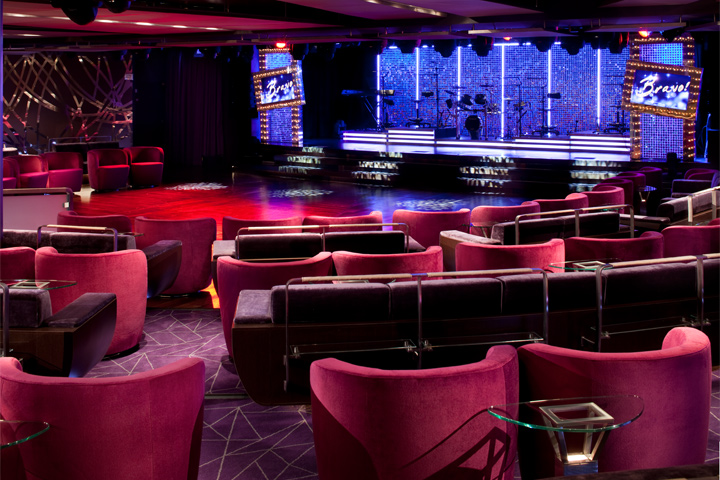
Show/Lounge
- Art Gallery
- Bars/Lounges
- Business Center
- Card Room
- Casino
- Concierge Desk
- Conference Center
- Disco/Nightclub
- Duty-Free Shops/Boutiques
- Educational Programs
- Elevators
- Fitness Center
- Fitness Classes
- Guest Lecturers
- Infirmary/Medical Center
- Internet Center
- Library
- Miniature Golf
- Movies
- Movies Under the Stars®
- Pool - Indoor/Covered
- Pool - Outdoor
- Religious Services
- Safe Deposit Boxes
- Sauna/Steam Room
- Self-Service Laundromat
- Theaters/Show Lounge
- Water Sports Platform
- Wedding/Vow Renewal
- Whirlpool/Jacuzzi
Activities & Services (available for an extra fee)
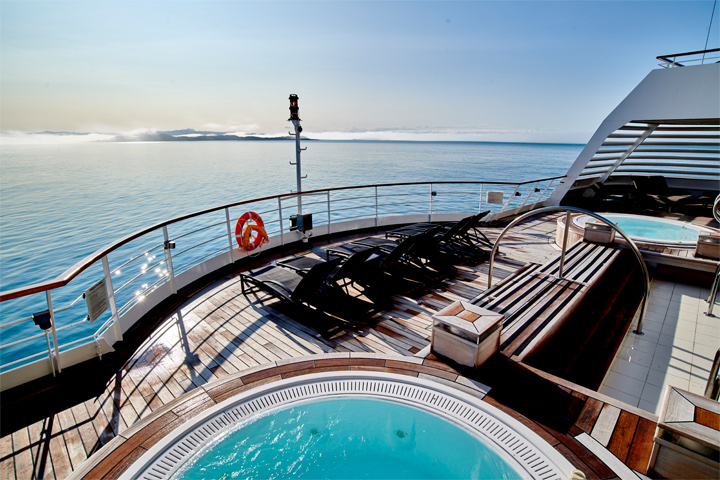
Spa
- Beauty Salon
- Dry Cleaning/Laundry Service
- Full-Service Spa
- Rock-Climbing Wall
- Scuba Diving PADI
- Spa Services/Massage
- Sports Facilities
- Surfing
- Water Park
- Water Slide
Dining
Main Dining
The Restaurant: Come when you like, with whom you please, and be seated as you wish. The room is beautiful, the cuisine is exquisite, and the service is simultaneously flawless, friendly and fun.
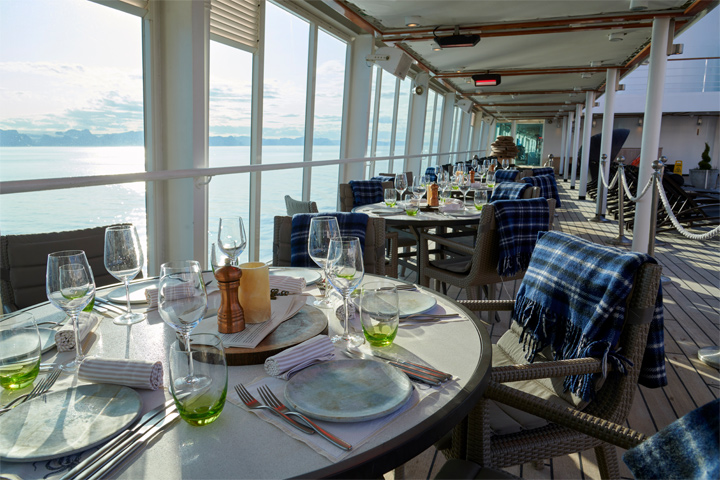
The Colonnade
Casual Dining
Coffee Bar: Enjoy a specialty crafted espresso just the way you like it.
Earth & Ocean: Each evening, the skilled chefs create an imaginative array of fresh, inventive dishes—a sophisticated menu celebrating eclectic traditional flavors from around the world, served in a relaxed setting under the stars for a distinctive dining experience unlike any other on board.
Observation Bar: A stunning round lounge with a square bar and panoramic views. Early Risers’ Coffee and Tea is served here every morning, and piano music makes it a great choice for drinks and conversation before and after dinner.
Seabourn Square: Whether you're looking for a place to enjoy your newspaper in the morning or want to socialize with your fellow passengers, Seabourn Square is what you're looking for. This inviting lounge offers plush seating, cocktail tables, a library, computer terminals, a coffee bar, and Guest Services staff.
Solis: Offering light, modern Mediterranean cuisine bursting with color and character, prepared fresh and entirely from scratch.
The Club: Open for afternoon tea then transforms into a dance club in the evening. Socialize while enjoying cocktails, live music, and great company. Serving a variety of light sushi bites freshly made to order each evening.
The Colonnade: The more casual, indoor/outdoor alternative features an open kitchen, lavish buffets or table service for breakfasts and lunch, and serves regionally themed, bistro-style dinners with table service nightly.
The Patio: Relaxed poolside dining offering luncheon buffets, salads, soups, grilled specialties and freshly baked pizza. Dinners feature a full menu in an alfresco setting.
Sky Bar: A place to enjoy a refreshing tropical beverage during the day, or an evening cocktail under the stars.
In-Suite Dining: A varied menu available around the clock for service in your suite. You may also order dinner from The Restaurant menu and have your meal served, course by course, in your suite or on your veranda.
Staterooms
All Ocean View Suites feature a large picture window, comfortable living area, queen-size bed or two twin beds, dining table for two, walk-in closet, interactive flat-screen television with music and movies, fully stocked bar and refrigerator, makeup vanity, spacious bathroom with separate tub and shower. Approximately 295 sq. ft. (28 sq.m.) of inside space.
- Ocean View Suite with Large Picture Window (Category: A)

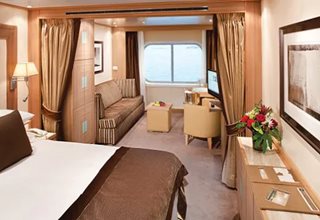
Category: A
All Ocean View Suites feature a large picture window, comfortable living area, queen-size bed or two twin beds, dining table for two, walk-in closet, interactive flat-screen television with music and movies, fully stocked bar and refrigerator, makeup vanity, spacious bathroom with separate tub and shower.
Approximately 295 sq. ft. (28 sq.m.) of inside space.
- Ocean View Suite with Large Picture Window (Category: A1)
Category: A1
All Ocean View Suites feature a large picture window, comfortable living area, queen-size bed or two twin beds, dining table for two, walk-in closet, interactive flat-screen television with music and movies, fully stocked bar and refrigerator, makeup vanity, spacious bathroom with separate tub and shower.
Approximately 295 sq. ft. (28 sq.m.) of inside space.
- Guarantee - Suite (Category: OS)
Category: OS
This category can be booked for a special rate, guaranteed to you. Please note that the category is not associated at the time of booking with a specific stateroom, deck, bedding configuration or other particular settings. The assignment of an actual cabin will be performed during your check-in. The cabin can be anywhere on the ship.
All Veranda Suites feature a full-length window and glass door to private veranda, comfortable living area, queen-size bed or two twin beds, dining table for two, walk-in closet, interactive flat-screen television with music and movies, fully stocked bar and refrigerator, makeup vanity, spacious bathroom with separate tub and shower.
- Veranda Suite (Category: V1)
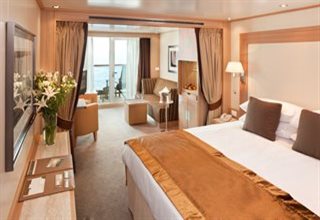
Category: V1
All Veranda Suites feature a full-length window and glass door to private veranda, comfortable living area, queen-size bed or two twin beds, dining table for two, walk-in closet, interactive flat-screen television with music and movies, fully stocked bar and refrigerator, makeup vanity, spacious bathroom with separate tub and shower.
- Veranda Suite (Category: V2)
Category: V2
All Veranda Suites feature a full-length window and glass door to private veranda, comfortable living area, queen-size bed or two twin beds, dining table for two, walk-in closet, interactive flat-screen television with music and movies, fully stocked bar and refrigerator, makeup vanity, spacious bathroom with separate tub and shower.
- Veranda Suite (Category: V3)
Category: V3
All Veranda Suites feature a full-length window and glass door to private veranda, comfortable living area, queen-size bed or two twin beds, dining table for two, walk-in closet, interactive flat-screen television with music and movies, fully stocked bar and refrigerator, makeup vanity, spacious bathroom with separate tub and shower.
- Veranda Suite (Category: V4)
Category: V4
All Veranda Suites feature a full-length window and glass door to private veranda, comfortable living area, queen-size bed or two twin beds, dining table for two, walk-in closet, interactive flat-screen television with music and movies, fully stocked bar and refrigerator, makeup vanity, spacious bathroom with separate tub and shower.
- Guarantee - Suite (Category: SV)
Category: SV
This category can be booked for a special rate, guaranteed to you. Please note that the category is not associated at the time of booking with a specific stateroom, deck, bedding configuration or other particular settings. The assignment of an actual cabin will be performed during your check-in. The cabin can be anywhere on the ship.
All Penthouse Suites on board feature a comfortable living area, glass door to private veranda, queen-size bed or two twin beds; walk-in closet with personal safe, two flat-screen TV with music and movies, fully stocked bar and refrigerator, writing desk with personalized stationary, makeup vanity, spacious bathroom with separate tub and shower, plush robes, slippers hair dryer and 110/220V AC outlets.
- Penthouse Guarantee (Category: PG)
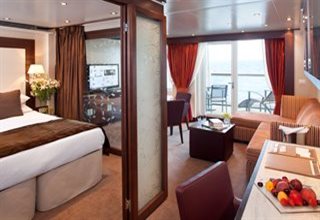
Category: PG
This category can be booked for a special rate, guaranteed to you. Please note that the category is not associated at the time of booking with a specific stateroom, deck, bedding configuration or other particular settings. The assignment of an actual cabin will be performed during your check-in. The cabin can be anywhere on the ship.
- Penthouse Suite (Category: PH)
Category: PH
All Penthouse Suites on board feature a comfortable living area, glass door to private veranda, queen-size-bed or two twin beds; walk-in closet with personal safe, two flat-screen TV with music and movies, fully stocked bar and refrigerator, writing desk with personalized stationary, makeup vanity, spacious bathroom with separate tub and shower, plush robes, slippers, hair dryer, and 110/220V AC outlets.
- Grand Suite (Category: GR)
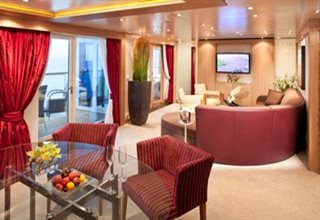
Category: GR
Suites on board feature a comfortable living area, private veranda, queen-size-bed or two twin beds; walk-in closet with personal safe, interactive flat-screen TV with music and movies, fully stocked bar and refrigerator, writing desk with personalized stationary, makeup vanity, spacious bathroom with separate tub and shower, plush robes, slippers, hair dryer, and 110/220V AC outlets.
- Signature Suite (Category: SS)
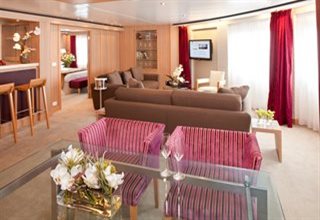
Category: SS
Suites on board feature a comfortable living area, private veranda, queen-size-bed or two twin beds; walk-in closet with personal safe, interactive flat-screen TV with music and movies, fully stocked bar and refrigerator, writing desk with personalized stationary, makeup vanity, spacious bathroom with separate tub and shower, plush robes, slippers, hair dryer, and 110/220V AC outlets.
- Wintergarden Suite (Category: WG)
Category: WG
Suites on board feature a comfortable living area, private veranda, queen-size-bed or two twin beds; walk-in closet with personal safe, interactive flat-screen TV with music and movies, fully stocked bar and refrigerator, writing desk with personalized stationary, makeup vanity, spacious bathroom with separate tub and shower, plush robes, slippers, hair dryer, and 110/220V AC outlets.
- Owner's Suite (Category: O1)
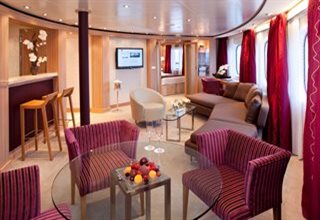
Category: O1
Suites on board feature a comfortable living area, private veranda, queen-size-bed or two twin beds; walk-in closet with personal safe, interactive flat-screen TV with music and movies, fully stocked bar and refrigerator, writing desk with personalized stationary, makeup vanity, spacious bathroom with separate tub and shower, plush robes, slippers, hair dryer, and 110/220V AC outlets.
- Owner's Suite (Category: O2)
Category: O2
Suites on board feature a comfortable living area, private veranda, queen-size-bed or two twin beds; walk-in closet with personal safe, interactive flat-screen TV with music and movies, fully stocked bar and refrigerator, writing desk with personalized stationary, makeup vanity, spacious bathroom with separate tub and shower, plush robes, slippers, hair dryer, and 110/220V AC outlets.
- Penthouse Spa Suite (Category: PS)
Category: PS
All Penthouse Suites on board feature a comfortable living area, glass door to private veranda, queen-size-bed or two twin beds; walk-in closet with personal safe, two flat-screen TV with music and movies, fully stocked bar and refrigerator, writing desk with personalized stationary, makeup vanity, spacious bathroom with separate tub and shower, plush robes, slippers, hair dryer, and 110/220V AC outlets.
Deck Plan

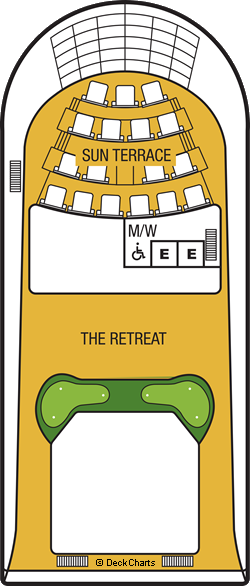
| Symbol | Description |
|---|---|
 | Wheelchair-accessible suite; roll-in shower only; wheelchair-accessible doorways; Suite 635 also has a tub |
 | Veranda railings are part metal and part glass from floor to teak rail |
 | Subject to noise when anchoring; has all-metal veranda railings, limiting the view |
 | Smaller veranda |
 | Third guest capacity suite |
 | Elevator |
 | Self service launderette |
 | Suite can be reached only via a staircase |
 | Partially obstructed veranda view |
Ship Facts
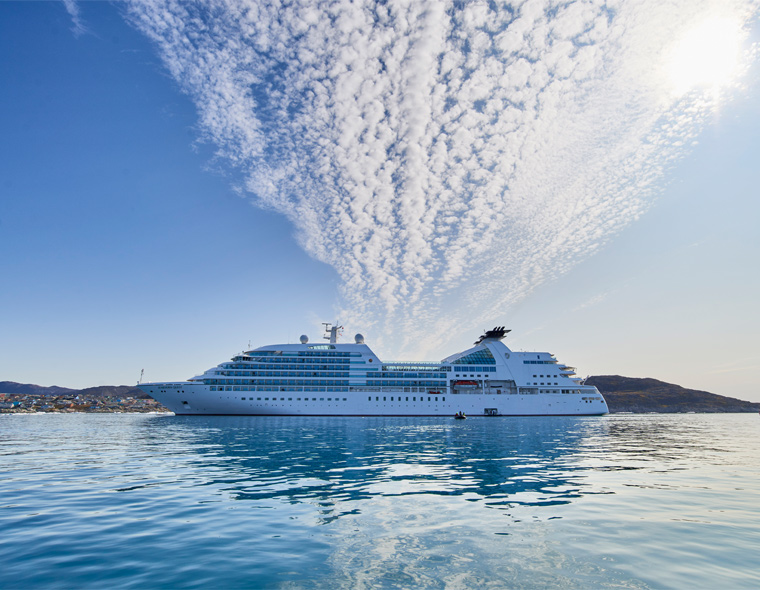
- Ship Name: Seabourn Quest
- Ship Name: Seabourn Quest
- Year Built: 2010
- Year Entered Present Fleet: 2011
- Ship Class: O
- Maximum Capacity: 458
- Number of Passenger Decks: 9
- Number of Crew: 295
- Officers' Nationality: International
- Tonnage (GRT): 32,000
- Capacity Based on Double Occupancy: 458
- Country of Registry: The Bahamas
- Total Staterooms: 229
- Crew/Hotel Staff Nationality: International
Costco Member Reviews
Available Dates and Prices
Terms & Conditions
*Price shown is per person based on double occupancy, is valid for select stateroom categories only and does include government taxes/fees and gratuities. Click on the Terms & Conditions link below for details.
**Select complimentary shore excursions and or Expedition experiences are for full-fare guests only, capacity controlled and subject to availability. Shore excursion and Expedition experiences reservations are accepted on a first-come, first-served basis. Please note, available excursions vary by sailing date and day of the week. Government fees and taxes are included. Requested excursions may not be available at time of booking. Supplement will apply on Ventures by Seabourn®, optional shore excursions. Restrictions apply and penalties apply 36 hours prior to shore excursion start date. All passengers must be at least 6 years of age at the time of embarkation to sail on Expedition cruises. The Captain and Expedition Leader will determine if a passenger aged 6 or older may participate in any excursion, considering weather, sea conditions, and the difficulty of disembarking at each location visited. For all other cruises with more than two consecutive sea days, the minimum passenger age is 12 months at the time of embarkation to sail.
†One Digital Costco Shop Card per room/stateroom, per stay. The exact amount of the Digital Costco Shop Card will be calculated during the booking process. The Digital Costco Shop Card promotion is nontransferable and may not be combined with any other promotion. A Digital Costco Shop Card will arrive by email approximately 10 days after the start of your cruise. Click on the Terms & Conditions link below for additional information.
Ship's registry: The Bahamas
Package ID: SBNQUEEUR20280329
Digital Costco Shop Card
Book this cruise with Costco Travel and receive a Digital Costco Shop Card. The Digital Costco Shop Card is a convenient payment option in our warehouses and on Costco.ca.



 You have unsaved preference changes.