

 Help Centre

 United States
 Canada
 Australia
Coupon Override
Please Call
For drivers under the age of 25, additional fees and/or restrictions may apply.
For information and assistance in completing your reservation, please call:
1-855-863-0357Sorry
We're unable to find your location.

South America: Chilean Fjords, Antarctica & South Atlantic Explorer Voyage

All-Inclusive Cruise

All onboard gratuities
Unlimited beverages, including fine wines and premium spirits served throughout the ship
Complimentary dining venues
Complimentary in-suite bar
Complimentary caviar
Complimentary Wi-Fi packages with unlimited minutes
Welcome bottle of Champagne

Executive Member Benefit
Executive Members receive an annual 2% Reward, up to $1,250, on qualified Costco Travel purchases

Digital Costco Shop Card
Member Exclusive: Digital Costco Shop Card with every Seabourn® sailing†
Sailing Itinerary

Note: Cruise itineraries are subject to change. Please verify ports and times directly with the cruise line.

Overview


The second-largest city in Chile, Valparaíso enjoys a spectacular location between the mountains and the sea. This coastal city boasts a romantic, time-worn elegance of cobbled streets and Victorian houses. The Chilean Congress recently moved to Valparaíso from Santiago, giving the city a fresh boost of energy. Just ten minutes north of Valparaíso lies Vina del Mar, Chile's premier coastal resort. You'll find fabulous beaches and a bustling commercial sector. Viña del Mar is known as the Ciudad Jardín (Garden City) thanks to its lavish gardens and subtropical atmosphere. The weather is often cool and foggy. The nightlife is better in Vina del Mar than in Valparaíso, so plan to head there to check out the cinemas and dance clubs.Near these twin cities are loads of beaches and stunning coastlines. Be sure to check out the fabulous seafood. The Reserva Nacional Lago Penuelas near Valparaiso is a popular spot for weekend outings. The Parque Nacional la Campana is a great place for communing with the outdoors as well.
Overview

This is the capital city of the Lakes Region X, the last city in its longitudinal valley. Puerto Montt was founded in 1853 by Vicente Perez Rosales as part of the policy of settling the area promoted by the government of the time. A year before, the first German immigrants to the country had arrived in the area, and the city, along with Valdivia and Osorno, retains much of their influence. The bay of Puerto Montt extends over the northern part of the Seno de Reloncavi, with a view of the distant Corcovado and Michinmahuida volcanoes. The central business and service section of the city lies around Manuel Irrazabal Square, with a nice view of the sea, and the Cathedral located north of the square. From the square westwards is the John Paul II Museum, which commemorates the visit of His Holiness the Pope in 1987, as well as housing articles from the culture of the indigenous peoples and the German settlers. Further on rise the harbor works and the Handicrafts Fair, where a variety of characteristic articles produced by local artists can be seen and purchased. At the end of the street is the Caleta Angelmo, famous for its fair and traditional restaurants, especially those where every sort of fish and seafood, in particular the local "curanto," can be sampled. Along the same coast road eastwards of the city is Pelluco Beach, with its beautiful residences, very good restaurants, discotheques, and pubs.
Overview

Castro is a city on Chiloé Island in Chile's Lake District. Colorful wooden stilt houses line the waterfront. On Plaza de Armas, the yellow, early-20th-century San Francisco Church has 2 steeples and a distinctive wooden interior. Nearby, woven baskets are sold at the craft fair. The Museum of Modern Art Chiloé displays works by Chilean artists. To the west, Chiloé National Park is home to sea lions.
Overview

The Gulf of Corcovado (Spanish: Golfo de Corcovado) is a large body of water separating Chiloé Island from the mainland of Chile. Geologically it is a foreland basin that has been carved out by Quaternary glaciers. A large population of blue whales is found there, and it is under threat from salmon farming.
Overview

Situated along the wild-west fjordland coast of Chile, 250 miles south of Puerto Montt, it is here that the northern Patagonian ice sheets fall into the sea in neon blue splendor. One of the last frontiers, there are few such remote, unspoiled, and underdeveloped places left on earth. To simply admire the pristine beauty of its untouched natural resources is the main reason for calling on this port. Puerto Chacabuco is a small isolated settlement with no clearly defined town center. The town itself consists of one main road, a fish processing facility, and a pier. A frontier-like village, about 10 miles north of the port, Puerto Aysen, is the area's main town.
Overview
Wide Channel is an inside passage of the Chilean Patagonia. It is 38 miles long, extending northward from the junction of Concepción Channel and Trinidad Channel to Saumarez Island.
Overview

Lying on Chile's beautiful stretch of southern coastline, Seno Eyre Fjord is a deep valley, terraced by walls of rich jungle greenery.
Overview

Discover the Pio XI Glacier, the largest glacier in the southern hemisphere, a real giant 6 kilometers wide and towers above, standing some 75 meters tall, with a length of 64 kilometers.
Overview
Peel Fjord is a fjord in Chile. It branches off from the Sarmiento Channel and is located at. The east side of the fjord has three side fjords, named Amalia, Asia and Calvo.
Overview

Glaciar El Brujo is an impressive and magnificent glacier located at the end of Fiordo Asia. Glaciar El Brujo is an enormous ice wall that fascinates the traveler. For this tour, we will lower our excursion boats and approach the site, to disembark on an incomplete magmatic rock, which volcanologists call “garbo”. On going ashore we walk on the rock, which is rather slippery when it rains, but is like walking on sandpaper in good weather so that our shoes manage to get a good grip.
Overview

Sarmiento Channel is a principal Patagonia channel, which extends in a north-south direction. It begins with the Guia Narrows (Angostura Guia) and is located in Magallanes y Antártica Chilena Region. The kawesqar people sailed its waters from around 6,000 years ago until end of 20th century, as they inhabited its coasts. The channel is named after Pedro Sarmiento de Gamboa, who was a Spanish explorer who navigated the region's waterways between 1579 and 1580.
Overview

Magellan, Strait of, c.330 mi (530 km) long and 2 1/2 to 15 mi (4–24 km) wide, separating South America from Tierra del Fuego and other islands south of the continent. Except for a few miles at its eastern end in Argentina, it passes through Chile. The strait, discovered by Ferdinand Magellan in 1520, was important in the days of sailing ships, especially before the building of the Panama Canal, and is still used by ships rounding South America. One of the most scenic waterways in the world, it affords an inland passage protected from almost continuous ocean storms. However, the strait is often foggy. The only city on the strait is Punta Arenas on Tierra del Fuego.
Overview

This is Patagonia's largest and most commercially important city. Located on the western side of the Strait of Magellan with a superb port and the only large airport in the area, it is the major hub for boat transport through the strait and research vessels on their way to or from Antarctica. For the visitor, Punta Arenas is better known as the gateway to Torres del Paine National Park, 400 kilometers to the northwest. This unique town grew up on wool and international shipping before the Panama Canal opened. In the late 19th century, huge fortunes made by sheep farming left the city with distinguished mansions, some of them now museums and other monuments. Summer cruise ships from Punta Arenas travel to Antarctica, where Chile claims a sector of the icebound continent. You can also begin a scenic ferry cruise through the Chilean fjords from Puerto Natales, sailing north to Puerto Montt, in the southern mainland lake region.
Overview

Garibaldi Glacier is undoubtedly one of the visual highlights of Patagonia. The setting is magical and surreal with sheer cliffs of up to 600 meters and streaming waterfalls and glacial ice. The bay is laced with thousands of chunks of floating ice that have dislodged from the glacier. One can stop to observe at close range a thriving colony of sea lions enjoying life in their frozen kingdom.
Overview

Ushuaia is the southernmost city in the world, on the shores of the Beagle Channel and surrounded by the Martial Mounts. It is the capital of the Tierra del Fuego, Antarctica, and Southern Atlantic Islands Province, and its superlative location allows you to enjoy the sea, mountains, and forests at the same time. Besides, it is a great place for shopping: the whole island is a tax-free zone, thus you can find lots of imported goods along with regional products.
Overview

Antarctica is the fifth largest continent and is asymmetrically centered on the South Pole and almost entirely within the Antarctic Circle. Antarctica consists of two major regions: W Antarctica (c.2,500,000 sq mi/6,475,000 sq km), a mountainous archipelago that includes the Antarctic Peninsula, and E Antarctica (c.3,000,000 sq mi/7,770,000 sq km), geologically a continental shield. They are joined into a single continental mass by an ice sheet thousands of feet thick. At the seaward margins of the ice sheet masses of ice break off and float away as icebergs, leaving ice cliffs. Where the outward creep of the ice is channeled into ice streams (zones of more rapid flow), great floating ice tongues project into the sea; where mountains retard outward movement, the flow is channeled into great valley glaciers. Less than 5% of Antarctica is free of ice; these areas include mountain peaks, arid dry valleys, small coastal areas, and islands. There is no native human population in Antarctica, nor are there any large land animals. Few species are adapted to the antarctic environment, but individuals of these few species are numberless.
Overview

Since 1833 the people of the Falkland Islands have been sure of their British identity, but whether you regard them as a detached part of the British Isles in the South Atlantic, or as a part of South America, that suffers from European delusions, you can be assured of encountering ‘a world of difference’ here. From the minute you arrive, the Falklands offers you total personal security, clean air, friendly people, no crowds, no neon, no fast food, and no stress. All this in surroundings where the vastness of the sky is only matched by the distance of the horizon and the eye is constantly captivated by the ever-changing play of light on water and white grass. This is a land where nature is sovereign and mankind is in the minority. Comfortable tourist lodges in remote locations and holiday cottages on island farms give, to a privileged few each year, incomparable opportunities to see at close quarters some of the millions of seabirds and mammals that breed in the Falklands: black-browed albatross, giant petrels, five kinds of penguin, elephant seals, sea lions, striated caracara, crested caracara, night heron ......... the list goes on. And then there’s the fly-fishing for sea trout up to a record of over 20 lbs. Direct flights from South America by LanChile, the Chilean national airline, together with the long-running direct RAF service from Brize Norton in Oxfordshire, England make this "world of difference" more accessible than ever before.
Overview

Stanley is a picturesque town of about 1700 people. Brightly colored wriggly-tin roofs contrast strikingly with the grays and browns of the surrounding hills. The town is named after Lord Stanley, Secretary of State for the Colonies 1841 - 1844. He ordered the main settlement to be removed from Port Louis to the Port Jackson area and Governor Richard Clement Moody completed the move and took up official residence in Stanley on the 15th July 1844. Your first point of call should be the newly completed Jetty Center - situated just off the Public Jetty, this is where you'll get all the information you'll need on what to do, how to get about, and where to stay. For anyone interested in history, a visit to Stanley will be a rich and rewarding experience. A maritime history trail around the harbor leads you to famous wrecks. Old stone cottages mingle with wriggly-tin houses - there are the amazing Jubilee Villas - a piece of British Victorian suburbia in the South Atlantic and the Chelsea Pensioners houses in Pioneer row (brought here in the late1840ss). There are also more recent reminders of the conflict in 1982 - Stanley may be small but it is filled with interest. Your visit would not be complete without a visit to the museum in Holdfast Road (so called because it was here on the 14th June 1982 that Maj. Gen. Sir Jeremy Moore ordered his troops to 'hold fast' until he had negotiated the Argentine surrender. The museum is packed with a huge variety of exhibits ranging from an 1896 Symphonium to whalebones. The stated objective of the museum is to present a taste of the many aspects of the Falklands' rich and varied history including Domestic, Maritime, Social, Military, and Natural History - it is not to be missed!
Overview

Home to almost 50% of the nation's population, Montevideo is a modern metropolis with a historical old town dating back to colonial times. Surrounding the whole city lies an uninterrupted stretch of white sandy beach. Highlights include Ciudad Vieja (Old Town) with its 18th-century buildings, the vibrant Mercado del Puerto, and the bustling commercial activity of Avenida 18 de Julio and its cultural offerings (theatres, museums, and art galleries)
Overview

This fabulous city is renowned for its sophistication, although travelers expecting a more 'South American' experience are sometimes disappointed with its European feel. Argentina is one Latin American country where Europeans and North Americans can feel at ease and travel relatively inconspicuously. An interest in soccer and some nimble foot skills may be all you need to feel like a local.
Overview

Inaccessible Island is an extinct volcano with Cairn Peak reaching 449 m. The island is 14 km² in area, rising out of the South Atlantic Ocean 45 km south-west of Tristan da Cunha.
Overview

Tristan and its uninhabited neighbors - Inaccessible, Nightingale, Stoltenhoff, and Middle Islands - are tips of a gigantic underwater volcano that erupted to break the surface of the Atlantic one million years ago. Situated on the island's only low-lying flat plateau, lies Edinburgh, the island's only settlement: home to 7 families, numbering some 300 people. Jammed between the constant stormy sea and the steeply sloping side of the 2000 m high (6,760 feet) volcano, it's no surprise that there is neither an airport nor a harbor. Indeed the only way to get to the island is when in calmer seas, Tristan's fishing boats approach one of the few container or ice-breaking ships that pass during the year, bringing much-needed food and medical supplies.
Overview

Nightingale Island is an island in the South Atlantic Ocean, 3 km² in area, part of the Tristan da Cunha group of islands. They are administered by the United Kingdom as part of the overseas territory of Saint Helena, Ascension, and Tristan da Cunha. Nightingale Island is part of the Nightingale Islands, which also include the islets of Middle Island and Stoltenhoff Island. All three are uninhabited but are regularly visited for scientific purposes and research.
Overview

Richards Bay is a town in KwaZulu-Natal, South Africa. It is situated on a 30 square kilometer lagoon of the Mhlatuze River, which gives it one of the country's largest harbors.
Overview

Maputo is situated on a large natural bay on the Indian Ocean, near where the rivers Tembe, Mbuluzi, Matola, and Infulene converge. The city consists of seven administrative divisions, which are each subdivided into quarters or bairros. The city is surrounded by Maputo Province but has been administered as a self-contained, separate province since 1998. Maputo City is the geographically smallest and most densely populated province in Mozambique.M aputo is a cosmopolitan city, with Bantu, Portuguese, and to a lesser extent, Arabic, Indian, and Chinese, languages and cultures present.
Overview

Durban is the perfect convention destination. Since being sighted by Vasco da Gama in 1497, its natural harbor has given birth to a vibrant, go-ahead, and ever-changing city. Apart from having the busiest harbor in Africa, Durban is served by its international airport only 15 minutes from its Central Business District. The attractive Yacht basin near the hub continues to provide anchorage and a haven for sailors from around the globe. Durban is an ideal base from which to explore the beauty and splendors of Southern Africa. Within two hours you could be on a safari at one of the country's renowned game reserves - home to some of the world's rarest and most exotic species - or you could be in the fairest Cape. Ninety minutes by road and you could be hiking or trout fishing in the magnificent Drakensberg mountains. Other options - a day or two away could put you amid a miraculous flower transformation in the Namaqualand Desert, or at the origins of man in the Sterkfontein Caves. You could be etched into memory the glorious sunsets and campfires of the Kruger National Park, or the majesty of the Victoria Falls. There are many faces to Durban - a city of great beauty and cultural diversity where you can witness the Dance of the Virgins, a Zulu war dance, and attend a performance of the ballet or Opera all on the same day. The only constant is the famous South African weather - and Durban can serve up the best of it, with an average of 320 sunny days a year. A surfer's paradise and international holiday mecca. Mile upon mile of unspoiled, sun-soaked beaches, bronzed lifeguards, and bikini beauties. Seagulls, pelicans, and exotic birds. Colorful rickshas, beautiful parks, sidewalk cafes, and restaurants. Here architecture encapsulates the diverse histories and cultures of the people. Graceful Victorian buildings, exotic temples, and dignified mosques all stand side by side. Accommodation is plentiful in the Sunshine City, with over 7200 ranging from luxury, tourist, and budget hotels, to all well-appointed serviced apartments, many of which are on the beachfront overlooking the Indian Ocean. Centrally situated and within walking distance of all this, is the International Convention Centre - Durban.
Overview

Port Elizabeth is a city on Algoa Bay in South Africa's Eastern Cape Province. A major port, it's also known for its numerous beaches. The Donkin Heritage Trail takes in the Old Hill neighborhood's Victorian landmarks. Coastal boat tours spot whales and rare seabirds, while wildlife reserves outside the metropolitan area are home to elephants, rhinos, and other big game.
Overview

Mossel Bay is a harbor town of about 60,000 people on the Southern Cape of South Africa. It is an important tourism and farming region of the Western Cape Province.
Overview

The cityscape of Cape Town reflects a history rich in contrasts: governors and slaves, reformers and missionaries, empire builders and ordinary people who became extraordinary role models for a new democratic nation. Beside soaring modern blocks of glass and steel in the city centre, historic buildings - preserved and restored to their former glory - bear testimony to this past. The oldest existing building in South Africa, the Castle was built in 1666 to protect the new settlement at the Cape. Still operational as a military base, today its five imposing stone walls also house a museum with artifacts dating back to the 17th century and troops dressed in historic uniform parade on its cobbled grounds. Nearby, across the Grand Parade, stand the Drill Hall and Cape Town's Italian Renaissance-style City Hall, completed in 1905. The Slave Lodge, the second oldest building in Cape Town, has served many purposes in its nearly three centuries. Originally built as accommodation for the slaves of the Dutch East India Company, it was also Cape Town's first post office, a library and the Supreme Court. Today it is home to the SA Cultural History Museum and its displays of ceramics, toys, silver and textiles from Cape Town's past, as well as artifacts from ancient Egypt, Greece and Rome. The historic Company Gardens, established by Jan van Riebeeck in 1652 as a vegetable garden from which to supply fresh produce to passing ships, today offers city dwellers and office workers a peaceful refuge from the bustle of the city's commercial centre. A cobbled avenue, lined with oak trees, leads to the South African Museum, the South African National Gallery, the Bertram House Museum and the Jewish Museum, which is housed in the oldest synagogue in South Africa. Just beyond, South Africa's Parliament buildings stand in imposing array around the cobbles of Stal Plein ("plein" meaning "square"). Numerous other buildings of historic interest, such as Koopman de Wet House in Strand Street, Heritage Square in Bree Street, and many along the upper reaches of Long Street, are dotted throughout the city centre. Situated on the lower slopes of Signal Hill, the Bo-Kaap (literally "upper Cape") is home to many descendants of the Malay slaves brought to the Cape during the 17th century. Most of the families which inhabit its colourful rows of houses are devout Muslims, and the call to prayer can be heard in the narrow, cobbled streets throughout the day. The Bo-Kaap Museum portrays aspects of Cape Muslim culture. Robben Island is, after Alcatraz, possibly the best known prison island in the world. Having served over the centuries as a penal settlement, leper colony and lunatic asylum, its notoriety has, more recently, centred around the fact that President Nelson Mandela and many of his colleagues were imprisoned here during the apartheid era. Regular trips are made to the island, a world heritage site, by a ferry which departs from the V&A Waterfront. National monuments such as Onze Molen, along with Mostert's Mill in Mowbray one of the few original windmills still extant in the Cape Town area, and numerous old churches in Durbanville and Parow, reflect the origins of some of the early settlers in the Tygerberg area. Set in landscaped gardens, Rust-en-Vrede Cultural Centre in Durbanville - an old Cape Dutch complex dating back to 1850 - originally served as a prison, Drostdy (magistrates court), school and, ultimately, a private residence. Inside, creations by prominent South Africans are on exhibition in the Durbanville Clay Museum. A few kilometres away in Khayelitsha, the Mayibuye Centre Museum reflects the political turbulence and memorabilia of the apartheid era. Somerset West, in the Helderberg region, boasts many buildings and artifacts from South Africa's diverse cultural past. These include Vergelegen, built in 1700 by Governor Willem Adriaan van der Stel, the Nederduitse Gereformeerde Kerk built in 1820 (where "Onze Jan" Hofmeyer and other prominent South Africans are buried), the old bridge over the Lourens River built in 1845, the coachman's cottage and the Ou Pastorie and, at the Macassar Kramat, the last resting place of Sheikh Yusuf, who was brought to South Africa as a slave and introduced Islam, today one of the Cape's major religions - to the area. The historic farms in the Oostenberg countryside, dating back to the 18th century, serve as a reminder of the area's agricultural heritage. Many of these fine examples of early Cape Dutch architecture, such as Zevenwacht, Hazendal and Mooiplaas Wine Estates, are still operating wine farms, producing outstanding vintages for South Africa's thriving wine industry. Other, less imposing though no less important souvenirs of the area's rich history include the historic milestone in Van Riebeeck Road, Kuilsriver (now on display in the entrance hall to the Municipal Building), which once marked the distance on the road from Cape Town to what, in the late 17th century, was a cattle-post near the convergence of the Kuils and Bottleray Rivers Just beyond the row of stately palms that marks the entrance to Milnerton stands an old wooden bridge (1901) that, while no longer in use, still links Woodbridge Island to the mainland. A cast of the original Postal Stone can be seen at the library in Table View, and Ons Huisie Restaurant, a restored fisherman's cottage in Bloubergstrand, typifies the vernacular architectural style of this region. Further up the coast are the historic Moravian Mission Stations of Pella and Mamre with a church dating back to 1808, an old watermill, cook house, long house, shop and school. Built in 1685 for Simon van der Stel, then governor of the Cape, Groot Constantia is the oldest homestead in the Cape. Reflecting the gracious lifestyle of the late 18th century, the manor house incorporates priceless collections of exquisite Cape furniture from the mid-1800s as well as rare Chinese and Japanese porcelains and Delft ceramics. Situated along the False Bay Coast in the South Peninsula, the suburbs of Kalk Bay, St James and Muizenberg were fashionable seaside resorts during the early part of this century. Many of the beautiful residences in St James are, in fact, National Monuments, while Muizenberg is reputed to have been one of Rudyard Kipling's favourite places, and is where Cecil John Rhodes retired after the events leading up to the Anglo-Boer War. Period furniture and some of this extraordinary man's personal possessions may be viewed at Rhodes Cottage. Once a whaling station, Kalk Bay is now a working fishing harbour that reflects its cosmopolitan past in architecture, cuisine, arts and crafts.
Overview
The cityscape of Cape Town reflects a history rich in contrasts: governors and slaves, reformers and missionaries, empire builders and ordinary people who became extraordinary role models for a new democratic nation. Beside soaring modern blocks of glass and steel in the city centre, historic buildings - preserved and restored to their former glory - bear testimony to this past. The oldest existing building in South Africa, the Castle was built in 1666 to protect the new settlement at the Cape. Still operational as a military base, today its five imposing stone walls also house a museum with artifacts dating back to the 17th century and troops dressed in historic uniform parade on its cobbled grounds. Nearby, across the Grand Parade, stand the Drill Hall and Cape Town's Italian Renaissance-style City Hall, completed in 1905. The Slave Lodge, the second oldest building in Cape Town, has served many purposes in its nearly three centuries. Originally built as accommodation for the slaves of the Dutch East India Company, it was also Cape Town's first post office, a library and the Supreme Court. Today it is home to the SA Cultural History Museum and its displays of ceramics, toys, silver and textiles from Cape Town's past, as well as artifacts from ancient Egypt, Greece and Rome. The historic Company Gardens, established by Jan van Riebeeck in 1652 as a vegetable garden from which to supply fresh produce to passing ships, today offers city dwellers and office workers a peaceful refuge from the bustle of the city's commercial centre. A cobbled avenue, lined with oak trees, leads to the South African Museum, the South African National Gallery, the Bertram House Museum and the Jewish Museum, which is housed in the oldest synagogue in South Africa. Just beyond, South Africa's Parliament buildings stand in imposing array around the cobbles of Stal Plein ("plein" meaning "square"). Numerous other buildings of historic interest, such as Koopman de Wet House in Strand Street, Heritage Square in Bree Street, and many along the upper reaches of Long Street, are dotted throughout the city centre. Situated on the lower slopes of Signal Hill, the Bo-Kaap (literally "upper Cape") is home to many descendants of the Malay slaves brought to the Cape during the 17th century. Most of the families which inhabit its colourful rows of houses are devout Muslims, and the call to prayer can be heard in the narrow, cobbled streets throughout the day. The Bo-Kaap Museum portrays aspects of Cape Muslim culture. Robben Island is, after Alcatraz, possibly the best known prison island in the world. Having served over the centuries as a penal settlement, leper colony and lunatic asylum, its notoriety has, more recently, centred around the fact that President Nelson Mandela and many of his colleagues were imprisoned here during the apartheid era. Regular trips are made to the island, a world heritage site, by a ferry which departs from the V&A Waterfront. National monuments such as Onze Molen, along with Mostert's Mill in Mowbray one of the few original windmills still extant in the Cape Town area, and numerous old churches in Durbanville and Parow, reflect the origins of some of the early settlers in the Tygerberg area. Set in landscaped gardens, Rust-en-Vrede Cultural Centre in Durbanville - an old Cape Dutch complex dating back to 1850 - originally served as a prison, Drostdy (magistrates court), school and, ultimately, a private residence. Inside, creations by prominent South Africans are on exhibition in the Durbanville Clay Museum. A few kilometres away in Khayelitsha, the Mayibuye Centre Museum reflects the political turbulence and memorabilia of the apartheid era. Somerset West, in the Helderberg region, boasts many buildings and artifacts from South Africa's diverse cultural past. These include Vergelegen, built in 1700 by Governor Willem Adriaan van der Stel, the Nederduitse Gereformeerde Kerk built in 1820 (where "Onze Jan" Hofmeyer and other prominent South Africans are buried), the old bridge over the Lourens River built in 1845, the coachman's cottage and the Ou Pastorie and, at the Macassar Kramat, the last resting place of Sheikh Yusuf, who was brought to South Africa as a slave and introduced Islam, today one of the Cape's major religions - to the area. The historic farms in the Oostenberg countryside, dating back to the 18th century, serve as a reminder of the area's agricultural heritage. Many of these fine examples of early Cape Dutch architecture, such as Zevenwacht, Hazendal and Mooiplaas Wine Estates, are still operating wine farms, producing outstanding vintages for South Africa's thriving wine industry. Other, less imposing though no less important souvenirs of the area's rich history include the historic milestone in Van Riebeeck Road, Kuilsriver (now on display in the entrance hall to the Municipal Building), which once marked the distance on the road from Cape Town to what, in the late 17th century, was a cattle-post near the convergence of the Kuils and Bottleray Rivers Just beyond the row of stately palms that marks the entrance to Milnerton stands an old wooden bridge (1901) that, while no longer in use, still links Woodbridge Island to the mainland. A cast of the original Postal Stone can be seen at the library in Table View, and Ons Huisie Restaurant, a restored fisherman's cottage in Bloubergstrand, typifies the vernacular architectural style of this region. Further up the coast are the historic Moravian Mission Stations of Pella and Mamre with a church dating back to 1808, an old watermill, cook house, long house, shop and school. Built in 1685 for Simon van der Stel, then governor of the Cape, Groot Constantia is the oldest homestead in the Cape. Reflecting the gracious lifestyle of the late 18th century, the manor house incorporates priceless collections of exquisite Cape furniture from the mid-1800s as well as rare Chinese and Japanese porcelains and Delft ceramics. Situated along the False Bay Coast in the South Peninsula, the suburbs of Kalk Bay, St James and Muizenberg were fashionable seaside resorts during the early part of this century. Many of the beautiful residences in St James are, in fact, National Monuments, while Muizenberg is reputed to have been one of Rudyard Kipling's favourite places, and is where Cecil John Rhodes retired after the events leading up to the Anglo-Boer War. Period furniture and some of this extraordinary man's personal possessions may be viewed at Rhodes Cottage. Once a whaling station, Kalk Bay is now a working fishing harbour that reflects its cosmopolitan past in architecture, cuisine, arts and crafts.
Onboard the Seabourn Quest
Seabourn Quest
Costco Member Reviews

Year Built: 2010
Double Occupancy Capacity: 458
Seabourn Quest, an oceangoing ship with a passenger capacity of just 458 guests, offers spacious accommodations spanning categories ranging in size from 295 to 1,182 square feet of indoor space. Verandas add an additional 65 to 558 square feet of outdoor living area spacious enough for private al fresco dining. All suites feature a comfortable living area, walk-in closet, fully stocked bar and refrigerator filled with seaside favorites. Expansive ocean views are framed by either a picture window or the glass doors of the veranda.
Onboard Activities
Activities & Services (included in cruise)
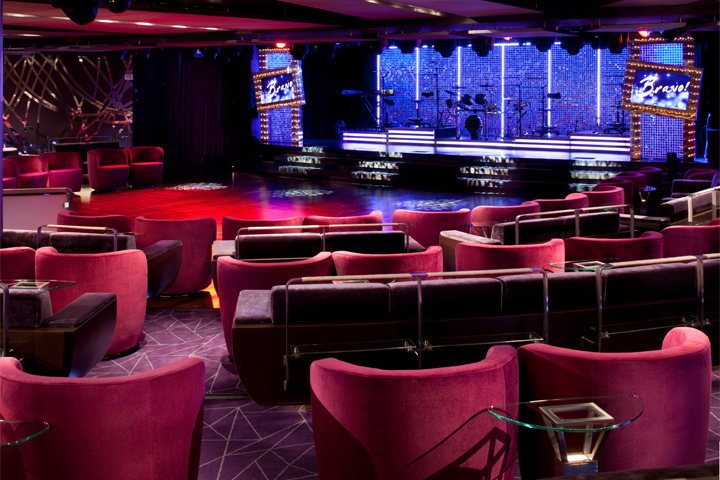
Show/Lounge
- Art Gallery
- Bars/Lounges
- Business Center
- Card Room
- Casino
- Concierge Desk
- Conference Center
- Disco/Nightclub
- Duty-Free Shops/Boutiques
- Educational Programs
- Elevators
- Fitness Center
- Fitness Classes
- Guest Lecturers
- Infirmary/Medical Center
- Internet Center
- Library
- Miniature Golf
- Movies
- Movies Under the Stars®
- Pool - Indoor/Covered
- Pool - Outdoor
- Religious Services
- Safe Deposit Boxes
- Sauna/Steam Room
- Self-Service Laundromat
- Theaters/Show Lounge
- Water Sports Platform
- Wedding/Vow Renewal
- Whirlpool/Jacuzzi
Activities & Services (available for an extra fee)
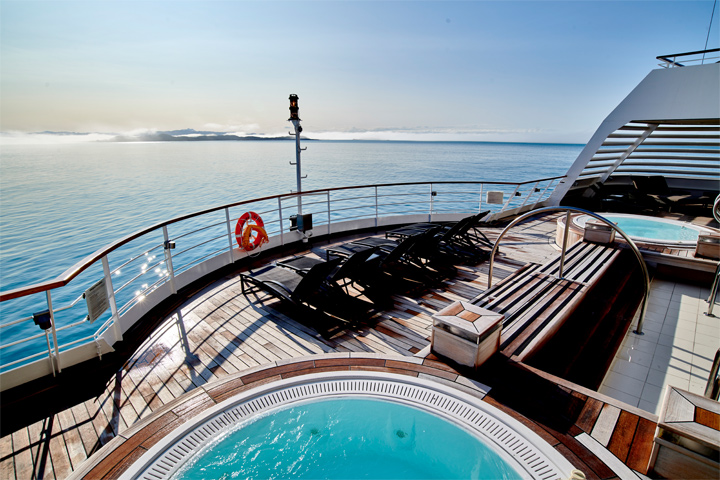
Spa
- Beauty Salon
- Dry Cleaning/Laundry Service
- Full-Service Spa
- Rock-Climbing Wall
- Scuba Diving PADI
- Spa Services/Massage
- Sports Facilities
- Surfing
- Water Park
- Water Slide
Dining
Main Dining
The Restaurant: Come when you like, with whom you please, and be seated as you wish. The room is beautiful, the cuisine is exquisite, and the service is simultaneously flawless, friendly and fun.
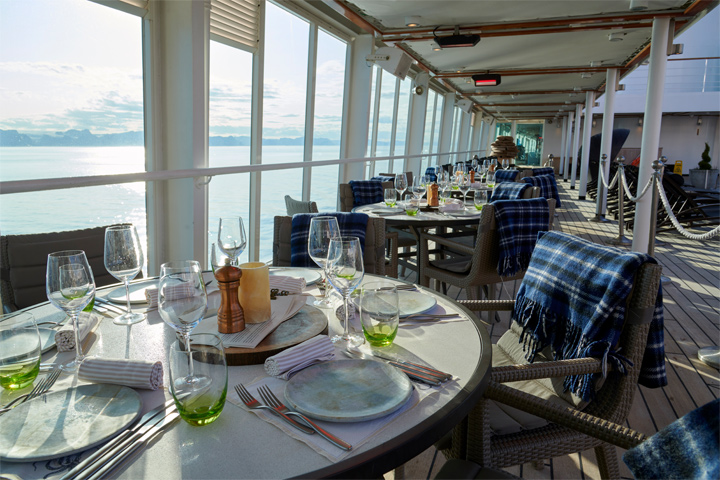
The Colonnade
Casual Dining
Coffee Bar: Enjoy a specialty crafted espresso just the way you like it.
Earth & Ocean: Each evening, the skilled chefs create an imaginative array of fresh, inventive dishes—a sophisticated menu celebrating eclectic traditional flavors from around the world, served in a relaxed setting under the stars for a distinctive dining experience unlike any other on board.
Observation Bar: A stunning round lounge with a square bar and panoramic views. Early Risers’ Coffee and Tea is served here every morning, and piano music makes it a great choice for drinks and conversation before and after dinner.
Seabourn Square: Whether you're looking for a place to enjoy your newspaper in the morning or want to socialize with your fellow passengers, Seabourn Square is what you're looking for. This inviting lounge offers plush seating, cocktail tables, a library, computer terminals, a coffee bar, and Guest Services staff.
Solis: Offering light, modern Mediterranean cuisine bursting with color and character, prepared fresh and entirely from scratch.
The Club: Open for afternoon tea then transforms into a dance club in the evening. Socialize while enjoying cocktails, live music, and great company. Serving a variety of light sushi bites freshly made to order each evening.
The Colonnade: The more casual, indoor/outdoor alternative features an open kitchen, lavish buffets or table service for breakfasts and lunch, and serves regionally themed, bistro-style dinners with table service nightly.
The Patio: Relaxed poolside dining offering luncheon buffets, salads, soups, grilled specialties and freshly baked pizza. Dinners feature a full menu in an alfresco setting.
Sky Bar: A place to enjoy a refreshing tropical beverage during the day, or an evening cocktail under the stars.
In-Suite Dining: A varied menu available around the clock for service in your suite. You may also order dinner from The Restaurant menu and have your meal served, course by course, in your suite or on your veranda.
Staterooms
All Ocean View Suites feature a large picture window, comfortable living area, queen-size bed or two twin beds, dining table for two, walk-in closet, interactive flat-screen television with music and movies, fully stocked bar and refrigerator, makeup vanity, spacious bathroom with separate tub and shower. Approximately 295 sq. ft. (28 sq.m.) of inside space.
- Ocean View Suite with Large Picture Window (Category: A)

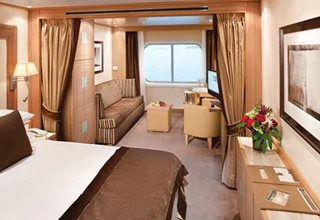
Category: A
All Ocean View Suites feature a large picture window, comfortable living area, queen-size bed or two twin beds, dining table for two, walk-in closet, interactive flat-screen television with music and movies, fully stocked bar and refrigerator, makeup vanity, spacious bathroom with separate tub and shower.
Approximately 295 sq. ft. (28 sq.m.) of inside space.
- Ocean View Suite with Large Picture Window (Category: A1)
Category: A1
All Ocean View Suites feature a large picture window, comfortable living area, queen-size bed or two twin beds, dining table for two, walk-in closet, interactive flat-screen television with music and movies, fully stocked bar and refrigerator, makeup vanity, spacious bathroom with separate tub and shower.
Approximately 295 sq. ft. (28 sq.m.) of inside space.
- Guarantee - Suite (Category: OS)
Category: OS
This category can be booked for a special rate, guaranteed to you. Please note that the category is not associated at the time of booking with a specific stateroom, deck, bedding configuration or other particular settings. The assignment of an actual cabin will be performed during your check-in. The cabin can be anywhere on the ship.
All Veranda Suites feature a full-length window and glass door to private veranda, comfortable living area, queen-size bed or two twin beds, dining table for two, walk-in closet, interactive flat-screen television with music and movies, fully stocked bar and refrigerator, makeup vanity, spacious bathroom with separate tub and shower.
- Veranda Suite (Category: V1)
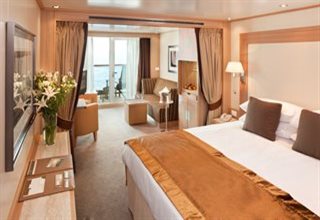
Category: V1
All Veranda Suites feature a full-length window and glass door to private veranda, comfortable living area, queen-size bed or two twin beds, dining table for two, walk-in closet, interactive flat-screen television with music and movies, fully stocked bar and refrigerator, makeup vanity, spacious bathroom with separate tub and shower.
- Veranda Suite (Category: V2)
Category: V2
All Veranda Suites feature a full-length window and glass door to private veranda, comfortable living area, queen-size bed or two twin beds, dining table for two, walk-in closet, interactive flat-screen television with music and movies, fully stocked bar and refrigerator, makeup vanity, spacious bathroom with separate tub and shower.
- Veranda Suite (Category: V3)
Category: V3
All Veranda Suites feature a full-length window and glass door to private veranda, comfortable living area, queen-size bed or two twin beds, dining table for two, walk-in closet, interactive flat-screen television with music and movies, fully stocked bar and refrigerator, makeup vanity, spacious bathroom with separate tub and shower.
- Veranda Suite (Category: V4)
Category: V4
All Veranda Suites feature a full-length window and glass door to private veranda, comfortable living area, queen-size bed or two twin beds, dining table for two, walk-in closet, interactive flat-screen television with music and movies, fully stocked bar and refrigerator, makeup vanity, spacious bathroom with separate tub and shower.
- Guarantee - Suite (Category: SV)
Category: SV
This category can be booked for a special rate, guaranteed to you. Please note that the category is not associated at the time of booking with a specific stateroom, deck, bedding configuration or other particular settings. The assignment of an actual cabin will be performed during your check-in. The cabin can be anywhere on the ship.
All Penthouse Suites on board feature a comfortable living area, glass door to private veranda, queen-size bed or two twin beds; walk-in closet with personal safe, two flat-screen TV with music and movies, fully stocked bar and refrigerator, writing desk with personalized stationary, makeup vanity, spacious bathroom with separate tub and shower, plush robes, slippers hair dryer and 110/220V AC outlets.
- Penthouse Guarantee (Category: PG)
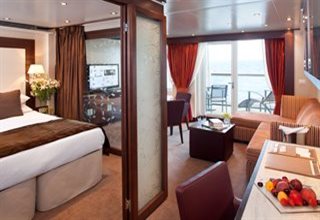
Category: PG
This category can be booked for a special rate, guaranteed to you. Please note that the category is not associated at the time of booking with a specific stateroom, deck, bedding configuration or other particular settings. The assignment of an actual cabin will be performed during your check-in. The cabin can be anywhere on the ship.
- Penthouse Suite (Category: PH)
Category: PH
All Penthouse Suites on board feature a comfortable living area, glass door to private veranda, queen-size-bed or two twin beds; walk-in closet with personal safe, two flat-screen TV with music and movies, fully stocked bar and refrigerator, writing desk with personalized stationary, makeup vanity, spacious bathroom with separate tub and shower, plush robes, slippers, hair dryer, and 110/220V AC outlets.
- Grand Suite (Category: GR)
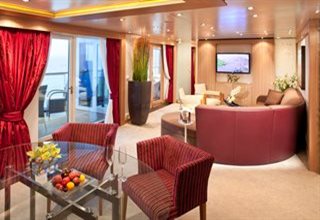
Category: GR
Suites on board feature a comfortable living area, private veranda, queen-size-bed or two twin beds; walk-in closet with personal safe, interactive flat-screen TV with music and movies, fully stocked bar and refrigerator, writing desk with personalized stationary, makeup vanity, spacious bathroom with separate tub and shower, plush robes, slippers, hair dryer, and 110/220V AC outlets.
- Signature Suite (Category: SS)
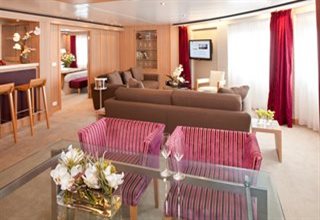
Category: SS
Suites on board feature a comfortable living area, private veranda, queen-size-bed or two twin beds; walk-in closet with personal safe, interactive flat-screen TV with music and movies, fully stocked bar and refrigerator, writing desk with personalized stationary, makeup vanity, spacious bathroom with separate tub and shower, plush robes, slippers, hair dryer, and 110/220V AC outlets.
- Wintergarden Suite (Category: WG)
Category: WG
Suites on board feature a comfortable living area, private veranda, queen-size-bed or two twin beds; walk-in closet with personal safe, interactive flat-screen TV with music and movies, fully stocked bar and refrigerator, writing desk with personalized stationary, makeup vanity, spacious bathroom with separate tub and shower, plush robes, slippers, hair dryer, and 110/220V AC outlets.
- Owner's Suite (Category: O1)
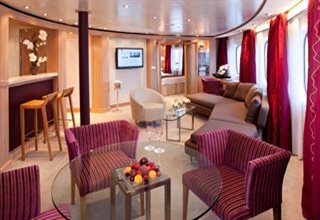
Category: O1
Suites on board feature a comfortable living area, private veranda, queen-size-bed or two twin beds; walk-in closet with personal safe, interactive flat-screen TV with music and movies, fully stocked bar and refrigerator, writing desk with personalized stationary, makeup vanity, spacious bathroom with separate tub and shower, plush robes, slippers, hair dryer, and 110/220V AC outlets.
- Owner's Suite (Category: O2)
Category: O2
Suites on board feature a comfortable living area, private veranda, queen-size-bed or two twin beds; walk-in closet with personal safe, interactive flat-screen TV with music and movies, fully stocked bar and refrigerator, writing desk with personalized stationary, makeup vanity, spacious bathroom with separate tub and shower, plush robes, slippers, hair dryer, and 110/220V AC outlets.
- Penthouse Spa Suite (Category: PS)
Category: PS
All Penthouse Suites on board feature a comfortable living area, glass door to private veranda, queen-size-bed or two twin beds; walk-in closet with personal safe, two flat-screen TV with music and movies, fully stocked bar and refrigerator, writing desk with personalized stationary, makeup vanity, spacious bathroom with separate tub and shower, plush robes, slippers, hair dryer, and 110/220V AC outlets.
Deck Plan

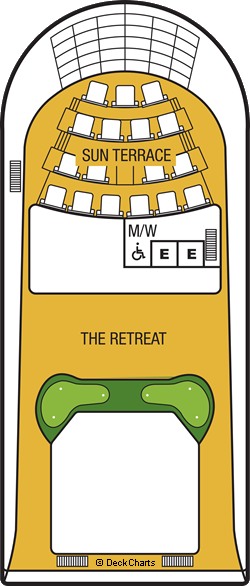
| Symbol | Description |
|---|---|
 | Wheelchair-accessible suite; roll-in shower only; wheelchair-accessible doorways; Suite 635 also has a tub |
 | Veranda railings are part metal and part glass from floor to teak rail |
 | Subject to noise when anchoring; has all-metal veranda railings, limiting the view |
 | Smaller veranda |
 | Third guest capacity suite |
 | Elevator |
 | Self service launderette |
 | Suite can be reached only via a staircase |
 | Partially obstructed veranda view |
Ship Facts
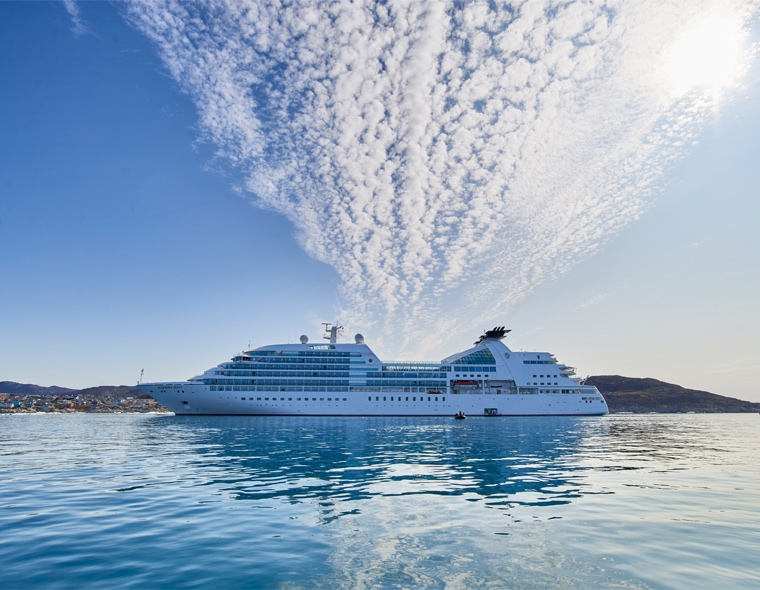
- Ship Name: Seabourn Quest
- Ship Name: Seabourn Quest
- Year Built: 2010
- Year Entered Present Fleet: 2011
- Ship Class: O
- Maximum Capacity: 458
- Number of Passenger Decks: 9
- Number of Crew: 295
- Officers' Nationality: International
- Tonnage (GRT): 32,000
- Capacity Based on Double Occupancy: 458
- Country of Registry: The Bahamas
- Total Staterooms: 229
- Crew/Hotel Staff Nationality: International
Costco Member Reviews
Available Dates and Prices
Terms & Conditions
*Price shown is per person based on double occupancy, is valid for select stateroom categories only and does include government taxes/fees and gratuities. Click on the Terms & Conditions link below for details.
†One Digital Costco Shop Card per room/stateroom, per stay. The exact amount of the Digital Costco Shop Card will be calculated during the booking process. The Digital Costco Shop Card promotion is nontransferable and may not be combined with any other promotion. A Digital Costco Shop Card will arrive by email approximately 10 days after the start of your cruise. Click on the Terms & Conditions link below for additional information.
Ship's registry: The Bahamas
Package ID: SBNQUESAM20280205
Digital Costco Shop Card
Book this cruise with Costco Travel and receive a Digital Costco Shop Card. The Digital Costco Shop Card is a convenient payment option in our warehouses and on Costco.ca.



 You have unsaved preference changes.