

 Help Centre

 United States
 Canada
 Australia
Coupon Override
Please Call
For drivers under the age of 25, additional fees and/or restrictions may apply.
For information and assistance in completing your reservation, please call:
1-855-863-0357Sorry
We're unable to find your location.

South America: South Pacific Explorer

All-Inclusive Cruise

All onboard gratuities
Select complimentary shore excursions**
Unlimited beverages, including fine wines and premium spirits served throughout the ship
Complimentary dining venues
Complimentary in-suite bar
Complimentary caviar
Complimentary Wi-Fi packages with unlimited minutes
Welcome bottle of Champagne

Executive Member Benefit
Executive Members receive an annual 2% Reward, up to $1,250, on qualified Costco Travel purchases

Digital Costco Shop Card
Member Exclusive: Digital Costco Shop Card with every Seabourn® sailing†
Sailing Itinerary

Note: Cruise itineraries are subject to change. Please verify ports and times directly with the cruise line.

Overview


Callao is built on and around a peninsula, in the district of La Punta, a wealthy residential neighborhood. A historical fortress, the Castillo de Real Felipe, stands on the promontory overlooking the harbor. A large naval base is located in Callao. Its prison holds Abimael Guzmán, the leader of the Shining Path terrorist organization, and Vladimiro Montesinos, the ex-director of internal security during the Fujimori regime. Jorge Chávez International Airport is located in Callao. On a bluff overlooking the harbor sits Colegio Militar Leoncio Prado, the military high school. The city also has a university, the National University of Callao. The main Naval Hospital, Centro Medico Naval is located on Avenida Venezuela in Bellavista. It contains the U.S. Navy Command Naval Medical Research Unit Six. Residents of Callao are known as chalacos. Callao's professional football teams are Sport Boys and Atlético Chalaco. Callao has several islands: San Lorenzo-currently a military base, El Frontón-a former high-security prison, the Cavinzas Islands, and the Palomino Islands, where numerous sea lions and sea birds live in a virtually untouched ecosystem. There are proposed plans to build a huge naval, terrestrial, and airport on San Lorenzo Island. This project is called the San Lorenzo Megaport Project.
Overview

Puerto General San Martin is a port in the middle of nowhere adjacent to the desert of Ica and the National Park of Paracas. Bird watchers and wildlife lovers can experience nirvana at the photogenic Paracas National Reserve and the Ballestas Islands; this is also your chance to fly over the vast, fragile symbols of the Nazca Lines.
Overview

Iquique is the capital of the First Region. Iquique is also the principal fishing port in Chile.The commercial activity of this city is centered around its Zona Franca (duty-free area). Iquique offers a mixture of shopping, history, and attractive beaches, and it is boarded by the desert, the sea, an oasis, and the Altiplano (high plateau).In Iquiqu,e we can find evidence of mining dating back to the magnificent times when saltpeter was mined, and historical sites as well as the great surroundings, such as the Pampa del Tamarugal (mesquite grove) and the Pica Oasis in the middle of the desert.
Overview

Easter Island is over 2,000 miles from the nearest population center, (Tahiti and Chile), making it one of the most isolated places on Earth. A triangle of volcanic rock in the South Pacific - it is best known for the giant stone monoliths, known as Moai, that dot the coastline. The early settlers called the island "Te Pito O Te Henua" (Navel of The World). Admiral Roggeveen, who came upon the island on Easter Day in 1722, named it Easter Island. Today, the land, people, and language are all referred to locally as Rapa Nui. There has been much controversy and confusion concerning the origins of the Easter Islanders. Thor Heyerdahl proposed that the people who built the statues were of Peruvian descent, due to a similarity between Rapa Nui and Incan stonework. Some have suggested that Easter Island is the remnant of a lost continent or the result of an extra-terrestrial influence. Archaeological evidence, however, indicates the discovery of the island by Polynesians at about 400 AD - led, according to legend, by Hotu Matua. Upon their arrival, an impressive and enigmatic culture began to develop. In addition to the statues, the islanders possessed the Rongorongo script; the only written language in Oceania. The island is also home to many petroglyphs (rock carvings), as well as traditional wood carvings, tapa (barkcloth) crafts, tattooing, string figures, dance and music. The population of Easter Island reached its peak at perhaps more than 10,000, far exceeding the capabilities of the small island's ecosystem. Resources became scarce, and the once lush palm forests were destroyed - cleared for agriculture and moving the massive stone Moai. In this regard, Easter Island has become, for many, a metaphor for ecological disaster. Thereafter, a thriving and advanced social order began to decline into bloody civil war and, evidently, cannibalism. Eventually, all of the Moai standing along the coast were torn down by the islanders themselves. All of the statues now erected around the island are the result of recent archaeological efforts. Contacts with western "civilization" proved even more disastrous for the island population which, through slavery and disease, had decreased to approximately 111 by the turn of the century. Following the annexation by Chile in 1888, however, it has risen to more than 2,000, with other Rapanui living in Chile, Tahiti, and North America. Despite a growing Chilean presence, the island's Polynesian identity is still quite strong. Easter Island today remains one of the most unique places you will ever encounter; an open-air museum showcasing a fascinating, but unfortunately lost, culture. The Rapanui are among the friendliest people you will ever meet, and the landscape is truly amazing - with its volcanic craters, lava formations, beaches, brilliant blue water, and archaeological sites. Lan Chile flies to Easter Island, with flights operating between Santiago, Chile, and Papeete, Tahiti. Airfare from Santiago, Chile to Easter Island and back costs approximately $800 US. Several companies can arrange package trips, including hotels, tours, etc., but it is possible, and much cheaper, to arrange a place to stay upon arrival. Many locals who operate hotels and guesthouses arrive at Mataveri Airport to greet the tourists and this is something you might consider. Staying in a private home is a great way to meet the islanders and experience the local culture; however, one should use judgment in choosing accommodations, as not all places are of equal quality. Notably, the tourism on Easter Island is run entirely by the Rapanui themselves. In late January to early February, the islanders celebrate Tapati, a festival honoring the Polynesian cultural heritage of the island. Far Horizons Archaeological and Cultural Tours organizes tours to the festival.
Overview
Easter Island is over 2,000 miles from the nearest population center, (Tahiti and Chile), making it one of the most isolated places on Earth. A triangle of volcanic rock in the South Pacific - it is best known for the giant stone monoliths, known as Moai, that dot the coastline. The early settlers called the island "Te Pito O Te Henua" (Navel of The World). Admiral Roggeveen, who came upon the island on Easter Day in 1722, named it Easter Island. Today, the land, people, and language are all referred to locally as Rapa Nui. There has been much controversy and confusion concerning the origins of the Easter Islanders. Thor Heyerdahl proposed that the people who built the statues were of Peruvian descent, due to a similarity between Rapa Nui and Incan stonework. Some have suggested that Easter Island is the remnant of a lost continent or the result of an extra-terrestrial influence. Archaeological evidence, however, indicates the discovery of the island by Polynesians at about 400 AD - led, according to legend, by Hotu Matua. Upon their arrival, an impressive and enigmatic culture began to develop. In addition to the statues, the islanders possessed the Rongorongo script; the only written language in Oceania. The island is also home to many petroglyphs (rock carvings), as well as traditional wood carvings, tapa (barkcloth) crafts, tattooing, string figures, dance and music. The population of Easter Island reached its peak at perhaps more than 10,000, far exceeding the capabilities of the small island's ecosystem. Resources became scarce, and the once lush palm forests were destroyed - cleared for agriculture and moving the massive stone Moai. In this regard, Easter Island has become, for many, a metaphor for ecological disaster. Thereafter, a thriving and advanced social order began to decline into bloody civil war and, evidently, cannibalism. Eventually, all of the Moai standing along the coast were torn down by the islanders themselves. All of the statues now erected around the island are the result of recent archaeological efforts. Contacts with western "civilization" proved even more disastrous for the island population which, through slavery and disease, had decreased to approximately 111 by the turn of the century. Following the annexation by Chile in 1888, however, it has risen to more than 2,000, with other Rapanui living in Chile, Tahiti, and North America. Despite a growing Chilean presence, the island's Polynesian identity is still quite strong. Easter Island today remains one of the most unique places you will ever encounter; an open-air museum showcasing a fascinating, but unfortunately lost, culture. The Rapanui are among the friendliest people you will ever meet, and the landscape is truly amazing - with its volcanic craters, lava formations, beaches, brilliant blue water, and archaeological sites. Lan Chile flies to Easter Island, with flights operating between Santiago, Chile, and Papeete, Tahiti. Airfare from Santiago, Chile to Easter Island and back costs approximately $800 US. Several companies can arrange package trips, including hotels, tours, etc., but it is possible, and much cheaper, to arrange a place to stay upon arrival. Many locals who operate hotels and guesthouses arrive at Mataveri Airport to greet the tourists and this is something you might consider. Staying in a private home is a great way to meet the islanders and experience the local culture; however, one should use judgment in choosing accommodations, as not all places are of equal quality. Notably, the tourism on Easter Island is run entirely by the Rapanui themselves. In late January to early February, the islanders celebrate Tapati, a festival honoring the Polynesian cultural heritage of the island. Far Horizons Archaeological and Cultural Tours organizes tours to the festival.
Overview

Nuku Hiva is without any doubt one of the most beautiful islands in French Polynesia. The exceptional location of its capital town Taiohae, along a splendid half-moon bay, sums up by itself the attraction that one may have for this island, at the same time both savage and friendly. No Gauguin or Brel to praise it or sing about it, but a rich history, especially around the magnificent valley of Taipivai. Do not forget to visit the sumptuous cliffs around the island.
Overview

Hiva Oa is the largest and most fertile of the islands in the southern group of the Marquesas Archipelago. It is located at 139° west longitude and 9°45’ south latitude. Hiva Oa has deep valleys, a lush plateau, and dense forests. The island, which covers an area of 320 square kilometers (123.6 sq. miles), has a curious and complex geological structure. All that is left of the volcano Taaoa is a 1,000-meter (3,281-ft.) high wall, which is on the edge of a volcanic crater. The volcano Atuona formed inside that crater. Further evidence of former volcanic activity is a ridge that forms a spine across the entire length of Hiva Oa, from Atuona to the former volcano Puamau, broken up only by the dike of Mt. Otua, which reaches a height of 924 meters (3,031 ft.). Atuona, the administrative center for the southern group of the Marquesas Islands, is 1,184 kilometers (736 miles) north of the island of Tahiti. Surrounded by the mountain on the land side and the Bay of Traitors on the ocean side, Atuona offers safe anchorage. But that anchorage area was abandoned by visiting sailboats and trading schooners after a port with a protective seawall was built in 1981 in the neighboring Tahauku Bay.
Overview

The second biggest atoll in Polynesia, a 60 km by 25 km rectangle has two main villages: Rotoava in the northeast near the Ngarue pass, one kilometer wide and its airdrome; and then there is Tetamanu, formerly the main village of the island located near the southern Tumakohua pass. This protected atoll together with its six neighboring islands, originally including Taiaro, makes up a Unesco-classified nature reserve, which is proof of the richness of the ecosystem of these atolls: the especially rare flora and fauna, including the hunting king-fisher, the Tuamotu palm, and in the lagoons, crustaceans such as squills or sea cicadas. Among the things to be explored here are: a pearl farm visit and the fairly colorful visit to the sea slug smoke house, the "rori" highly prized by Asian gourmets, and the ancient village of Tetamanu with one of the first Catholic churches built in coral and dating from 1874. The real drawcard to the island is its scuba diving which still holds its share of excitement in the virtually untouched spots where there is to be found a concentration of lagoon and ocean fish such as loach, meru, barracuda, rays, and the highly memorable hammerhead and tiger sharks.
Overview

The atolls of Tahiti are some of the largest and most beautiful in the world. They are low-lying islands and are very different from the mountainous islands of Tahiti, Moorea, and Bora Bora. All of the islands that make up theTuamotus are coral atolls. These coral rings surround a lagoon and offer some of the most beautiful colors and clear waters set against dramatic white sand beaches. Explore the islands by open-air cars or bicycles; discover the lagoon and surrounding motus by motorboat, canoe, or sailboat. Rangiroa, the largest atoll in the South Pacific, is only an hour’s flight from Tahiti. Its lagoon is 42 miles long and 16 miles wide, which is larger than the island of Tahiti. The total population of the island is about 1,400 people who live in two villages. These villages lie on opposite sides of a navigable pass that provides access to the lagoon from the open ocean beyond. It is one of these passes that provides one of Tahiti’s best and most adventurous diving experiences, a drift dive teaming with Hammerhead sharks. This island also offers you one of the more unique hotel experiences, the Kia Ora Sauvage.
Overview

Papeete is the major city of Tahiti and the capital of French Polynesia. This little city of 80,000 people is pretty recent as there were no buildings on its site when in 1769, Captain Cook first reached Matavai Bay located 10 km away on the East Coast. Since the 18th century, sailors realized how safe was its bay for their ships. In 1797, the London Missionary Society (LMS) tried to send some missionaries to settle down in Papeete but they did not succeed until 1824 with the help of Queen Pomare IV. It was Governor Bruat who decided in 1843 that Papeete would become the administrative center of the newly born French Protectorate. At that time, the expansion of the city was going fast and the bay of Papeete had become a large harbour. In the 19th century, some Chinese started to settle down in Papeete which counted only 5,000 persons. During World War I, Papeete was bombed by the Germans, and the Municipal Market was destroyed.
Overview
Papeete is the major city of Tahiti and the capital of French Polynesia. This little city of 80,000 people is pretty recent as there were no buildings on its site when in 1769, Captain Cook first reached Matavai Bay located 10 km away on the East Coast. Since the 18th century, sailors realized how safe was its bay for their ships. In 1797, the London Missionary Society (LMS) tried to send some missionaries to settle down in Papeete but they did not succeed until 1824 with the help of Queen Pomare IV. It was Governor Bruat who decided in 1843 that Papeete would become the administrative center of the newly born French Protectorate. At that time, the expansion of the city was going fast and the bay of Papeete had become a large harbour. In the 19th century, some Chinese started to settle down in Papeete which counted only 5,000 persons. During World War I, Papeete was bombed by the Germans, and the Municipal Market was destroyed.
Onboard the Seabourn Quest
Seabourn Quest
Costco Member Reviews

Year Built: 2010
Double Occupancy Capacity: 458
Seabourn Quest, an oceangoing ship with a passenger capacity of just 458 guests, offers spacious accommodations spanning categories ranging in size from 295 to 1,182 square feet of indoor space. Verandas add an additional 65 to 558 square feet of outdoor living area spacious enough for private al fresco dining. All suites feature a comfortable living area, walk-in closet, fully stocked bar and refrigerator filled with seaside favorites. Expansive ocean views are framed by either a picture window or the glass doors of the veranda.
Onboard Activities
Activities & Services (included in cruise)
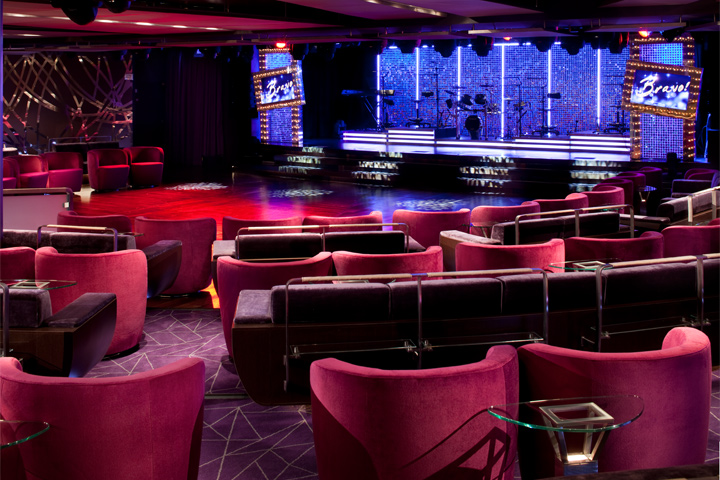
Show/Lounge
- Art Gallery
- Bars/Lounges
- Business Center
- Card Room
- Casino
- Concierge Desk
- Conference Center
- Disco/Nightclub
- Duty-Free Shops/Boutiques
- Educational Programs
- Elevators
- Fitness Center
- Fitness Classes
- Guest Lecturers
- Infirmary/Medical Center
- Internet Center
- Library
- Miniature Golf
- Movies
- Movies Under the Stars®
- Pool - Indoor/Covered
- Pool - Outdoor
- Religious Services
- Safe Deposit Boxes
- Sauna/Steam Room
- Self-Service Laundromat
- Theaters/Show Lounge
- Water Sports Platform
- Wedding/Vow Renewal
- Whirlpool/Jacuzzi
Activities & Services (available for an extra fee)
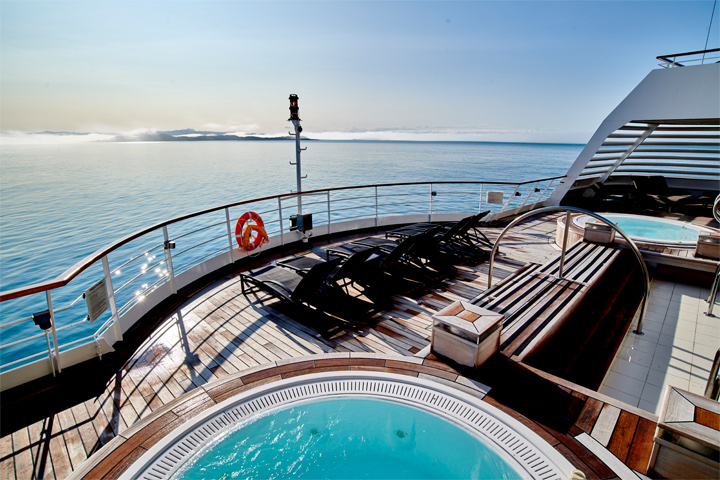
Spa
- Beauty Salon
- Dry Cleaning/Laundry Service
- Full-Service Spa
- Rock-Climbing Wall
- Scuba Diving PADI
- Spa Services/Massage
- Sports Facilities
- Surfing
- Water Park
- Water Slide
Dining
Main Dining
The Restaurant: Come when you like, with whom you please, and be seated as you wish. The room is beautiful, the cuisine is exquisite, and the service is simultaneously flawless, friendly and fun.
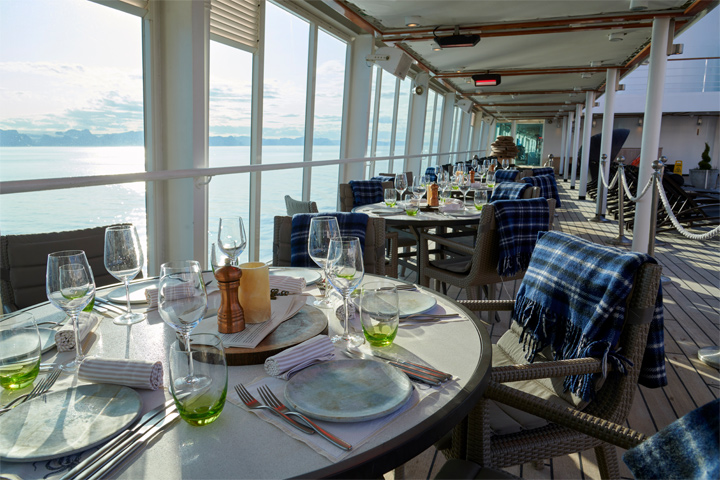
The Colonnade
Casual Dining
Coffee Bar: Enjoy a specialty crafted espresso just the way you like it.
Earth & Ocean: Each evening, the skilled chefs create an imaginative array of fresh, inventive dishes—a sophisticated menu celebrating eclectic traditional flavors from around the world, served in a relaxed setting under the stars for a distinctive dining experience unlike any other on board.
Observation Bar: A stunning round lounge with a square bar and panoramic views. Early Risers’ Coffee and Tea is served here every morning, and piano music makes it a great choice for drinks and conversation before and after dinner.
Seabourn Square: Whether you're looking for a place to enjoy your newspaper in the morning or want to socialize with your fellow passengers, Seabourn Square is what you're looking for. This inviting lounge offers plush seating, cocktail tables, a library, computer terminals, a coffee bar, and Guest Services staff.
Solis: Offering light, modern Mediterranean cuisine bursting with color and character, prepared fresh and entirely from scratch.
The Club: Open for afternoon tea then transforms into a dance club in the evening. Socialize while enjoying cocktails, live music, and great company. Serving a variety of light sushi bites freshly made to order each evening.
The Colonnade: The more casual, indoor/outdoor alternative features an open kitchen, lavish buffets or table service for breakfasts and lunch, and serves regionally themed, bistro-style dinners with table service nightly.
The Patio: Relaxed poolside dining offering luncheon buffets, salads, soups, grilled specialties and freshly baked pizza. Dinners feature a full menu in an alfresco setting.
Sky Bar: A place to enjoy a refreshing tropical beverage during the day, or an evening cocktail under the stars.
In-Suite Dining: A varied menu available around the clock for service in your suite. You may also order dinner from The Restaurant menu and have your meal served, course by course, in your suite or on your veranda.
Staterooms
All Ocean View Suites feature a large picture window, comfortable living area, queen-size bed or two twin beds, dining table for two, walk-in closet, interactive flat-screen television with music and movies, fully stocked bar and refrigerator, makeup vanity, spacious bathroom with separate tub and shower. Approximately 295 sq. ft. (28 sq.m.) of inside space.
- Ocean View Suite with Large Picture Window (Category: A)

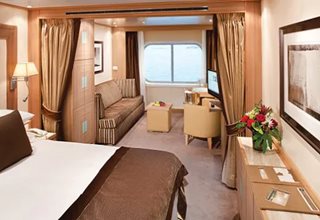
Category: A
All Ocean View Suites feature a large picture window, comfortable living area, queen-size bed or two twin beds, dining table for two, walk-in closet, interactive flat-screen television with music and movies, fully stocked bar and refrigerator, makeup vanity, spacious bathroom with separate tub and shower.
Approximately 295 sq. ft. (28 sq.m.) of inside space.
- Ocean View Suite with Large Picture Window (Category: A1)
Category: A1
All Ocean View Suites feature a large picture window, comfortable living area, queen-size bed or two twin beds, dining table for two, walk-in closet, interactive flat-screen television with music and movies, fully stocked bar and refrigerator, makeup vanity, spacious bathroom with separate tub and shower.
Approximately 295 sq. ft. (28 sq.m.) of inside space.
- Guarantee - Suite (Category: OS)
Category: OS
This category can be booked for a special rate, guaranteed to you. Please note that the category is not associated at the time of booking with a specific stateroom, deck, bedding configuration or other particular settings. The assignment of an actual cabin will be performed during your check-in. The cabin can be anywhere on the ship.
All Veranda Suites feature a full-length window and glass door to private veranda, comfortable living area, queen-size bed or two twin beds, dining table for two, walk-in closet, interactive flat-screen television with music and movies, fully stocked bar and refrigerator, makeup vanity, spacious bathroom with separate tub and shower.
- Veranda Suite (Category: V1)
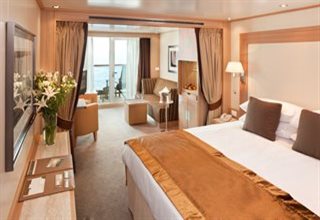
Category: V1
All Veranda Suites feature a full-length window and glass door to private veranda, comfortable living area, queen-size bed or two twin beds, dining table for two, walk-in closet, interactive flat-screen television with music and movies, fully stocked bar and refrigerator, makeup vanity, spacious bathroom with separate tub and shower.
- Veranda Suite (Category: V2)
Category: V2
All Veranda Suites feature a full-length window and glass door to private veranda, comfortable living area, queen-size bed or two twin beds, dining table for two, walk-in closet, interactive flat-screen television with music and movies, fully stocked bar and refrigerator, makeup vanity, spacious bathroom with separate tub and shower.
- Veranda Suite (Category: V3)
Category: V3
All Veranda Suites feature a full-length window and glass door to private veranda, comfortable living area, queen-size bed or two twin beds, dining table for two, walk-in closet, interactive flat-screen television with music and movies, fully stocked bar and refrigerator, makeup vanity, spacious bathroom with separate tub and shower.
- Veranda Suite (Category: V4)
Category: V4
All Veranda Suites feature a full-length window and glass door to private veranda, comfortable living area, queen-size bed or two twin beds, dining table for two, walk-in closet, interactive flat-screen television with music and movies, fully stocked bar and refrigerator, makeup vanity, spacious bathroom with separate tub and shower.
- Guarantee - Suite (Category: SV)
Category: SV
This category can be booked for a special rate, guaranteed to you. Please note that the category is not associated at the time of booking with a specific stateroom, deck, bedding configuration or other particular settings. The assignment of an actual cabin will be performed during your check-in. The cabin can be anywhere on the ship.
All Penthouse Suites on board feature a comfortable living area, glass door to private veranda, queen-size bed or two twin beds; walk-in closet with personal safe, two flat-screen TV with music and movies, fully stocked bar and refrigerator, writing desk with personalized stationary, makeup vanity, spacious bathroom with separate tub and shower, plush robes, slippers hair dryer and 110/220V AC outlets.
- Penthouse Guarantee (Category: PG)
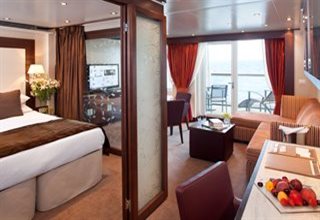
Category: PG
This category can be booked for a special rate, guaranteed to you. Please note that the category is not associated at the time of booking with a specific stateroom, deck, bedding configuration or other particular settings. The assignment of an actual cabin will be performed during your check-in. The cabin can be anywhere on the ship.
- Penthouse Suite (Category: PH)
Category: PH
All Penthouse Suites on board feature a comfortable living area, glass door to private veranda, queen-size-bed or two twin beds; walk-in closet with personal safe, two flat-screen TV with music and movies, fully stocked bar and refrigerator, writing desk with personalized stationary, makeup vanity, spacious bathroom with separate tub and shower, plush robes, slippers, hair dryer, and 110/220V AC outlets.
- Grand Suite (Category: GR)
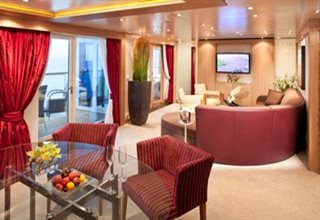
Category: GR
Suites on board feature a comfortable living area, private veranda, queen-size-bed or two twin beds; walk-in closet with personal safe, interactive flat-screen TV with music and movies, fully stocked bar and refrigerator, writing desk with personalized stationary, makeup vanity, spacious bathroom with separate tub and shower, plush robes, slippers, hair dryer, and 110/220V AC outlets.
- Signature Suite (Category: SS)
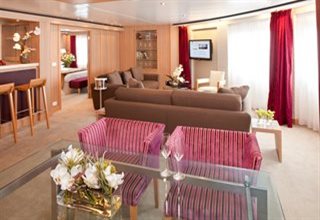
Category: SS
Suites on board feature a comfortable living area, private veranda, queen-size-bed or two twin beds; walk-in closet with personal safe, interactive flat-screen TV with music and movies, fully stocked bar and refrigerator, writing desk with personalized stationary, makeup vanity, spacious bathroom with separate tub and shower, plush robes, slippers, hair dryer, and 110/220V AC outlets.
- Wintergarden Suite (Category: WG)
Category: WG
Suites on board feature a comfortable living area, private veranda, queen-size-bed or two twin beds; walk-in closet with personal safe, interactive flat-screen TV with music and movies, fully stocked bar and refrigerator, writing desk with personalized stationary, makeup vanity, spacious bathroom with separate tub and shower, plush robes, slippers, hair dryer, and 110/220V AC outlets.
- Owner's Suite (Category: O1)
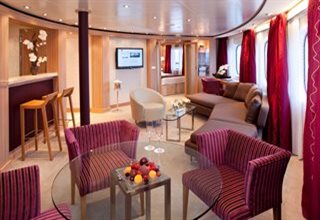
Category: O1
Suites on board feature a comfortable living area, private veranda, queen-size-bed or two twin beds; walk-in closet with personal safe, interactive flat-screen TV with music and movies, fully stocked bar and refrigerator, writing desk with personalized stationary, makeup vanity, spacious bathroom with separate tub and shower, plush robes, slippers, hair dryer, and 110/220V AC outlets.
- Owner's Suite (Category: O2)
Category: O2
Suites on board feature a comfortable living area, private veranda, queen-size-bed or two twin beds; walk-in closet with personal safe, interactive flat-screen TV with music and movies, fully stocked bar and refrigerator, writing desk with personalized stationary, makeup vanity, spacious bathroom with separate tub and shower, plush robes, slippers, hair dryer, and 110/220V AC outlets.
- Penthouse Spa Suite (Category: PS)
Category: PS
All Penthouse Suites on board feature a comfortable living area, glass door to private veranda, queen-size-bed or two twin beds; walk-in closet with personal safe, two flat-screen TV with music and movies, fully stocked bar and refrigerator, writing desk with personalized stationary, makeup vanity, spacious bathroom with separate tub and shower, plush robes, slippers, hair dryer, and 110/220V AC outlets.
Deck Plan

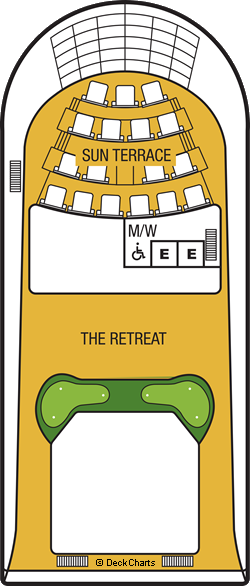
| Symbol | Description |
|---|---|
 | Wheelchair-accessible suite; roll-in shower only; wheelchair-accessible doorways; Suite 635 also has a tub |
 | Veranda railings are part metal and part glass from floor to teak rail |
 | Subject to noise when anchoring; has all-metal veranda railings, limiting the view |
 | Smaller veranda |
 | Third guest capacity suite |
 | Elevator |
 | Self service launderette |
 | Suite can be reached only via a staircase |
 | Partially obstructed veranda view |
Ship Facts
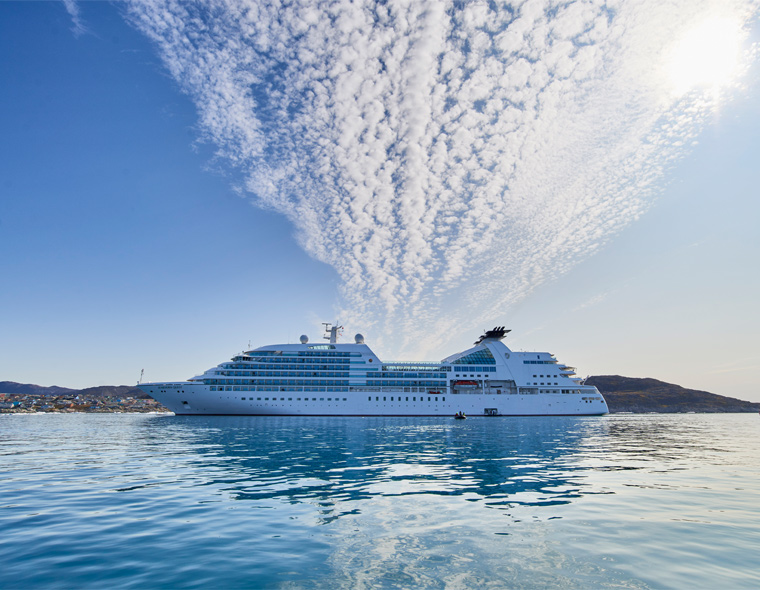
- Ship Name: Seabourn Quest
- Ship Name: Seabourn Quest
- Year Built: 2010
- Year Entered Present Fleet: 2011
- Ship Class: O
- Maximum Capacity: 458
- Number of Passenger Decks: 9
- Number of Crew: 295
- Officers' Nationality: International
- Tonnage (GRT): 32,000
- Capacity Based on Double Occupancy: 458
- Country of Registry: The Bahamas
- Total Staterooms: 229
- Crew/Hotel Staff Nationality: International
Costco Member Reviews
Available Dates and Prices
Terms & Conditions
*Price shown is per person based on double occupancy, is valid for select stateroom categories only and does include government taxes/fees and gratuities. Click on the Terms & Conditions link below for details.
**Select complimentary shore excursions are for full-fare guests only, capacity controlled and subject to availability. Shore excursion reservations are accepted on a first-come, first-served basis. Please note, available excursions vary by sailing date and day of the week. Government fees and taxes are included. Requested excursions may not be available at time of booking. Supplement will apply on Ventures by Seabourn®, optional shore excursions. Restrictions apply and penalties apply 36 hours prior to shore excursion start date.
†One Digital Costco Shop Card per room/stateroom, per stay. The exact amount of the Digital Costco Shop Card will be calculated during the booking process. The Digital Costco Shop Card promotion is nontransferable and may not be combined with any other promotion. A Digital Costco Shop Card will arrive by email approximately 10 days after the start of your cruise. Click on the Terms & Conditions link below for additional information.
Ship's registry: The Bahamas
Package ID: SBNQUESSPA20270117
Digital Costco Shop Card
Book this cruise with Costco Travel and receive a Digital Costco Shop Card. The Digital Costco Shop Card is a convenient payment option in our warehouses and on Costco.ca.



 You have unsaved preference changes.